


One of the strangest amnesia acts in recent gaming discourse is how quickly people have forgotten the global atmosphere of 2020. The George Floyd protests weren’t just an American event; they became a worldwide moral referendum, a moment when corporations, studios, and creative industries scrambled to demonstrate alignment with a forced cultural narrative. Ubisoft did this openly with Assassin's Creed Shadows while other studios did it more quietly. But the pressure was real, and it reached places most players never think about, including the Czech Republic.
Yes, even Prague, one of the least ethnically diverse capitals in Europe, held Black Lives Matter demonstrations in June 2020, with roughly 300 people gathering in Old Town Square, lying down for eight minutes and forty‑six seconds in Floyd’s memory before marching to the U.S. Embassy. The symbolism was unmistakable: this was a global moral moment, and institutions everywhere were expected to respond.
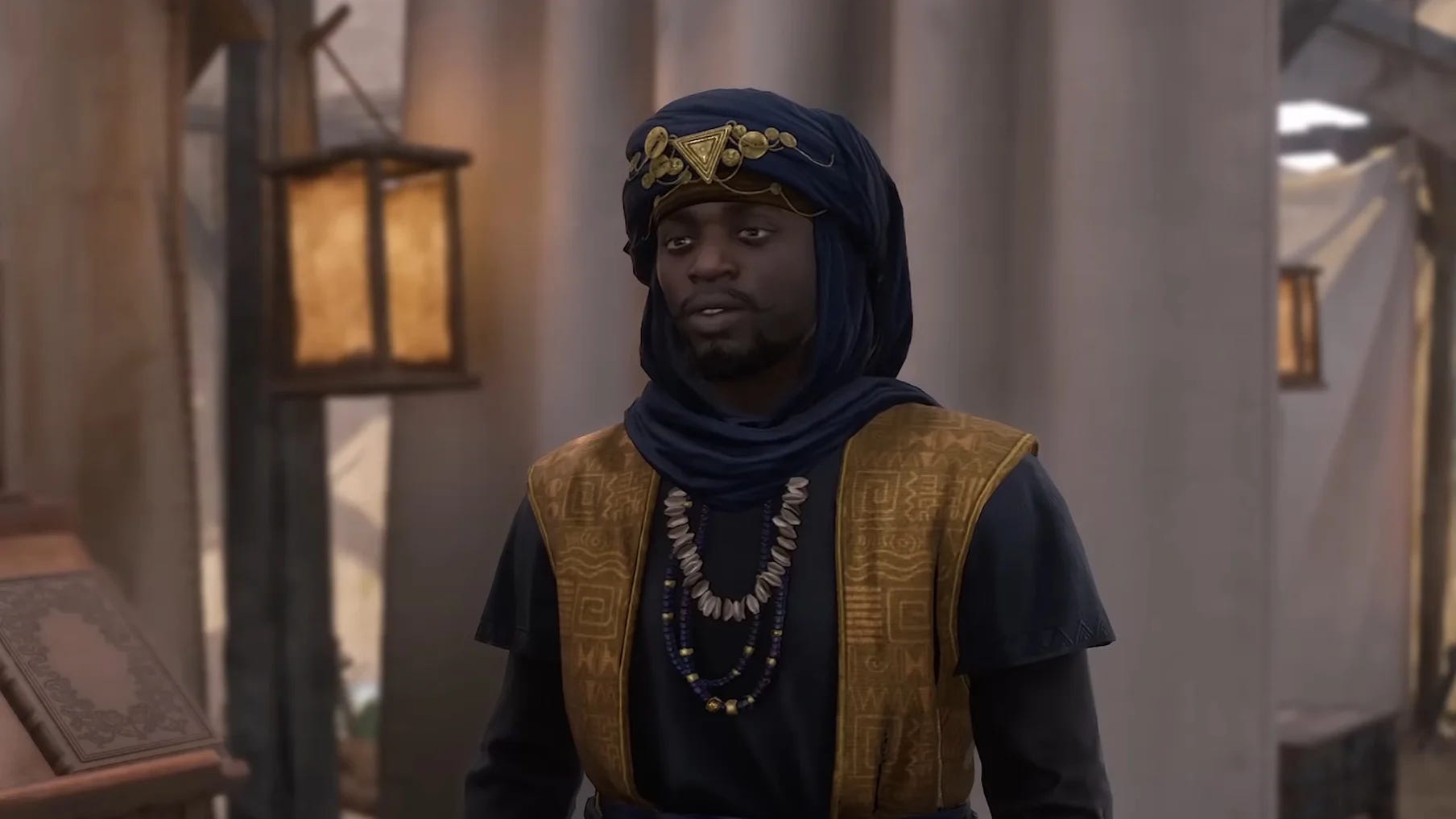
This is the context people ignore when discussing the sudden appearance of Musa of Mali in Kingdom Come: Deliverance II. The conversation gets stuck on surface‑level debates about “historical accuracy,” but the deeper question is why this character exists at all, and why he feels so disconnected from the rest of the game’s narrative logic.
To understand that, you have to go back to 2020.
The Globalization of the George Floyd Moment
The George Floyd protests triggered demonstrations across Europe, including in Prague and other Czech cities. Black Lives Matter banners appeared in places with almost no African diaspora population. It wasn’t a local movement; it was a symbolic alignment with a global cultural moment. And for creative industries, especially ones already sensitive to accusations of exclusion or nationalism, this moment created a new kind of pressure.
Ubisoft also responded in the most predictable way: by pivoting Assassin’s Creed toward a narrative of racial justice and representation. Assassin’s Creed Shadows is the clearest example of a studio trying to retroactively align itself with the moral expectations of 2020, even if that alignment comes at the cost of historical accuracy.
Warhorse Studios and Daniel Vávra
During the promotional periods for his games, Daniel Vávra has always been a lightning rod on social media. In the past, Kingdom Come: Deliverance was attacked for its overwhelmingly white cast, despite being set in a region and period where that was historically accurate.
Warhorse Studios had no institutional backing, no government cultural funding, and no major publisher support during the early stages of game development for its original game. Vávra and his team operated on a financial knife‑edge, relying on private investment and personal reputation rather than structural support. Interviews from the period describe him as being under “permanent stress,” and he later attributed health issues to the strain of development.
The sequel, however, emerged in a radically different cultural moment. The original game had been criticized for its overwhelmingly white cast, despite being set in a region and period where that was historically accurate. But the George Floyd protests reignited global conversations about representation and, unlike in 2018, the cultural expectation in 2020 was to participate in the movement.
It’s not unreasonable to think that Warhorse felt the need to demonstrate solidarity with Black Lives Matter because the cultural moment demanded it.
Enter Musa.
Why Musa Feels Like a Character Added for External Reasons
Musa’s presence in Kingdom Come: Deliverance II is narratively odd. He is positioned as morally enlightened, and is given a kind of savior‑complex arc that doesn’t integrate with the grounded, local storytelling that defines the rest of the series. And then, just as abruptly, he disappears. Poof! No resolution, no payoff.
Musa feels like a character whose purpose was fulfilled simply by existing.
That’s the hallmark of a character added to satisfy an external pressure rather than an internal narrative need.
He does not meaningfully shape Henry’s arc.
He does not alter the political landscape of Bohemia.
He does not represent a historically grounded presence.
He does not receive a conclusion, because his function was entirely symbolic, not narrative.
The result is a character who feels entirely forced.
The Unspoken Possibility
No one wants to say it, but the timeline is hard to ignore:
2020: George Floyd protests erupt globally.
BLM demonstrations appear in the Czech Republic.
Ubisoft and other studios pivot sharply toward representation‑driven narratives.
Warhorse begins development on Kingdom Come: Deliverance II under the shadow of its earlier controversies.
Musa appears; a character whose existence contradicts the studio’s prior commitment to historical realism.
This reveals the affect the cultural environment of 2020 had on studios, compelling creators to forfeit their creative fidelity in order to virtue signal. Musa’s narrative treatment reads like the footprint of that pressure.
Why This Matters
What the last decade has shown us is that this whole concept of representation in storytelling is entirely performative and inorganic. Identity Politics is an incredibly volatile monster, shaped entirely by external cultural demands that directly interfere with internal logic of storytelling.
A writer has to understand that symbolic gestures are the easiest thing in the world for an audience to detect and an even easier thing for them to dismiss. When a story leans on visible signaling rather than on genuine character work, it collapses under its own transparency. Even progressive types who support the ideological goals behind such gestures instinctively recoil when the execution is clumsy. They want subtlety, not slogans.
Actual character development, by contrast, demand commitment. Characters are people in your stories and therefore require their own agency. They must be built up and not inserted for entirely symbolic purposes. The paradox of representation, as it is often practiced today, claims to honor identity yet it reduces identity to a surface-level trait. The result is not the "inclusion" everyone says they are striving for, but abstraction. It is an emphasis on the physical appearance of a human over their personhood.
Characters and Symbols
The irony of today's subversion is that they seek to extract Whiteness from everything. Whiteness, as I have often stated, is a coverall term for Western Europeans, many of whom also colonized the Americas. And yes, that also includes Mexico and parts of South America as well. Many blacks who were slaves and then freed are also White by proxy of having been influenced by the prevailing Christian values espoused by generations of Europeans.
This is why White storytelling traditions, while depicting outsiders, foreigners, and distant peoples with exaggeration or romanticism, still depicted them as characters. Non-white people were allowed to be heroic, foolish, tragic, ambitious, treacherous, or noble. They were allowed to act outside the confines of their race. While their ethnicity may have shaped their role in a story, it did not replace it.
The modern tendency to treat identity as a narrative endpoint rather than a narrative beginning has the opposite effect. It produces figures who are defined by what a symbol that they represent rather than who they are as persons.
In the end, the audience will not remember symbols. They remember people.
NEXT: Kane's Games 'Kingdom Come: Deliverance 2' Review Stands Out

I love living in a country where I never have to worry about scum bag George Floyd ever committing crimes again.
It affected Western game dev a lot, but I think Eastern game dev continued mostly without changing.