


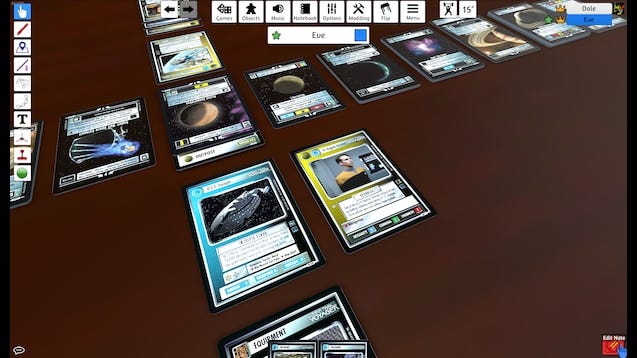
Decipher, Inc. built the second-biggest trading card game business in America on the back of Star Trek and Star Wars, then watched a company vice president siphon millions out of the register while the games he was supposed to be steering grew too complicated for their own players to track. The Star Trek Customizable Card Game outlived its publisher by nearly two decades because a volunteer fan committee refused to let it die. Getting to that ending means walking through where Decipher came from, how it built the game, and how the company fell apart around it.
From Puzzle Boxes to Pente
Warren Holland founded Decipher in Norfolk, Virginia in 1983 as a puzzle company. The first product carried the company’s own name: a jigsaw puzzle called Decipher, built around four embedded cryptograms and a cash prize for solving them. A sequel followed. The final puzzle in that line, Decipher III, has never been solved. From puzzles, Holland moved the company into party games with the How to Host a Murder line, then picked up the Pente license from Parker Brothers. By the early 1990s, Decipher was a small, established name in party and abstract strategy games with no card game pedigree at all.
That changed because of two former Pente world champions. Tom Braunlich and Rollie Tesh had watched Magic: The Gathering take off and pitched Decipher on a new idea: a customizable card game built on licensed media instead of an invented fantasy setting. Decipher approached Paramount, and in December 1993 acquired the rights to Star Trek: The Next Generation. The game previewed at Gen Con in August 1994 and released that November as Star Trek: The Next Generation Customizable Card Game.
Expansion, Success, and the Seeds of Bloat
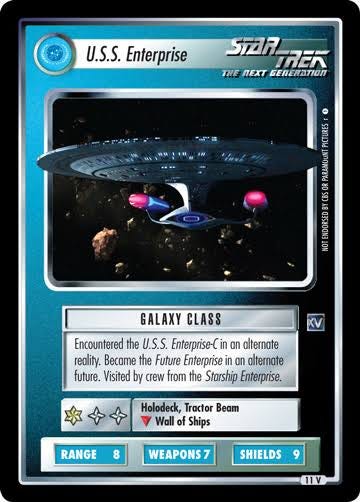
The TNG game was supposed to run three years and five sets. It did well enough that Paramount renegotiated in November 1996, handing Decipher the rights to every live-action Star Trek property: the Original Series, Deep Space Nine, Voyager, and the films. The card game’s name shrank to match its new scope: Star Trek Customizable Card Game. A month later Decipher had already applied the same formula to Star Wars, licensing the property from Lucasfilm in December 1995. Both games ranked among the top five CCGs on the market for most of their runs, with Star Wars regularly trailing only Magic itself.
Growth on this scale came without a governor. Star Trek CCG launched with three factions (the Federation, the Klingons, and the Romulans) plus a catch-all Non-Aligned slot, and nine card types. Within a few years that had grown past seventeen card types, spread across new affiliations for the Kazon, Vidiians, and Hirogen introduced through Voyager. There was no unified point-cost system governing what a card was allowed to do relative to its price. Instead, Decipher patched the rules set after set, layering fix on top of fix rather than rebuilding the foundation. The community’s own oral history of the era, preserved on fan wikis, names the Voyager expansion as the start of what players still call “the Time of Breaking,” when specific cards (the Holy Hexany and Vic Fontaine among them) broke the game’s balance badly enough that organized play never fully recovered from the memory of it. Sales dipped through the final sets built around the films and holodeck scenarios, and Decipher itself took note.
Chasing Younger Players, Losing the Big One
1999 brought two moves in opposite directions. The Phantom Menace convinced Decipher its two flagship games were too dense for younger players chasing Pokémon, so it built the simpler Young Jedi Collectible Card Game around the prequel era. In the same year, Decipher tried to extend its card-game brand into party-game territory with an Austin Powers Collectible Card Game tied to The Spy Who Shagged Me. The property never found its footing as a card game and production stopped after the initial release.
Then came the loss that mattered. Star Wars was Decipher’s biggest earner, and at the end of 2001 the license came up for renewal. Wizards of the Coast, freshly folded into Hasbro alongside Hasbro’s existing Lucasfilm relationship, took the rights out from under Decipher. All three Star Wars card lines Decipher had built stopped cold. Decipher had already hedged by picking up the Lord of the Rings film license that same year, timed to release one month ahead of Peter Jackson’s first movie in November 2001, but the loss of Star Wars was still the loss of the company’s flagship product.
The Reboot, the RPGs, and the Kids’ Market Again
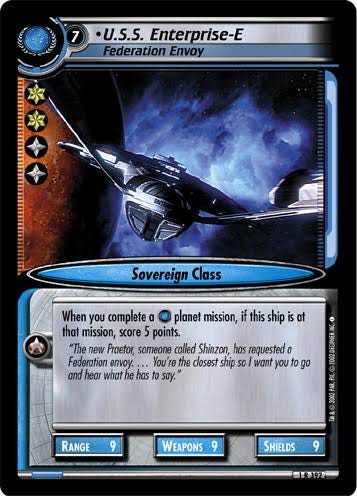
2002 brought Decipher’s attempt to fix what seven years of unmanaged growth had done to Star Trek. The company relaunched the game as Second Edition, keeping the mechanics that had made the original popular while adding the point-cost system the first version never had. The same year, Decipher bought most of the design staff from the collapsed Last Unicorn Games and used them to build licensed Star Trek and Lord of the Rings roleplaying games on a new system called CODA. 2003 saw another swing at the youth market that Yu-Gi-Oh! now dominated, with card games built on .hack and Beyblade. The Beyblade line died quickly. The .hack//Enemy game lasted years and won an Origins Award. 2004 added a Mega Man NT Warrior card game and Decipher’s first original, non-licensed card game, WARS, built on the same underlying system that had made the original Star Wars CCG work.
The Rot Nobody Could See
None of that diversification could offset what had already happened inside the company’s own finance office. Rick Eddleman, Warren Holland’s brother-in-law, had been Decipher’s Vice President of Finance since 1993, the same year Braunlich and Tesh first pitched the Star Trek game. Beginning in 2000, Eddleman began writing company checks to himself and running personal expenses through company credit cards. The theft continued until his resignation in 2001, and by the time it was fully accounted for in a civil suit, Decipher’s claim against him totaled $8.9 million. Eddleman pleaded guilty to twelve counts of embezzlement covering more than $1.5 million of that total and was sentenced in July 2009 to six years and five months in federal prison.
The money was gone years before anyone outside the company knew it. Decipher’s fan community has long pointed to the embezzlement as the root cause of the company’s collapse, and Holland himself built a public accounting of the fraud after the fact. The mechanics of the fraud are less important here than the timing: a company burning through licensing fees, print runs, and payroll on the belief that its books were sound had a multimillion-dollar hole in exactly the accounts it needed to weather a shrinking hobby market.
2005: The Year It Broke
2005 delivered every remaining problem at once. The .hack and Mega Man cartoons lost their audience, forcing Decipher to cancel both card lines. WARS never found players without a built-in media brand behind it and went on indefinite hold. Decipher shut down its roleplaying game division. The broader collectible card game industry was contracting on its own, and layered on top of an embezzlement loss the company was only now fully reckoning with, Decipher laid off as many as 40 employees. Warren Holland kept the company out of bankruptcy, but the staff left behind could not keep pace with the release schedule for the two properties still generating revenue: Star Trek and Lord of the Rings.
The result was a death spiral with a name among Lord of the Rings TCG players: the Hunters block, originally due in November 2005, arrived seven months late with what the game’s own community still calls the least playtested, least balanced set Decipher ever printed, full of overpowered cards and combinations nobody had time to catch before print. Delays fed retailer distrust, distrust fed falling sales, and falling sales fed more layoffs, in a loop that left a single employee doing the work of an entire studio to finish out the final sets.
Two Licenses, Two Endings
The Lord of the Rings license expired on schedule in 2007, and Decipher released its last expansion, Age’s End, rather than losing the property outright. Star Trek ended differently. On December 12, 2007, Decipher announced the current expansion, What You Leave Behind, would be the Star Trek CCG’s final set. The company spent that holiday season teasing a “player revolution coming in 2008” on its homepage, which turned out to be Fight Klub, a combat card game licensed across disparate action-movie properties like Rambo and Chuck Norris. It released in February 2009 and did not revive the company’s fortunes.
The Fans Who Refused to Let It End
What happened next is the part of this story that gives it a different shape than most dead trading card games. Within days of Decipher’s December 2007 announcement, a group of players organized the Star Trek CCG Continuing Committee to keep producing new content on a volunteer, non-profit basis. By the account of the game’s own longtime players, the Committee has since released more sets of cards than Decipher ever did, distributed as free print-and-play files. In 2010 the Committee issued a set of Modern Rules, including a ban list, specifically to correct the balance failures that had accumulated across the original run, the same power creep and rules bloat that had made the game harder to learn with each passing set. Star Wars got the same treatment years earlier: after losing that license in 2001, Decipher donated more than a million dollars in product and financial backing to help fans form the Star Wars Customizable Card Game Players Committee, which still runs tournaments today.
The game Decipher built in 1994 introduced ideas that no card game before it had tried: missions instead of an open-ended win condition, an away-team structure that made every card in the deck function as a role rather than just a stat block, a dilemma pile that punished careless deck-building as much as it rewarded clever construction. Two volunteer committees have now kept that design alive for longer than the company that built it managed to keep it running honestly. Was the game undone by its own ambition, by a corporate parent that never controlled its own bloat, or by the man inside the building who was stealing from it the whole time?
First contact with the Oridians was supposed to be humanity’s proudest moment. Instead, their chief engineer is dead, their ship is sabotaged, and an ancient alien technology is stealing souls. Book one of the Valiant Frontiers series delivers exploration, mystery, and the kind of crew you’ll want to follow across the galaxy. Read The Soul Catcher on Amazon and start the adventure.
NEXT: Tired of What They Did to Your Favorite Franchise? Here’s the Fix!
Interesting.