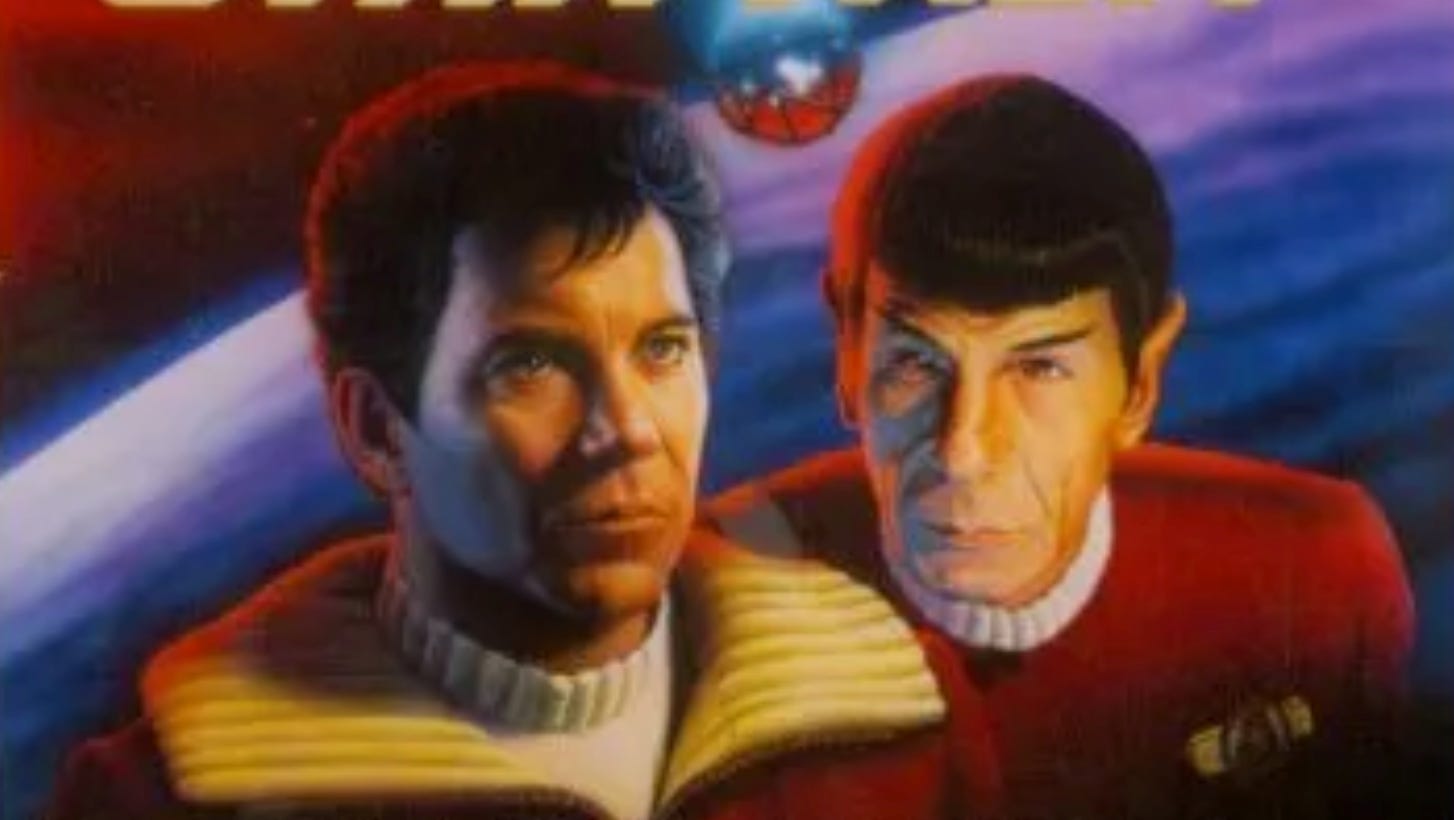
Star Trek: Probe hit shelves in April 1992 promising to answer one of the biggest lingering questions the franchise had left dangling since 1986: where the alien probe from Star Trek IV: The Voyage Home came from and what it wanted. Credited to Margaret Wander Bonanno, the novel reached number six on the New York Times Best Seller List and held a spot there for six weeks. It also bears almost no resemblance to the book Bonanno turned in.
Readers who first picked up Probe as kids tend to remember it as fast and action packed, a book that moved at a good clip even if the plot got complicated. A return trip through the novel as an adult tells a different story. Probe reads like three separate books stapled together, and that is close to the literal truth of how it was made.
Three Novels In One Cover

The published version of Probe juggles three storylines that barely touch each other. The first is a political thriller: the Romulan praetor dies, an Interim Committee scrambles for control of the Empire, and a peace conference on the world of Temaris Four turns into a defection plot involving twin Romulan siblings, a murdered subcenturion, and a conspiracy that is never fully unpacked. The second is an archaeological drama, with a human archeologist named Audrea Benar working alongside a Romulan colleague to excavate the ruins of the Erisian Ascendancy, an extinct civilization that has nothing to do with the probe and whose dig ultimately goes nowhere. The third is the promised probe mystery itself, resolved almost entirely in a single scene near the end when Spock mind melds with the probe and learns its creators were an advanced, whale-like species nearly wiped out by hostile “mites in metal cubes,” a detail widely read as an early Borg reference.
Those three threads never really merge. The Erisian excavation sets up a mystery about an ancient lost culture that the book drops. The Romulan political collapse resolves through a defection and a tour of Kirk building trust with a Romulan commander, disconnected from anything the probe is doing. And the probe’s actual origin story, the reason the book exists and the reason it made the bestseller list, arrives as a single information dump rather than something the previous three hundred pages were building toward.
What Bonanno Wrote
The reason for that disjointed structure traces back to a fight that had nothing to do with plotting and everything to do with control over the franchise.
Bonanno’s original pitch, approved and written in 1990, was a sequel not primarily to Star Trek IV but to her own 1985 novel Dwellers in the Crucible. Her manuscript, titled Music of the Spheres, centered on two original characters from that earlier book, Cleante al-Faisal and T’Shael, and built the probe mystery around them rather than around Kirk and Spock carrying the entire narrative weight.
That approach ran headlong into a shift already underway at Paramount. Star Trek: The Next Generation had debuted in 1987, and with it came renewed oversight from Gene Roddenberry’s office over how tie-in novels handled his creations. Roddenberry’s assistant Richard Arnold, who vetted manuscripts on his behalf, held a narrow view of what Star Trek fiction should do. Original characters belonged in supporting roles, not driving the plot, and the established cast needed to carry the story. Bonanno’s manuscript, built around her own characters investigating a mystery the studio wanted solved by Kirk and Spock, did not pass that test.
Her manuscript was rejected, reportedly for its focus on those original characters. By that point the hardcover dust jackets already had Bonanno’s name printed on them, so Pocket Books could not simply pull the book. Instead editor Dave Stern brought in J.M. Dillard to rewrite it. Dillard was then replaced by Gene DeWeese, who took over the project for a flat fee of ten thousand dollars with no royalties and no cover credit. By Bonanno’s own count, only about seven percent of her original manuscript survived into what became the published novel, with one identifiable scene reportedly the only piece of her prose still recognizable on the page.
That explains the seams. The Erisian archaeology subplot and the Romulan defection drama, the parts of the book with the most character interiority and the least connection to the marketing premise, are the most likely remnants of what Bonanno actually wrote. The Borg-coded probe reveal, delivered almost entirely through one mind meld late in the book, reads like the piece that was added specifically to deliver on the cover copy after everything else got rewritten around it.
“I Know My Name Is On The Cover, But No, I Did Not Write It”
Bonanno did not stay quiet about what happened to her book. She has stated plainly on her own website: “I know my name is on the cover, but no, I did not write it.” She went further than a public statement, making her original manuscript available to fans, eventually sharing printed and digital copies at conventions and using it to raise money for charity over the years.
She also documented the entire process in an essay fans still pass around, giving the people involved pseudonyms drawn from Star Trek villains. Richard Arnold became “Trelane,” the spoiled, reality-bending antagonist from the original series episode “The Squire of Gothos.” Editor Dave Stern became “RockStar.” The essay lays out, from her side, how an approved proposal turned into a manuscript she no longer recognized as her own work.
The fallout was not limited to one bad publishing experience. Bonanno’s public disavowal of Probe reportedly got her frozen out of Star Trek publishing entirely. She did not write another Star Trek novel for more than a decade, returning only in 2003 with Catalyst of Sorrows for the Star Trek: The Lost Era line.
A Franchise Still Answering For It
The whale probe itself has outlived the controversy over the book meant to explain it. It showed up decades later in the opening credits of Star Trek: Lower Decks, and in 2025 the comic series Lower Decks addressed the long-standing plot hole The Voyage Home left behind: what happens if the probe returns and finds humpback whales extinct on Earth. The franchise keeps circling back to a mystery it tried to close out once already, in a book that was rewritten by three different people before anyone agreed on an answer.
Bonanno’s original manuscript is still out there for anyone curious enough to compare the two versions directly. The published Probe solves the probe’s origin. It just does it in a book that was never really allowed to be the one its credited author set out to write.
For readers who track down Music of the Spheres, does Bonanno’s original version of the story hang together any better than the published one, or does the probe’s origin remain a problem neither draft managed to solve on its own terms?
If the golden age of Trek and Babylon 5 left a hole in your sci-fi diet, The Stars Entwined fills it — interstellar espionage between two civilizations on the brink of war. Read The Stars Entwined on Amazon!