


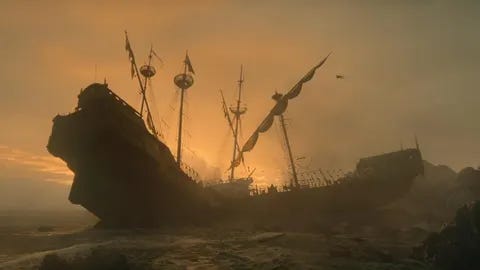
“House of the Dragon Season 3 Episode One” was actually more enjoyable than I thought it would be.
Yes, I had the usual problems with the diversity casting. Sharako Lohar, the Triarchy admiral who commands the fleet at the Gullet, is a man in George R.R. Martin’s Fire & Blood. Here he becomes she, played by Abigail Thorn, gender-swapped into a ruthless female mercenary commander who tosses armored Lannister soldiers overboard mid-battle with cheerful efficiency. The show has form for this kind of substitution and the pattern is familiar enough by now to clock within the first scene the character appears in. But after a two-year wait, the story easily grabbed me and dragged me back in. The episode’s raw narrative force quickly overpowered such distractions.
The simmering clash between the two queens, Rhaenyra and Alicent, continues to pulse like a live wire beneath the chaos. Their bond, forged in childhood friendship and now shattered by betrayal and loss, remains the emotional core of the series. It is a quiet tragedy amid the roar of dragons, the thing that elevates the episode beyond mere plot mechanics. And when Rhaenyra, locked in her chambers by her own son and raging against it, takes a dagger to her garment and says “I may appear to have the weak and feeble body of a woman, but I possess the heart and spirit of a king,” it is not just another girl-power moment. You believe it. Emma D’Arcy sells the fury and the grief in the same breath, and the line lands because the show has earned it across two seasons of watching Rhaenyra be sidelined by the men around her who believe they are protecting her.
The Battle of the Gullet unfolds with a ferocious poetry. Dragons clash with Triarchy warships in a sequence that captures the primal terror and grandeur of war without romanticizing any of it. This is not Helm’s Deep. Nobody is glorious here. Jace and Baela ride Vermax and Moondancer into the chaos and the show makes clear that dragon warfare is essentially children flying nuclear warheads over a burning sea, with all the precision that implies. Sharako Lohar targets Vermax with a weighted grapnel line, dragging the dragon earthward; Baela sweeps in with Moondancer to cut the line on the first attempt and the boy survives. The second attempt kills him.
Jacaerys’ death lands with tragic inevitability, but not for the obvious reasons. He dies because he chose mercy. He spots Rhaena on Sheepstealer’s back at the last second and pulls Vermax back rather than incinerate his own kin. That hesitation leaves him vulnerable. The grapnel catches Vermax again, Moondancer cannot cut the line in time, and the dragon is hauled underwater and drowned. Jace frees himself from the saddle and breaks the surface. Then the Triarchy soldiers in the water shoot him. An arrow in the back. Two more in the chest and neck. He was fourteen. The show loves to kill men as a surrogate for dismantling the patriarchy, and one senses the writers enjoyed the irony of having Rhaenyra’s most devoted protector, the son who locked her in her room to keep her safe, die for exactly that impulse.
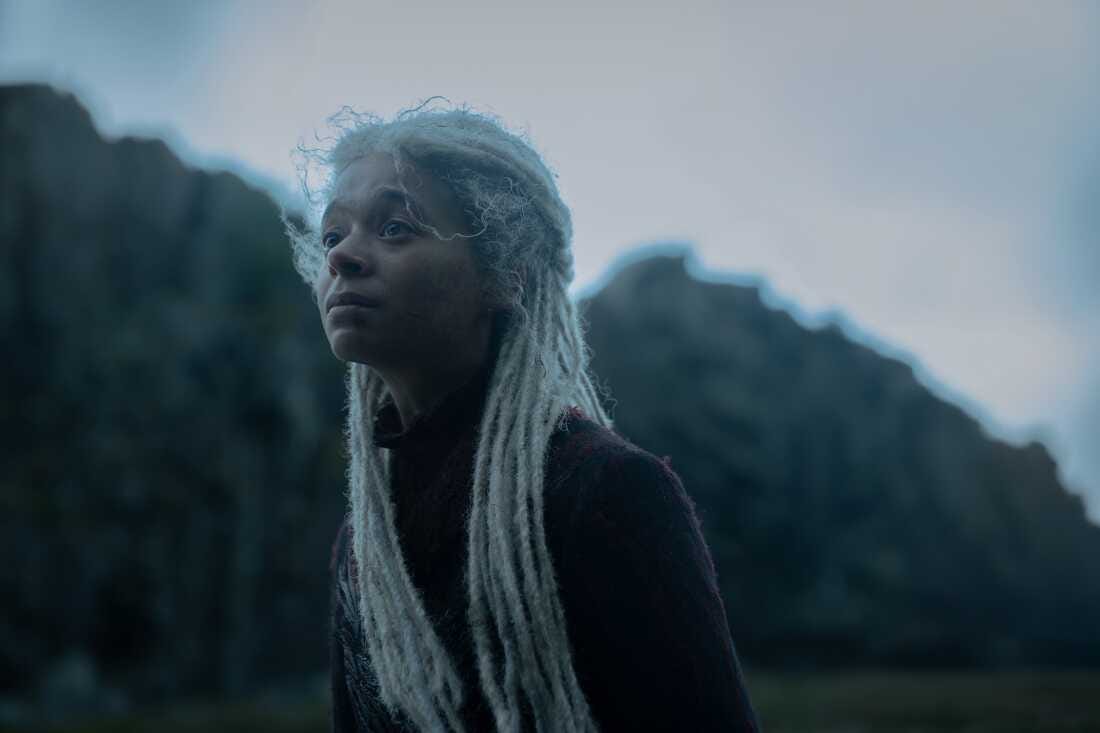
Book readers will note that Rhaena’s claiming of Sheepstealer is a significant deviation from Martin’s text. In Fire & Blood, a commoner girl named Nettles tames Sheepstealer through patient daily feeding, bringing the wild dragon fresh-slaughtered sheep until it accepts her. It is one of the more unusual and moving dragon-taming stories in the source material, and it is gone entirely, replaced by a Targaryen princess bonding with the beast in the Vale because the showrunners needed to give Rhaena something to do. The substitution works on screen in spite of itself. Phoebe Campbell hangs on that dragon without saddle or riding leathers or any discernible plan, and the comedy of her terror provides the episode’s most needed moment of relief amid the carnage. Sheepstealer ignoring every command and torching allies and enemies with equal enthusiasm is genuinely funny, until it is not, and then it is the direct cause of Jace’s death.
Then there is Ulf. The Dragonseeds, waiting in position to intercept Aemond and Vhagar, pass the time trading stories. Ulf (Tom Bennett) apparently offers a quiet confession about his priest’s sexual abuse in his past. It reads like a character detail that the writers thought added dimension. On modern HBO it lands as exactly what it is: the network that cannot resist weaving transgression into every quiet scene to remind you this is serious, edgy drama, not entertainment.
And do not get me started on that mother-son kiss.
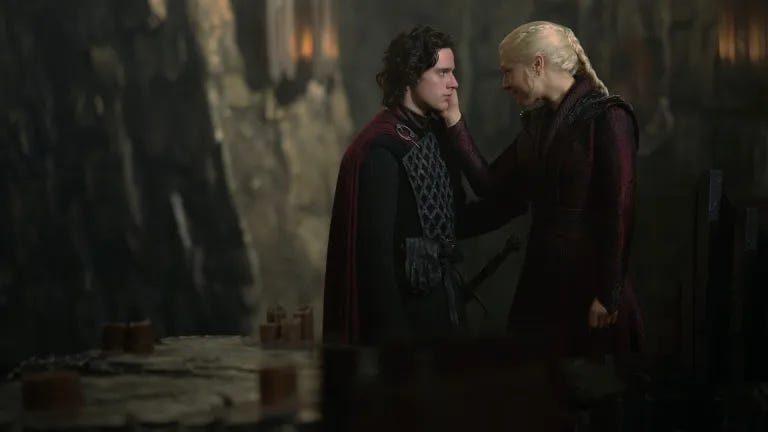
Aemond corners Alicent in the Red Keep, pins her gaze, and kisses her on the lips. She freezes. Does not pull away. He pulls back with the satisfied look of a man who has just declared ownership. Showrunner Ryan Condal has explained this as Aemond “assuming control of the family” through the gesture — “I’m the daddy now,” in his words. Olivia Cooke’s explanation is equally frank: Alicent does not pull away because Aemond is dangerous and rejection might get her killed. The scene is not in Martin’s books. Ryan Condal invented it. It will probably be the most-discussed moment of the season, overshadowing the Battle of the Gullet it shares an episode with, and not in the way the writers likely intended when they were congratulating themselves on their daring.
But even as the series wrestles with its modern impulses, the episode’s commitment to escalating the Dance of the Dragons pulls you inexorably back into the war. A flawed but fiercely compelling start to the season. I cannot wait to see what happens next.
Follow Byl Holte on X where he gives based opinions on movies, TV and more!

Crap lectures thinly disguised as "storytelling" is still crap no matter how fantastic or well-costumed.
Whoop de doo.
More Hollywood toilet and... no one is surprised. Only those still willing to make excuses still sup at the Turd Buffet.
I had trouble remembering who half the characters were. Too much going on. Dragons are still cool.