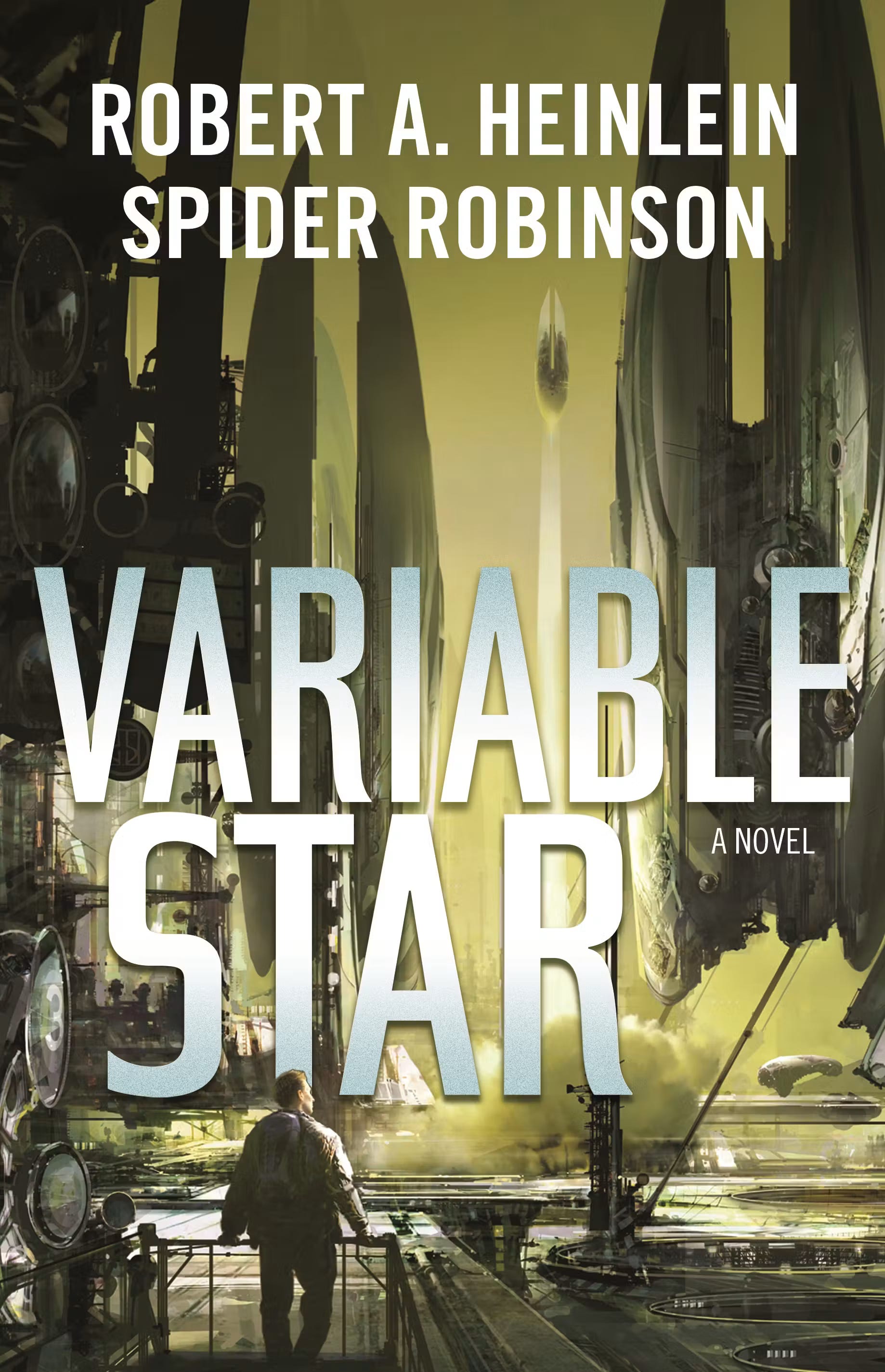
Variable Star, the 2006 Tor novel Spider Robinson wrote from an unfinished Robert A. Heinlein outline, remains a single book. Robinson announced three sequels in 2009, and none has been published. The raw material Heinlein left for the whole project was seven surviving pages and fourteen handwritten index cards.
Robinson dates the outline in his afterword to the novel. On November 14, 1955, he writes, Heinlein sat at his desk in Colorado Springs and wrote an outline for a book he first called The Stars Are a Clock. The pages ran single-spaced in ten pica type, with almost no margin on any side and very few strikeovers. Heinlein later wrote in half a dozen alternate titles by hand, including Doctor Einstein’s Clock, and settled on none of them. Then he filed the work in a drawer and left it there.
The timing puts it in the middle of Heinlein’s Scribner’s juvenile run. Tunnel in the Sky came out in 1955, and Double Star won the 1956 Hugo. Time for the Stars followed in 1956. One Heinlein fan database argues the outline predates Time for the Stars because that book appears to borrow elements from it. Robinson says only that Heinlein put the outline away for reasons he never gave. One reviewer reads the afterword as saying John W. Campbell talked Heinlein out of it, but the portion of the afterword available for this piece does not contain that claim.
Robinson describes the surviving pages as establishing the ficton, Heinlein’s term for the time and place of a story. Joel and Jinny get the most detail, and Jinny’s grandfather gets nearly as much. The pages lay out the conflict that sends Joel off Earth and the economics of interstellar colonization, then sketch his first adventures. They stop mid-sentence. Robinson adds that the full outline may have run fifty pages for all anyone knows.
There was no ending, and Robinson found one in Heinlein’s voice. After a week of staring at the pages, he writes, his music player rolled past the last Ray Charles album and landed on Heinlein: six short audio clips from a 1987 radio interview in Butler, Missouri, recorded a year before Heinlein died. The first clip sent him upright in his chair. A Slashdot review summarizes the afterword as saying the climax extrapolates from Heinlein’s stated views on humanity’s future.
The outline surfaced after Virginia Heinlein died in 2003. At the 2003 Worldcon in Toronto, researcher Robert James told a panel on rare Heinlein works that an outline for an unknown novel existed. A woman in the back of the room called out, “You should get Spider Robinson to finish that novel.” Heinlein’s literary agent Eleanor Wood, who also represented Robinson, and Heinlein Prize Trust trustee Art Dula were both on the panel. Robinson received the outline soon after, with permission to write two sample chapters and a proposal for Dula.
The Plot (Spoilers Ahead)
Joel Johnston is an eighteen-year-old musician and composer from Ganymede, on Earth to study. He is poor and an orphan, and he is in love with a fellow student named Jinny Hamilton, who is also poor and also an orphan. When Jinny decides the relationship is ready for marriage, she tells him her real name is Jinnia Conrad. Her grandfather, Richard Conrad, is the richest man in the solar system.
SFF180 reviewer Thomas Wagner places the revelation at a family hideout inside a glacier. Conrad has already mapped out Joel’s future: a role in the family business and children to carry on the dynasty. Joel refuses. With help from Jinny’s seven-year-old cousin Evelyn, he flees the Conrad estate.
To get beyond Conrad’s reach, Joel signs on to the RSS Charles Sheffield, a colony ship with a crew of 500 bound for a star dozens of light-years away. The voyage takes twenty years aboard ship. At near-light speed, one review puts the elapsed time on Earth at about 90 years.
Aboard, Joel works as a farmer, using what he learned on Ganymede, and plays music for the crew. A shipboard psychologist helps him through the breakup, and the National Space Society’s reviewer notes that the treatment draws on Zen Buddhism and yoga. Telepathic twins on the ship keep contact with their siblings on Earth, and through them Joel stays in touch with Evelyn.
Six “relativists” run the Sheffield’s quantum ramjet drive with their minds. Each can take the strain reliably for only six hours a day, and at relativistic speed the drive is nearly impossible to restart once it stops. Five years into the voyage, one relativist dies and another is mentally incapacitated, which leaves no margin for error.
The next year the ship’s telepaths report that the Sun has gone nova and killed everyone in the Solar System. A wave of gamma radiation is expanding at lightspeed toward the colonies, which are all that remain of humanity. The Sheffield can warn one colony in time. The nova contradicts every astrophysical theory, and more than 90 percent of the Sun’s mass converted to energy, so characters suspect an alien cause. The relativist team breaks down, the drive shuts off, and the Sheffield is left to coast past its destination at 97.6 percent of the speed of light.
Then a ship overtakes them. Jinny has married a scientist who built a faster-than-light drive. Only one experimental vessel exists, and it carries ten people, among them Jinny, her husband, Richard Conrad, and Evelyn. Time dilation has aged Evelyn to nineteen. Conrad proposes to shuttle the Sheffield’s people to their destination nine at a time. Joel works out that Conrad is lying: he came for supplies, has no plan to return, and wants control of the colonies. Conrad is defeated, and the faster-than-light engine is transferred to the Sheffield.
Joel and Evelyn marry and join the mission to warn the remaining colonies. Joel chooses to stay in space with his wife and child rather than settle on a planet. The book closes with lines from Tennyson’s “Ulysses,” the poem that gave Heinlein’s last published novel its title, To Sail Beyond the Sunset.
The Heinlein Callbacks and Robinson’s Winks
Robinson sets the book in a divergent offshoot of Heinlein’s Future History and fills it with references. Nehemiah Scudder, the Prophet of Heinlein’s American theocracy, gets a mention. So does LeCroix, the first man on the Moon in Heinlein’s alternate history, according to the NSS review. Joel’s Ganymede farm echoes Farmer in the Sky, the telepaths echo Time for the Stars, and the moving walkways echo The Roads Must Roll, as an SFFWorld review points out.
The chapter epigraphs carry a different kind of tribute. Chapters seventeen and eighteen open with quotes credited to Anson MacDonald, one of Heinlein’s pseudonyms, on “Anson MacDonald Day.” Robinson’s afterword says the words are Heinlein’s, taken from the 1987 Robert Heinlein Day radio interview in Butler, Missouri, the same Butler radio clips Robinson describes finding while he searched for an ending.
The winks run in other directions. The ship is named for the late science fiction writer Charles Sheffield. The colony’s governor-general, Lawrence Cott, plays on the name of Laurence van Cott Niven, and Cott’s lifemate, Perry Jarnell, plays on Jerry Pournelle. George R.R. Martin is a tuckerization target as well. The pop-culture references include The Simpsons, with Jinny calling Conrad’s major-domo “Smithers,” and the Canadian series Trailer Park Boys, whose characters supply names for two troublemakers and their lawyer. Joel meets a shipboard date when she accompanies his playing without his seeing her, a setup that echoes how a character meets his wife in Robinson’s Callahan stories.
Robinson’s version is also more open about sex and drugs than a 1955 juvenile could have been, according to Wikipedia, and the NSS reviewer counts references to 9/11 and the War on Terror among the touches no 1955 manuscript could have carried.
How Critics Received It
Reviews split. Wikipedia’s summary calls them mixed, and its Robinson entry says critics praised how he handled a difficult assignment and the lively story while faulting unlikely plot twists and weak romantic scenes.
The opening chapters drew the most complaints. Nicholas Whyte of Strange Horizons wrote, “This is, frankly, not a great book,” and Wikipedia says SFF World and SF Reviews voiced similar complaints, with SF Reviews calling the plot twists contrived and absurd. Quill & Quire found the early pages slowed by heavy scene-setting but called the book compelling once the story left Earth. Thomas Wagner of SFF180 argued the novel would have worked better if it had started with Joel boarding the Sheffield and skipped the Conrad setup.
Wagner praised the saxophone scene as some of Robinson’s most effective character writing. He also read the nova disaster as a 9/11 allegory. He wrote that Heinlein might frown at some of Robinson’s political conclusions, and that he himself agreed with them.
The ending split reviewers. Wagner called it one of the most risible he had read in years and compared its banality to the film Pearl Harbor. SFFWorld’s Mark Yon found it “one coincidence too far,” though he allowed that a need to end on a positive note is a Heinlein trait. A 2021 blog reviewer said the climax, with returning characters in a showdown, worked, and praised Robinson’s reading of the audiobook while finding the one-liners relentless. Publishers Weekly said old Heinlein hands might be disappointed because the book is “all journey and no arrival.”
The larger argument was whether it reads as Heinlein. Publishers Weekly called it a mostly credible pastiche of a 1955 Heinlein young adult novel. It said a contemporary author’s nonaggressive view of the future, set against Heinlein’s more militaristic one, left traces and some unexplained role reversals. The National Space Society’s Bart Leahy put the plot at perhaps 90 percent Heinlein, then wrote, “Variable Star is fun, in the way Heinlein juveniles were meant to be.” Wagner said Robinson captured Heinlein’s virtues and his faults, gave the book two stars, and filed it under “writers who love too much.”
William Stoddard made the sharpest structural objection. He called the book fan fiction by a much more skilled writer than usual and noted that its plot is essentially Time for the Stars again. The outline dates to 1955 and Time for the Stars appeared in 1956, so Stoddard asked whether Heinlein would have drafted a second near-identical book. Readers who want original Heinlein-era science fiction, he concluded, should look for authors telling their own stories.
The favorable notices came from several directions. Sci-Fi Dimensions called it a worthy continuation of Heinlein’s legacy and a good Robinson novel in its own right. Booklist found it “serviceably entertaining” while noting that the source material was a fifties outline rather than a lost masterpiece. Tor’s paperback carries Entertainment Weekly’s “An enjoyable read.” and a San Diego Union-Tribune line calling it a Robinson novel that also happens to be a new Heinlein novel. The New York Times line printed there, “I’d nominate Spider Robinson as the new Robert Heinlein,” appears to be the 1982 Times Book Review remark that the book’s editor cites, so it predates the novel. David Crosby also gave the book a cover comment, and the book’s website carries a video interview with Robinson and Crosby.
Reader ratings run wide. A Goodreads listing for the hardcover showed 3.86 across 5,374 ratings, and the Kindle edition showed 4.28 across 429. Amazon reviews from late 2006 range from five stars to a one-star review titled “Heinlein Pie: a Travesty.”
Editions and the Heinlein Prize
Tor published the hardcover on September 19, 2006. Blackstone released an unabridged audiobook on June 1, 2007, narrated by Robinson, running 10 hours and 46 minutes. Tor’s mass market paperback followed on November 27, 2007, an Italian edition titled Stella variabile came out in February 2008, and Tor reissued the book in paperback on January 15, 2019. The publisher’s listing says profits from the book help fund the annual $500,000 Heinlein Prize for innovation in commercial manned spaceflight.
The Series That Heinlein Never Wrote
Heinlein wrote his juveniles as standalone books, and no source reviewed for this piece reports sequel notes for this one. The series case comes from the structure. Joel ships out on a colony vessel for a 20-year voyage that takes about 90 years on Earth, according to one review. Time dilation at that scale sets up sequels almost automatically, since anyone who returns finds a changed Earth.
Robinson saw it. His website announced in 2009 that Wood had sold Tor three sequels, to be called the Orphan Stars Trilogy, with Pat LoBrutto editing.
Why It Stopped
Jeanne Robinson, his wife and Stardance co-author, died of biliary cancer on May 30, 2010. Years later Robinson told a Vancouver-area reporter that he sat at the computer for hours on the sequel and nothing came: “I just stopped getting science fiction ideas.” In 2013 his website still reported that Orphan Stars was moving, slowly. That year he also suffered a heart attack. His daughter Terri da Silva died of breast cancer on December 5, 2014. Wikipedia states he has not published a novel since 2008.
His most recent collection, My Favorite Shorts (2016), is a reprint volume. A reader review on Goodreads says nothing in it is new beyond links to four songs. The listing adds a new introduction and a reminiscence about Jeanne and meeting Robert and Ginny Heinlein. He also co-edited the 2017 anthology Compostela.
The 46-volume Virginia Edition has no volume for the outline, and no source reviewed for this piece shows its text published in full. If the Heinlein Prize Trust released the seven pages and fourteen cards, would readers want to see Heinlein’s version of the story, or is Robinson’s ending the last word?
First contact with the Oridians was supposed to be humanity’s proudest moment. Instead, their chief engineer is dead, their ship is sabotaged, and an ancient alien technology is stealing souls. Book one of the Valiant Frontiers series delivers exploration, mystery, and the kind of crew you’ll want to follow across the galaxy. Read The Soul Catcher on Amazon and start the adventure.