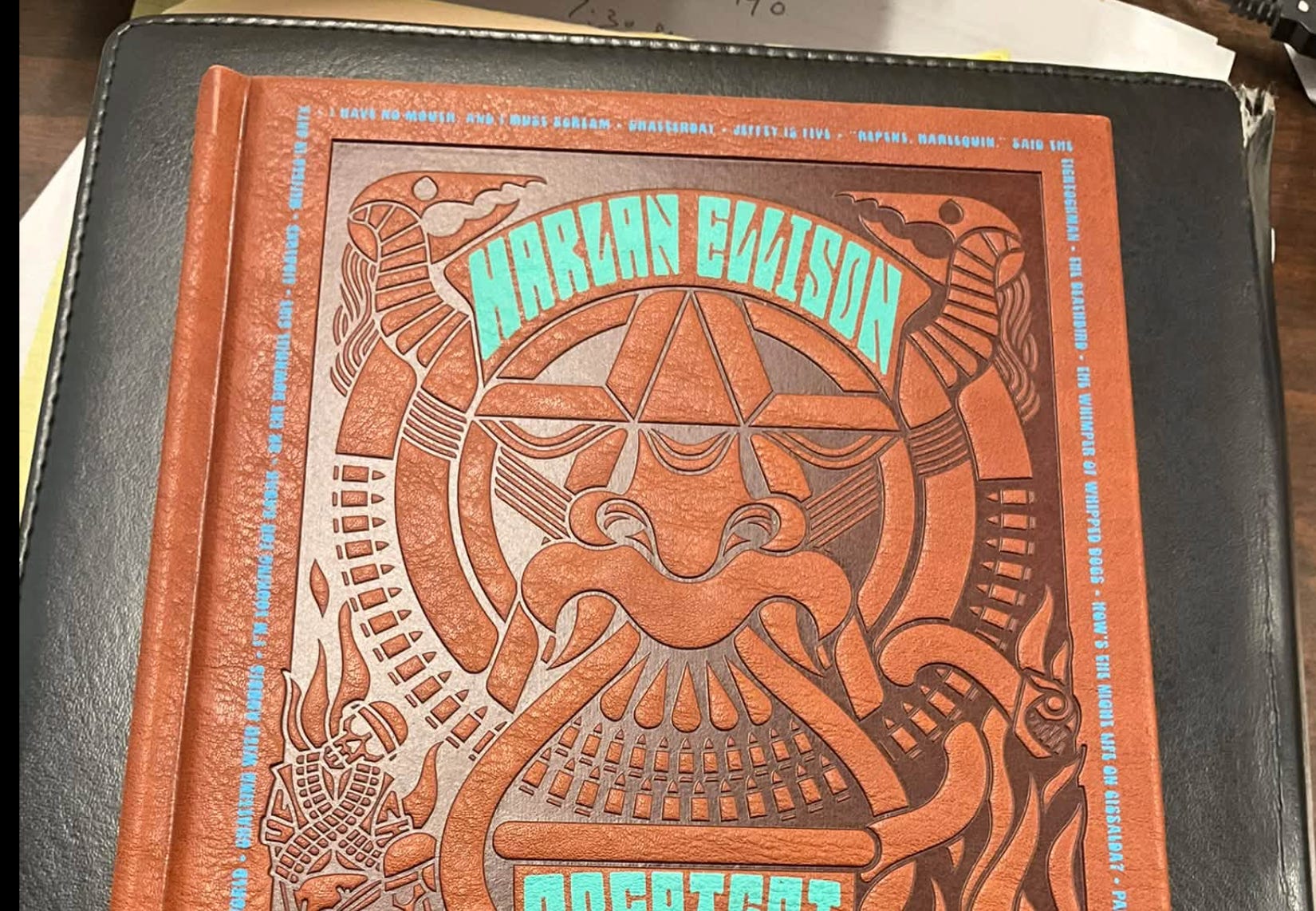
Harlan Ellison’s Greatest Hits landed October 6 in a deluxe hardcover from Union Square & Co. The book weighs 2.82 pounds, runs 480 pages, and costs $40. Every page is premium glossy stock, the edges are colored, a ribbon bookmark is sewn in, and the cover has a textured finish. It is a handsome object, and the stories inside it need no defense.
The cover has a pedigree. Tim Kirk said in a comment that its design is based on a carved presentation box his brother, Steve Kirk, built for a 40-copy limited edition of Ellison’s Stalking the Nightmare. Steve Kirk also designed and fabricated the “Lost Aztec Temple of Mars” facade at Ellison Wonderland, the author’s home. Limited deluxe editions were a habit with Ellison, who liked to see his work in collector formats. This edition brings that tradition to a trade-priced hardcover.
The collection first appeared March 12, 2024, edited by J. Michael Straczynski, who took over Ellison’s literary estate. Nineteen stories run across five sections: Angry Gods, Lost Souls, The Passage of Time, The Lighter Side, and The Last Word. Ellison is an eight-time Hugo winner, and the table of contents reads like an awards ledger. “‘Repent, Harlequin,’ Said the Ticktockman” took the Hugo and the Nebula. “The Whimper of Whipped Dogs” won an Edgar. “Jeffty Is Five” took multiple awards, and “Paladin of the Lost Hour” became a Twilight Zone episode. The themes are universal: time as a tyrant, machines that torment, cruelty toward the helpless.
The front matter is where the book goes wrong. Straczynski’s preface turns to rants about racism and feminism before the first story begins. Cassandra Khaw’s introduction is worse, because it is about Khaw all about.
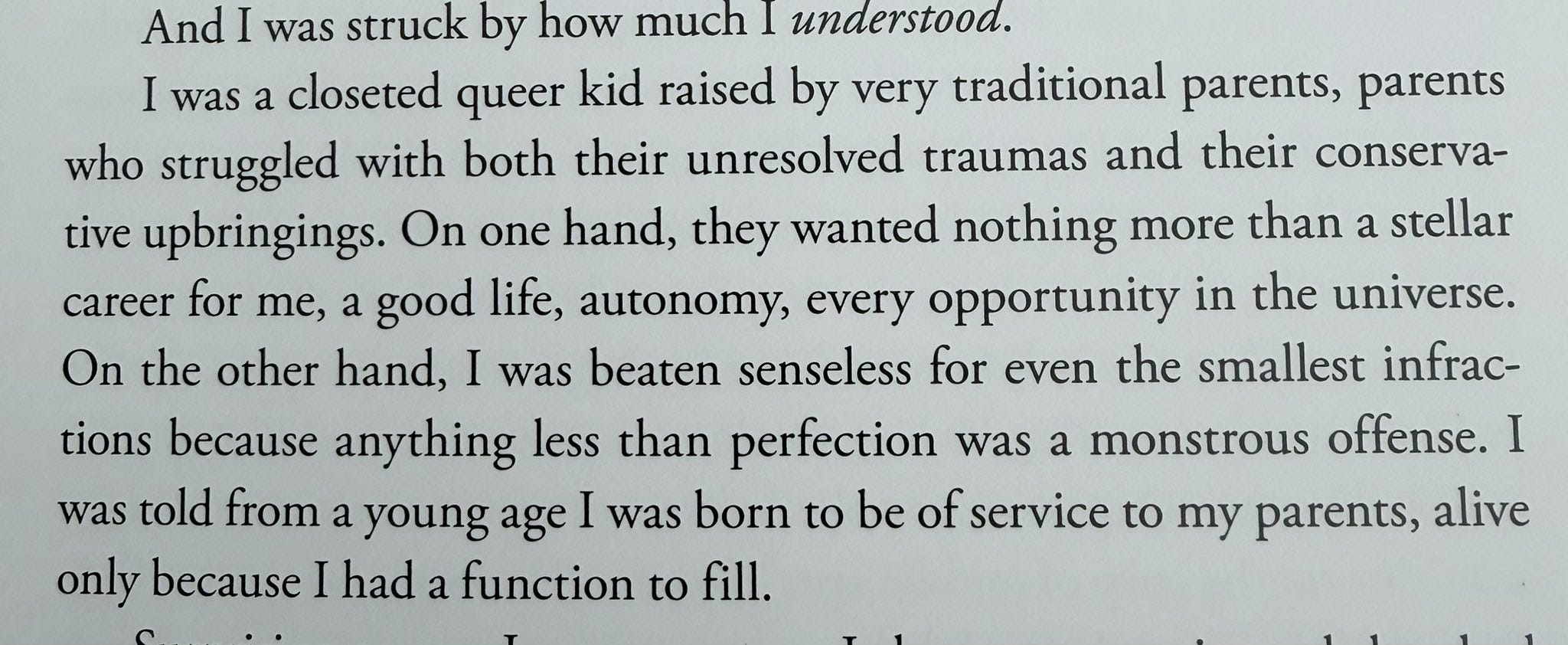
Khaw opens the personal turn with a line about being a “closeted queer kid raised by very traditional parents.” The paragraph goes on to describe parents shaped by trauma and conservative upbringings, beatings for the smallest infractions, and a childhood in which Khaw was told they existed to serve. Whatever happened in that house is Khaw’s to tell. A memoir is the place for it. The introduction to a Harlan Ellison collection is not, and the reader who bought the book for “I Have No Mouth, and I Must Scream” gets a sexual identity essay in which conservative parents play the villains.
Khaw is a Bram Stoker Award winner and a USA Today bestselling horror author, and a name that carries a small weight in that corner of publishing. It carries little with an Ellison audience. The selection reads as a signal to the industry, not a service to the reader.
Straczynski has said he wants to keep Ellison’s progressive politics in circulation, and Ellison was a man of the 1960s left. That left was once the counterculture. Today its positions are the house positions of mainstream publishing, and the people at Union Square who green-lit these introductions would never acknowledge the real counterculture, the writers and readers working outside their approval who reject all of it. Ellison understood the instinct, and if you look at his Dangerous Visions vs. the Straczynski edited final one, he contains viewpoints from hard right authors at the time such as Poul Anderson and Gene Wolfe, whereas Straczysnki’s sanitized edition does not dare to publish such viewpoints. One must also remind that Harlan told a Boston University crowd in 2005, “The whole concept of political correctness is over my head.” He complained elsewhere that the pressure to avoid insulting anyone meant a writer could not put an unpleasant woman or a character with a deformity on the page.
The deluxe edition also drops Neil Gaiman’s foreword, which opened the 2024 book. In January 2025, eight women made allegations against Gaiman in a Vulture report, including Scarlett Pavlovich, who worked as a nanny for him and his then-wife, Amanda Palmer. Gaiman denies all of it. Dark Horse announced it would stop publishing his work. Pavlovich’s federal suit was dismissed on forum non conveniens grounds, with the court sending the dispute to New Zealand, and the Seventh Circuit affirmed on June 29, 2026. No court has ruled on whether the allegations are true, and no criminal charges have been filed. The foreword that sat in the 2024 book is gone from the deluxe edition. It looks like a soft cancellation, and the edition lists two introductions in its place, one credited to Ellison.
Would Ellison have folded? His record says no. At the 2006 Hugo ceremony he grabbed Connie Willis’s breast on stage, which was wrong. Afterward he complained that Willis had not acknowledged his apology and lashed out at the fans who criticized him. He escalated every fight and sued over Usenet postings of his stories. A man who handled pressure that way is hard to picture scrubbing a friend’s foreword to keep a publisher comfortable.
None of this touches the stories, and the stories are why the book exists. Should a collection built on Ellison’s fiction open with writers who use the pages to talk about themselves?
Contents
Angry Gods
“‘Repent, Harlequin,’ Said the Ticktockman” (1966): Hugo Award, Nebula Award, 2015 Prometheus Hall of Fame Award
“I Have No Mouth, and I Must Scream” (1967): Hugo Award
“The Deathbird” (1974): Hugo Award, Locus Award
“Chatting with Anubis” (1995): Bram Stoker Award, Deathrealm Award
“The Whimper of Whipped Dogs” (1973): Edgar Allan Poe Award
Lost Souls
“Jeffty Is Five” (1977): British Fantasy Award, Hugo Award, Nebula Award, 1999 Locus Poll Winner for Best Short Story of All Time
“Pretty Maggie Moneyeyes” (1967): Hugo Award nomination, Nebula Award nomination
“Shatterday” (1980): Nebula Award nomination, Twilight Zone episode
“Mefisto in Onyx” (1993): Bram Stoker Award, Locus Award, Hugo Award nomination, Nebula Award nomination, World Fantasy Award nomination
“On the Downhill Side” (1972): Locus Award nomination, Nebula Award nomination
The Passage of Time
“Paladin of the Lost Hour” (1986): Hugo Award, Locus Award, Nebula Award nomination, Twilight Zone episode
“The Beast That Shouted Love at the Heart of the World” (1969): Hugo Award
“I’m Looking for Kadak” (1974)
“How Interesting: A Tiny Man” (2010): Nebula Award
The Lighter Side
“Djinn, No Chaser” (1983): Locus Award
“How’s the Night Life on Cissalda?” (1977)
“From A to Z, in the Chocolate Alphabet” (1976)
“Eidolons” (1989): Locus Award
The Last Word
“All the Lies That Are My Life” (1981): Hugo Award nomination
Space marines on a holy crusade across the galaxy. If that sentence got your attention, Justified: Saga of the Nano Templar is your next read. Three books of relentless action Read Justified: Saga of the Nano Templar on Amazon!