


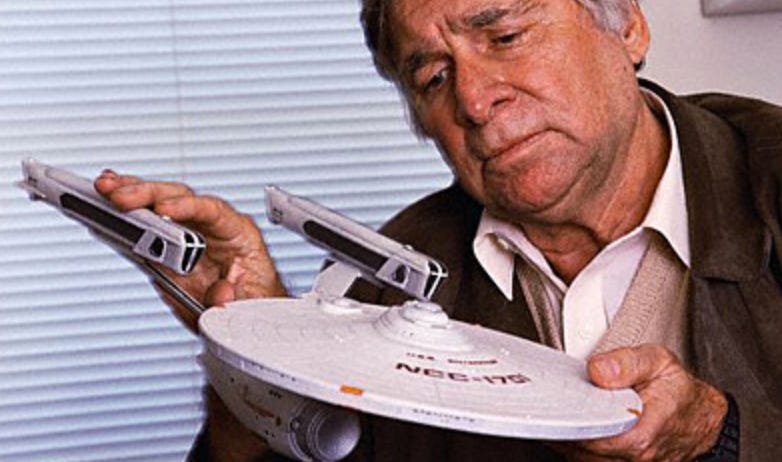
Gene Roddenberry attended channeling sessions at Andrija Puharich’s estate in Ossining, New York in 1974 and 1975. The sessions were conducted with Phyllis Schlemmer as the medium. The entities who spoke through her called themselves the Council of Nine. They identified themselves as the Egyptian Ennead, the nine gods of Heliopolis, and they claimed responsibility for the direction of human civilization across the entirety of recorded history.
Roddenberry took notes.
Those notes made their way into the cosmology of Star Trek: The Next Generation, which he developed and produced through the late 1980s. The Q Continuum, the omnipotent beings who stand in judgment of humanity, the framing of human evolution as a project overseen by superior non-physical intelligences: the architecture came from sessions conducted with a medium while entities dictated cosmological claims to a man who had already abandoned the Christianity of his upbringing and was looking for something to replace it.
This is documented. Phyllis Schlemmer transcribed and published the session material in The Only Planet of Choice (1993). Roddenberry’s involvement is confirmed in the biographical literature. The sessions are referenced in Jeffrey Kripal’s Mutants and Mystics and in multiple accounts of the broader Puharich circle.
The man who sat in those sessions was not the idealistic humanist of the popular biography. The popular biography describes a WWII veteran who believed in humanity’s potential and built that belief into a television franchise. That version of Roddenberry is real as far as it goes. It does not go very far.
The man David Alexander interviewed for the authorized biography Star Trek Creator (1994) said things the publicists did not put in the press releases. On his own sexuality: “I’m sorry that I have never had a homosexual relationship,” he remarked pensively, out of the blue, one afternoon. He elaborated: “Because I know that there must be many joys and pleasures and degrees of closeness in those relationships. I think that I have in a way been cursed by having picked my particular time period and background and so on, because I have no doubt that I am capable of homosexualism.” He told Alexander he believed everyone was bisexual. He told Alexander that two genders were an evolutionary mistake and that he hoped he was “not either.” He was, at the time of these conversations, in the late stages of producing Star Trek: The Next Generation, and he was telling his biographer he was “in the midst of making a decision about homosexuality, male and female, and how we are going to treat it on Star Trek, the lovely ways in which we will treat it.”
