



Fritz Leiber's "Swords & Deviltry" stands as one of the most influential works in the sword and sorcery genre, introducing readers to the legendary duo of Fafhrd and the Gray Mouser through a collection that somehow manages to feel like a cohesive novel despite being comprised of three distinct short stories. This literary sleight of hand represents just one of many innovations Leiber brought to a genre still finding its footing in the wake of Robert E. Howard's untimely death.
The collection's structure proves particularly ingenious, with the first two stories ("The Snow Women" and "The Unholy Grail") serving as origin tales for Fafhrd and the Gray Mouser respectively, before bringing them together in the final story, "Ill Met in Lankhmar." This approach allows Leiber to establish each character's distinct personality and background before their meeting, creating a sense of destiny when they finally cross paths in Lankhmar's foggy streets.
What's particularly striking about these tales is Leiber's willingness to embrace moral characters with moral failings that sometimes cause a reader to squirm as it makes it difficult to root for the protagonist. Fafhrd's casual impregnation of Mara before abandoning her for the exotic Vlana would be shocking even in contemporary fiction, as not only does it present morals that would have been outrageous at the time of writing, but it also flies in the face of modern feminist culture. This casual amorality establishes immediately that these are not the virtuous heroes of high fantasy but flawed men navigating a corrupt world with their own compromised moral compasses.
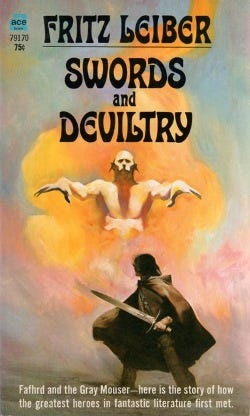
Even more jarring is the brutal fate that awaits both protagonists' lovers. As readers settle into what appears to be the conclusion of traditional adventure narrative, Leiber savagely drops a shock bomb by having Vlana and Ivrian murdered by the Thieves' Guild. This development not only cements the bond between Fafhrd and the Mouser through shared tragedy but establishes the unforgiving nature of Nehwon as a setting where no character is safe.
While Robert E. Howard's Conan stories certainly didn't shy away from violence, they typically positioned Conan as an unstoppable force triumphing over adversity. Leiber, by contrast, makes his heroes vulnerable not just physically but emotionally, allowing them to experience genuine loss and failure. This psychological depth, combined with Leiber's more sophisticated prose style, elevates these tales to, in my humble and perhaps controversial opinion, be better than many of the original Conan short stories.
Leiber's Lankhmar itself deserves recognition as perhaps fantasy's first fully realized urban setting. Unlike Howard's frontier wilderness punctuated by decadent cities, Leiber creates a metropolis teeming with thieves, sorcerers, and corrupt officials that would become the template for countless fantasy cities to follow, from Terry Pratchett's Ankh-Morpork to Scott Lynch's Camorr.
The collection also establishes tropes that would become staples of the sword and sorcery genre: the contrast between the physically imposing barbarian and the nimble, clever thief; the corrupt urban setting; the unreliable patron; and magic as a dangerous, unpredictable force rather than a systematic power. These elements would be adopted by countless authors from Michael Moorcock to Steven Brust.
For readers looking to explore the Fafhrd and Gray Mouser series, "Swords & Deviltry" represents the perfect entry point, showcasing Leiber at the height of his powers. Unfortunately, the quality of the series declines noticeably in later volumes, particularly those written in the 1980s when Leiber returned to the characters after a significant hiatus. These later tales often lack the narrative tightness and moral complexity that make the early stories so compelling.
Despite these later missteps, "Swords & Deviltry" remains a masterclass in sword and sorcery storytelling, demonstrating how the genre can accommodate genuine emotional depth while still delivering the adventure and excitement readers crave. For anyone interested in the foundations of modern fantasy, Leiber's introduction to his legendary duo remains essential reading.
For a great novel with a classic sword & sorcery feel, read The Demon’s Eye, an incredible new classic fantasy novel. Support Fandom Pulse!

NEXT: Tor Books Author John Scalzi Lambasts Worldcon Using AI While Hugo Award Finalist Drops Convention