


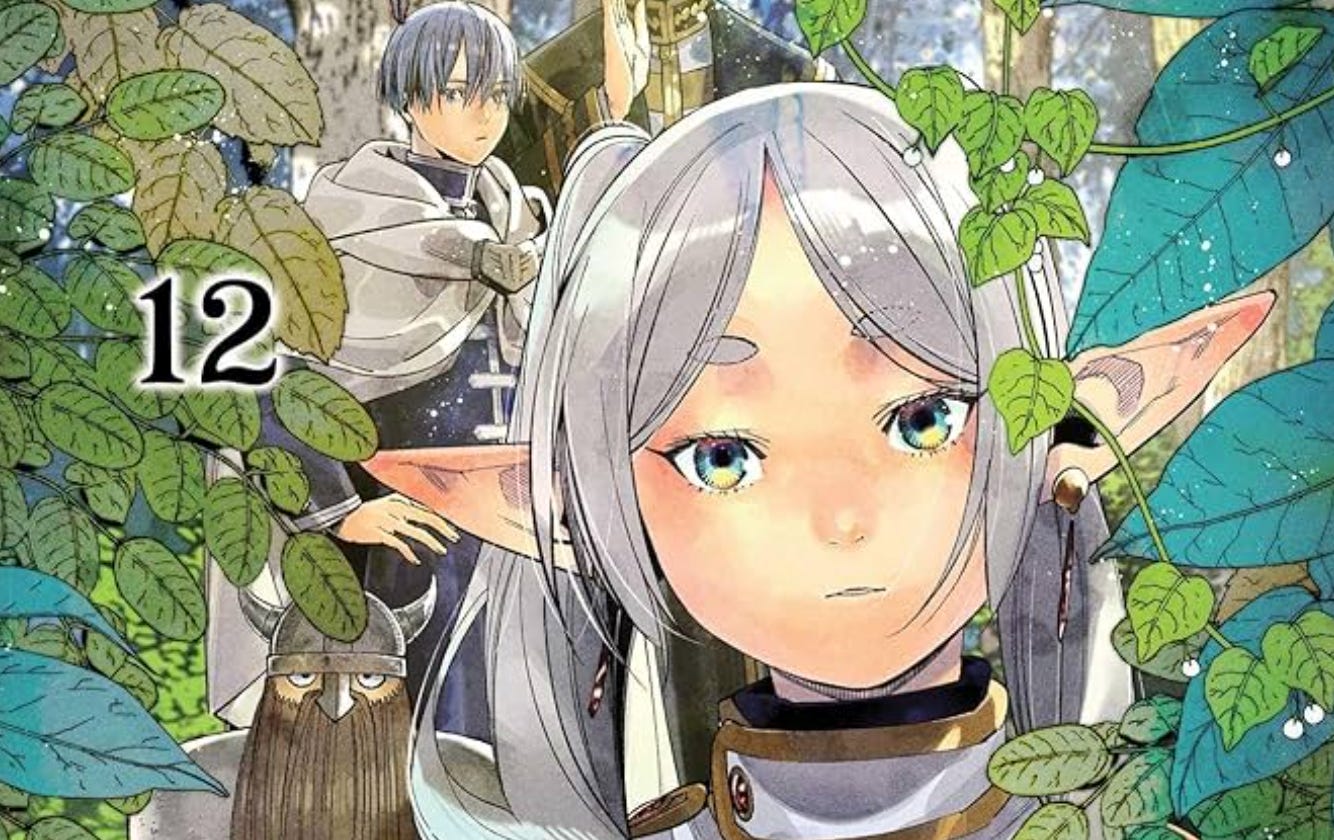
Frieren: Beyond Journey’s End has operated on a simple but powerful premise: what happens after the adventure ends? The series follows Frieren, an elf mage who helped defeat the Demon King alongside the hero Himmel and their companions, as she processes grief, regret, and the realization that she didn’t appreciate her friends while they were alive.
The story has been told through flashbacks with brief glimpses of the original party, moments that Frieren remembers with increasing clarity as she understands what she lost. But readers have never spent extended time with Himmel, Heiter, and Eisen as living, active characters. We’ve seen them through the filter of memory, idealized and distant.
Volume 12 changes that. Through time travel magic, Frieren is transported back into her younger self’s body, rejoining the hero’s party during their original journey. For the first time in the series, we get to see these characters together, alive, and in action.
The Setup
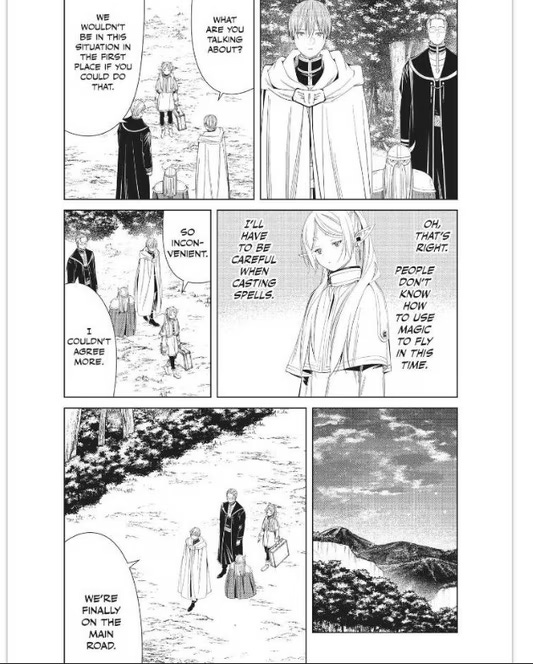
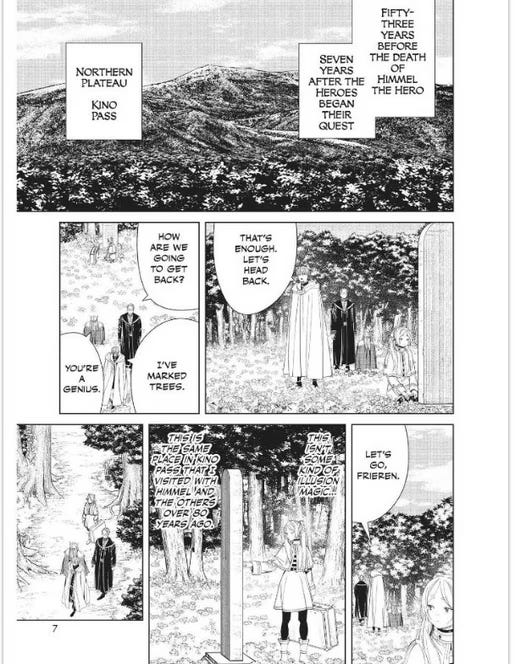
Frieren touches an enchanted stone and finds herself back in time, inserted into her own body decades earlier. She’s traveling with Himmel, Heiter, and Eisen on their quest to defeat the Demon King. She knows she’s gone back in time.
Her first instinct is caution. She tries to hide her knowledge, worried about changing the timeline or revealing information that could alter the future. But eventually, she lets it slip. The party figures it out.
The series handles this revelation remarkably well. Himmel, Heiter, and Eisen are adventurers. They understand that time travel probably means the timeline is fixed or that their actions won’t change what’s already happened. They ask a few questions, mostly in a quippy, teasing manner, but they don’t press too hard. They accept the situation and move on.
This is smart writing. The volume could have bogged down in time travel paradoxes and philosophical debates about causality. Instead, it trusts the characters to be competent and the readers to understand the implications without needing everything spelled out.
Greatest Hits and Character Depth
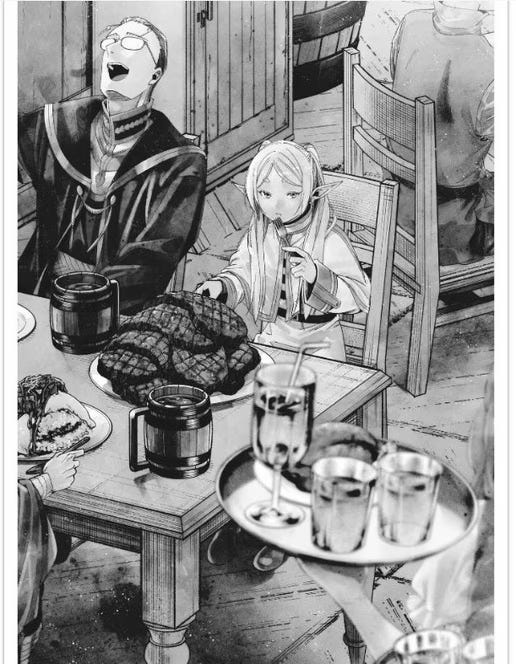
Much of the volume is devoted to reminding readers why they fell in love with this series in the first place. Frieren gets caught in traps while searching for treasure chests—a running gag from early volumes. She teases Heiter, calling him “corrupt priest” whenever he drinks too much. The party bickers, jokes, and operates with the easy camaraderie of people who’ve been through hell together and come out the other side.
These are the “greatest hits” moments, and they work because they’re grounded in character. Frieren isn’t just going through the motions—she’s experiencing these moments with the awareness of what she’ll lose. Every joke, every shared meal, every quiet moment around the campfire carries weight because she knows how it ends.
The volume also deepens our understanding of the original party. Himmel is revealed to be more thoughtful and perceptive than the flashbacks suggested. Heiter’s drinking is contextualized as a coping mechanism rather than just comic relief. Eisen’s quiet strength is shown in action rather than just described in retrospect.
Most importantly, the volume makes explicit what the series has only implied: Himmel was in love with Frieren. When a demon traps him in a dream, the dream is of marrying her. It’s a moment that recontextualizes every flashback, every memory, every regret Frieren has carried. She didn’t just miss the chance to appreciate her friends—she missed the chance to understand that one of them loved her.
This adds layers to Frieren’s grief. She’s not just mourning a friend. She’s mourning a relationship that could have been, a future she didn’t realize was possible until it was too late.
Action and Pacing
One of the common criticisms of Frieren‘s early volumes is that they’re slow. The pacing is deliberate, reflective, and contemplative. Time moves differently for an immortal elf, and the series mirrors that in its structure. Episodes can feel meandering, with entire chapters devoted to quiet character moments or philosophical musings.
Volume 12 is different. The pacing is fast, propulsive, and action-heavy. The party fights a dragon. They confront demons. They navigate traps and solve magical puzzles. The volume is structured as a series of quests, each one bringing Frieren closer to finding the spell that will return her to her own time.
This shift in pacing serves multiple purposes. It demonstrates why Himmel’s party was legendary—we see them in action, not just in memory. It provides contrast to the slower, more melancholic tone of the present-day storyline. And it keeps the volume from becoming too sentimental. The nostalgia is earned because it’s balanced with genuine adventure.
The action sequences are well-executed. The art is clear, the choreography is easy to follow, and the stakes feel real despite the fact that we know these characters survive (at least until the end of their journey). The volume doesn’t rely on spectacle—it uses action to reveal character and advance the plot.
The Time Travel Mechanics
The series handles time travel with a light touch. Frieren is cautious about changing the past, but the volume doesn’t dwell on paradoxes or alternate timelines. The implication is that the timeline is fixed—what happened, happened—and Frieren’s presence in the past was always part of the original journey, even if she didn’t remember it the first time through.
This is a common solution to time travel stories, and it works here because the focus isn’t on the mechanics. The time travel is a narrative device to give Frieren (and the reader) access to a period of her life she didn’t fully appreciate. The point isn’t to change the past—it’s to understand it.
Frieren is searching for the spell that will return her to the present. She wants to go back, not because she’s unhappy in the past, but because she has unfinished business in the present. She has Fern and Stark, her current companions, waiting for her. She has a journey to complete. The past is precious, but it’s not where she belongs.
This is thematically consistent with the series as a whole. Frieren is about learning to live in the present while honoring the past. Frieren can’t stay in the past, no matter how much she might want to. She has to return to her own time and continue moving forward.
The Cliffhanger

The volume ends with a confrontation. The demons have figured out that Frieren and her party are at the enchanted stone. Two greater demons arrive, along with reinforcements. One of them traps Himmel in the dream where he’s marrying Frieren, paralyzing him and leaving the party vulnerable.
It’s a strong cliffhanger that sets up volume 13. The action is unresolved, the stakes are high, and the emotional weight of Himmel’s dream adds urgency to the situation. Frieren has to save him, and in doing so, she’ll have to confront what his feelings for her mean—both in the past and in how she remembers him in the present.
Why This Works
Volume 12 succeeds because it delivers something readers have wanted since the series began: extended time with the original hero’s party. We finally get to see Himmel, Heiter, and Eisen as living, breathing characters rather than idealized memories. We get to understand why Frieren’s grief is so profound and why her regret is so sharp.
The volume also demonstrates how much Frieren has changed. The Frieren of the past is more detached, less emotionally engaged, less present in the moment. The Frieren who’s traveled back in time is different. She’s learned to care about the people around her. She’s learned to appreciate the time she has with them. The contrast between past-Frieren and present-Frieren highlights the character growth the series has been building toward.
The time travel arc could have been a gimmick—a nostalgic detour that doesn’t advance the story. Instead, it’s essential character development. Frieren needed to go back to understand what she missed. She needed to see Himmel’s feelings for her made explicit. She needed to experience the hero’s journey one more time, with the awareness she lacked the first time through.
Final Thoughts
Frieren: Beyond Journey’s End Vol. 12 is one of the strongest volumes in the series, earning a 9.5/10. It’s fast-paced, action-packed, and emotionally resonant. It delivers on the promise of showing the original hero’s party in action while deepening the themes of grief, regret, and learning to live in the present.
What do you think?
Want something different from the mainstream that has classic superhero storytelling? Sign up for the Flying Sparks Omnibus, collecting over 450 pages of the epic story of Meta-Girl by Jon Del Arroz!

NEXT: Faced With Sagging Sales, DC Comics Turns To Absolute Universe Crossover Event
I didn't know you guys started reviewing the manga source of one of my all time favorite animes! Love it!