


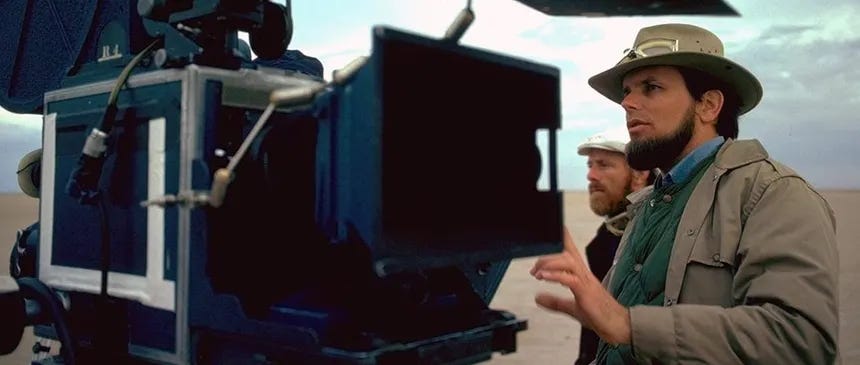
Gary Kurtz produced Star Wars and The Empire Strikes Back, pushed George Lucas toward the religious ideas that became the Force, and walked away from the saga before Return of the Jedi rolled a foot of film. Ask a casual fan today who built Star Wars and the answer comes back as George Lucas, with John Williams and Irvin Kershner collecting whatever credit is left over. Kurtz almost never makes the list.
That gap in knowledge by fans is the reason this series exists. Some of the people who built the science fiction that shaped generations of readers and viewers never chased a spotlight, and the record has thinned out around them. Kurtz may be the clearest case in all of Star Wars history.
Born in Los Angeles on July 27, 1940, Kurtz arrived at USC in 1959 on a music scholarship and ended up in the film program instead. He spent the next several years grinding through forty or fifty low-budget exploitation pictures in the Roger Corman orbit, taking whatever job was open: grip work, electrical, sound boom, camera, editing, production supervision. In 1965 he was assistant director on Monte Hellman’s Western “Ride in the Whirlwind” with Jack Nicholson, then production manager on “Voyage to the Prehistoric Planet” for American International Pictures.
The Marine Corps interrupted all of it. Drafted in 1966, Kurtz served three years and shipped to Vietnam. Raised a Quaker, he enlisted as a conscientious objector and refused to carry a weapon. “I carried an empty pistol holster,” he said years later, noting that four or five of his fellow cameramen were killed. He shot combat footage and directed documentaries in country. That is the man who would soon argue for a story about a moral order running underneath the universe.
Francis Ford Coppola introduced Kurtz to George Lucas in 1971, while Lucas was cutting THX-1138. The partnership that followed lasted a decade. Kurtz produced “American Graffiti” in 1973, which earned him and Coppola a Best Picture nomination, and then went straight into Star Wars as Vice President of the Star Wars Corporation, responsible for development and merchandising rights.
His fingerprints are all over the 1977 production. Kurtz negotiated the move to English stages, kept 20th Century Fox off Lucas’s back, and directed a large share of the pickup shots at Elstree himself, including most of the cockpit dogfight material and the fight aboard the Tantive IV. He rode Industrial Light & Magic when John Dykstra’s shots ran behind. The picture cost eleven million dollars, became the highest grossing film released to that point, and took ten Academy Award nominations including Best Picture for Kurtz.
Then there is the Force, where his contribution runs deepest and where the credit went missing. Kurtz had studied comparative religion at length, and in early script development he pressed Lucas to give the film a universal faith rather than a set of gadgets. Earlier drafts tied that energy to the Kaiburr crystal, buried in exposition. The two men cut it down to something a viewer could absorb in one line of Alec Guinness dialogue. Kurtz said they were after a simple handle on an idea that could be explained fast. Whatever a Catholic makes of the theology that resulted, a producer who had sat with the great religious traditions is the reason the film reaches for the transcendent at all instead of settling for laser swords and dogfights.
“The Empire Strikes Back” is where his instincts ran the shop. Kurtz suggested Kershner for the director’s chair, hired production designer Norman Reynolds, makeup artist Stuart Freeborn and first AD David Tomblin, ran the England shoot, and shot second unit while Lucas stayed stateside on the effects. He came up with the title. The production ran eighty days past its hundred-day schedule and the budget swelled to thirty million, forcing Lucas to borrow ten million to finish. The film grossed north of half a billion dollars, and it remains the one fans hold up when they argue about the high point of the franchise.
The break came over “Return of the Jedi.” Kurtz and Lucas had an outline in which Han Solo died in a raid on an Imperial base partway through the film, Leia carried the weight of rule as a hard duty rather than a reward, and Luke walked off alone at the end. Kurtz called the proposed second Death Star “too derivative.” Lucas rewrote the whole thing. “We had an outline and George changed everything in it,” Kurtz said in 2010. He laid the blame on the merchandising operation, which by then was pulling three times what the films made. “The toy business began to drive the empire,” he told the Los Angeles Times. Kurtz resigned from Lucasfilm in December 1980. Mark Hamill compared the split to “Mom and Dad getting a divorce.”
He went on to produce “The Dark Crystal” with Jim Henson in 1982 and “Return to Oz” in 1985, then “Slipstream” in 1989 with Hamill. His later credits shrank to television and small independent work, and his final producing credit came on “5-25-77,” a film about a kid trying to get to Star Wars on opening day. Kurtz died of cancer in London on September 23, 2018, at 78.
Craig Miller, Lucasfilm’s first Director of Fan Relations and the author of “Star Wars Memories,” worked alongside Kurtz on both films, and Kurtz wrote the foreword to Miller’s book. Miller gave Fandom Pulse this exclusive comment on the state of the record:
“Gary definitely deserves more acclaim. The family wants me to write a biography of him but most of the people he worked with pre-Star Wars and even many of the key SW folks are no longer with us. Since Gary always eschewed publicity about himself, it’s hard going without primary sources.”

That is the whole problem with the system of fame much of fandom operates on. Hollywood does not hand out retroactive credit to the humble, and the entertainment press has spent forty years writing the origin story as one alone in a room.
Hopefully more readers walk away from this knowing the name. Kurtz was in the Vietnamese jungle with an empty holster and a camera, at Elstree shooting cockpit inserts nobody would ever credit him for, and in development meetings arguing that a space adventure should carry real spiritual weight. The two films everyone points to as the good ones both have his name on them.
How much of what fans still love about those first two pictures came from the producer nobody talks about, and who else from that 1977 crew has the fandom quietly written out of the story?
Space marines on a holy crusade across the galaxy. If that sentence got your attention, Justified: Saga of the Nano Templar is your next read. Three books of relentless action Read Justified: Saga of the Nano Templar on Amazon!
It's an old story. Hard core fans know who Jack Kirby is. Everyone else? Stan Lee.
Gary was my dear friend and collaborator on many projects, including producing "5-25-77" (along with Fred Roos-- ANOTHER mostly unsung hero!) This is a very nice and much-deserved tribute to a wonderful human being who left us far too soon. Well done.