



George R.R. Martin is currently suing AI companies for using his books without permission. That irony makes the latest controversy surrounding his work particularly bitter: the newly released illustrated edition of A Feast for Crows appears to be filled with AI-generated artwork.
The $50 deluxe edition hit shelves on November 4, 2025, and fans immediately noticed something wrong. X user @drouseytunes broke the story in a viral thread, posting images from the book with a simple question: “hey so, my illustrated edition of AFFC just came in and, like... are these not ALL ai? fucking look at them. did i get scammed? did george sanction this?”
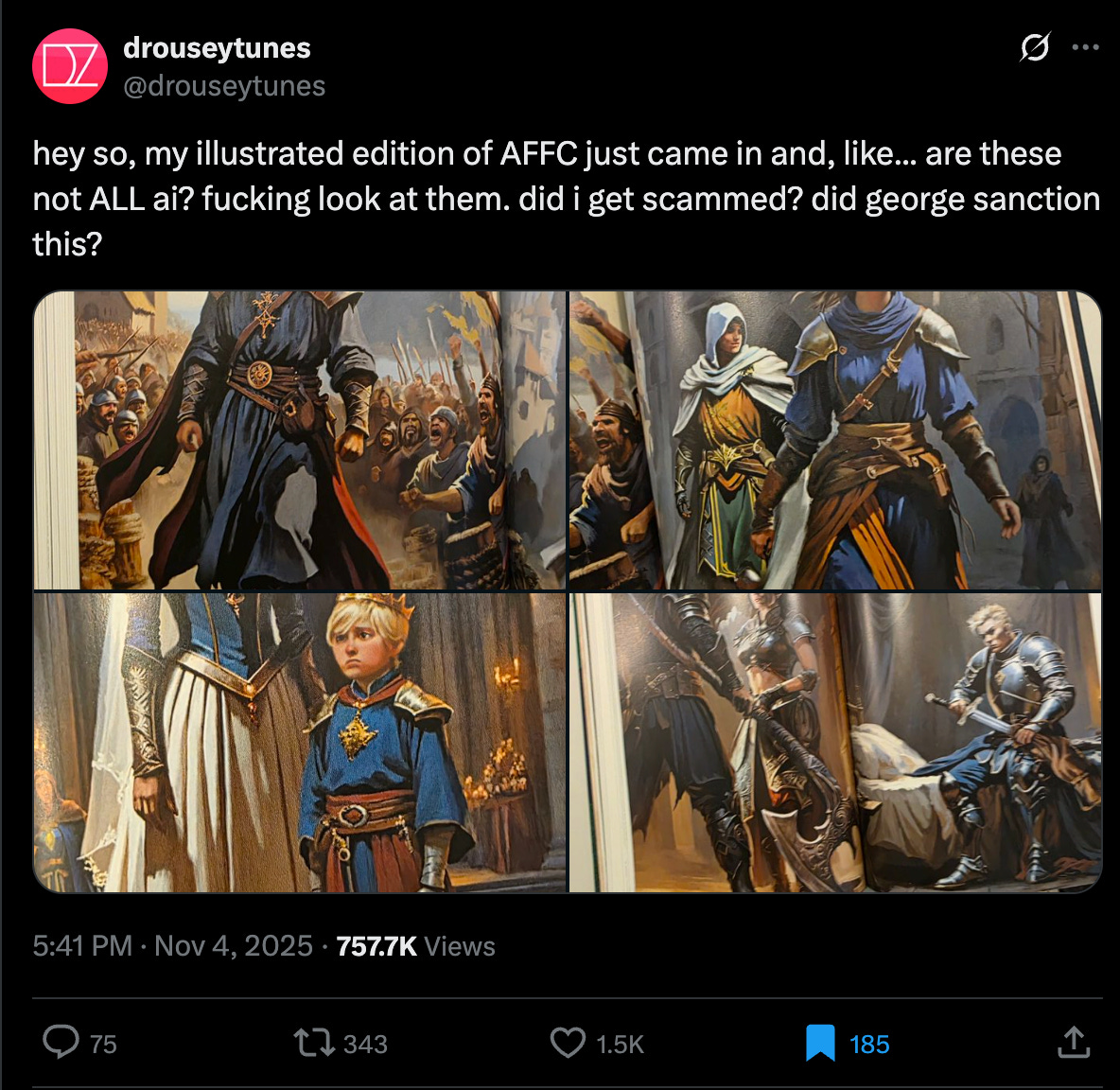
The evidence is damning. YouTuber Daniel Greene broke down the allegations in detail, comparing the new Feast for Crows illustrations to previous entries in Penguin Random House’s illustrated Song of Ice and Fire series. The contrast is stark. Earlier editions featured work from top fantasy artists like Magali Villeneuve with detailed, hand-crafted illustrations with clear linework, proper anatomy, and intentional composition. The Game of Thrones illustrated edition showcased a magnificent Iron Throne with intricate details, proper perspective, and guards that made visual sense.
The Feast for Crows edition? Greene didn’t mince words: “Holy smokes are there some real big indicators that we have all just been given a huge heaping slopfest of AI.”
The telltale signs are everywhere. One illustration shows a one-eyed warrior rallying a crowd, but his gauntlet looks wrong, his arm doesn’t connect properly to his body, and the character has hair in a scene where he shouldn’t. “Details in scenes that AI would likely get wrong, but an artist given a task in a carefully crafted brief wouldn’t,” Greene noted. Another image features what appears to be a Christian crucifix on the wall, complete with what looks like Jesus half-rendered on it. In a fantasy world with its own religion, the Faith of the Seven, this is a glaring error no human artist familiar with the source material would make.
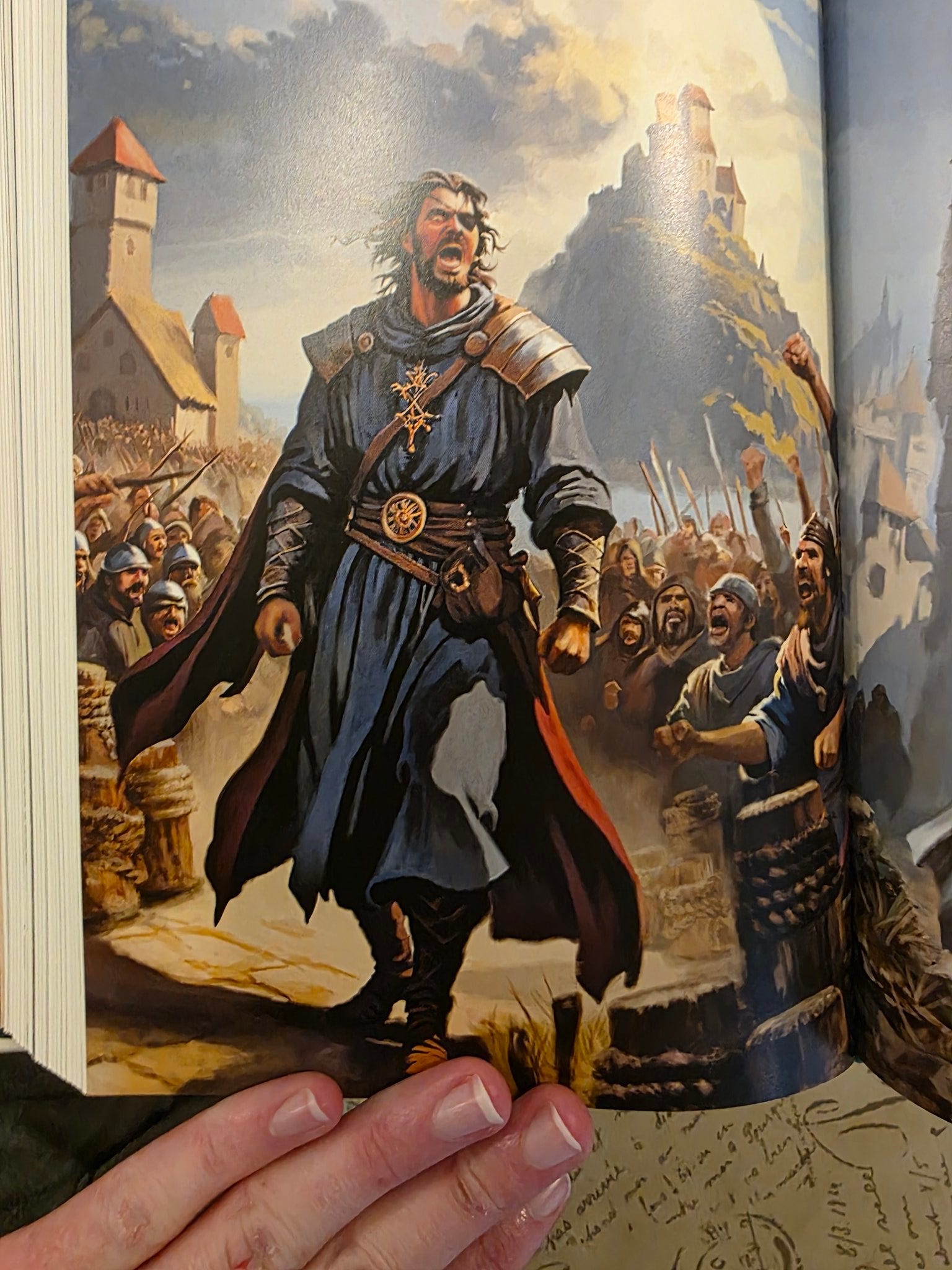
“Does that look like a crucifix on the wall to anyone, or just me and a bunch of people online pointing it out?” Greene asked. “It actually does look like it has Jesus on it, too.”
The problems compound across every illustration. Gratuitous overuse of blue coloring. Demonic “stretchmouth” faces in background characters. Random straps and buttons on clothing that serve no purpose. Chaotic lighting and shadows that don’t match any consistent light source. Stained glass windows in the throne room that look like generic cathedral windows rather than the Faith of the Seven iconography established in both the books and HBO series. “There’s no sigil or specific Ice and Fire markers of any kind in any of these images,” Greene observed. “Most of these scenes, I have no idea what scenes they are.”
The @drouseytunes thread laid out the evidence methodically. Heavy use of blue on characters where it makes no sense. Cersei, Jaime, Margaery, and Tommen all drowning in blue tones. Complete absence of House Lannister lions, banners, and heraldry that should dominate scenes at King’s Landing. Victorian Greyjoy bizarrely wielding two swords when he carries an axe and shield in the books. Most damning: the image of Lady Stoneheart looks suspiciously similar to existing fan art, and one illustration of Samwell Tarly punching Dareon includes that Christian cross in the background—an impossibility in Westeros.
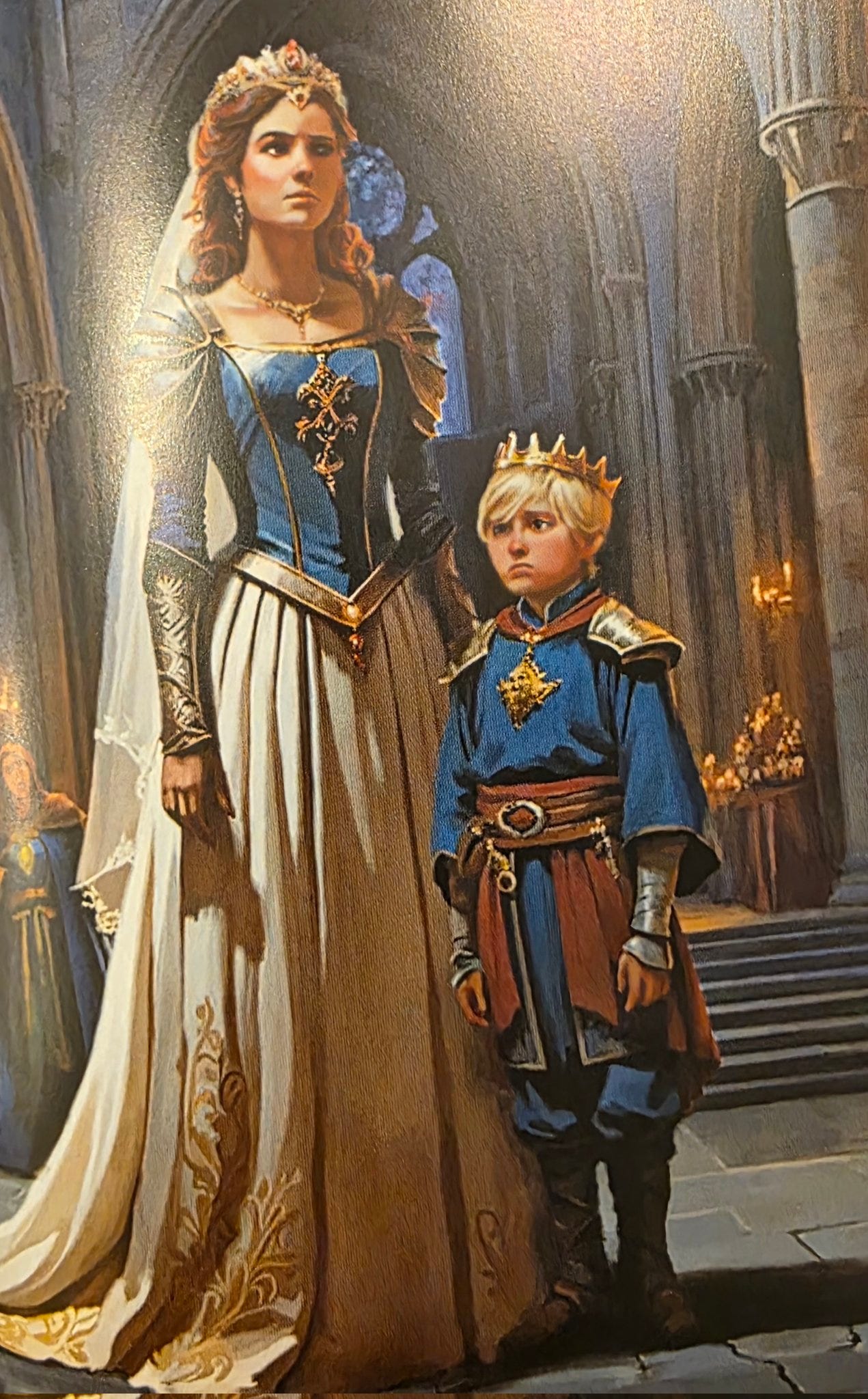
Reddit users piled on with additional analysis. The Iron Throne in one image resembles the HBO show’s version rather than Martin’s book description. As one Redditor summarized: “It’s not looking awesome.”
Penguin Random House credited the interior illustrations to Jeffrey McDonald. A search of McDonald’s previous work shows a style that doesn’t match the Feast for Crows illustrations. This raises uncomfortable questions about what happened during production. Greene speculated on possibilities: “Whether or not this is a decision the artist made or something the publisher did, that remains to be known. Potentially they tried to pay Jeffrey less and then do some kind of AI filler over base sketches. Who knows?”
The CEO of Penguin has previously balked at the idea that AI would eliminate jobs for artists. Greene was careful with his language throughout the video: “I want to make that very clear, this does look like AI art. And I will without shame if it comes out that this is not AI art, come here on my channel and apologize by name to the artist.” But he also noted: “You have to see the red flags here for AI, too, right?”
The illustrated Song of Ice and Fire editions aren’t cheap paperbacks. These are premium products marketed to collectors willing to pay extra for high-quality artwork interpreting Martin’s world. Fans have been building these collections for years, waiting for each new volume. “This is deep in a collection people have been working on,” Greene emphasized. “Putting this out like this allegedly... there’s a bigger issue beyond the bad luck.”
The deluxe book space operates on trust. Small publishers and specialty bookbinders rely on fans believing their special editions will feature vetted, high-quality artwork from real artists. If unedited AI slop becomes acceptable in premium editions, especially from major publishers like Penguin Random House, it breaks that trust completely. “If suddenly it starts getting talked about how frequently there’s just going to be AI slop shoved into special editions and as AI art gets better and gets harder to spot, well, way to break trust with the consumer,” Greene said. “This niche area that does help generate a lot of revenue for artists and creatives who like to bind and decorate these books could just go kaput.”
Greene made his position clear: “I sure as hell will not spend money on a book that has any potential to have AI in it. So now every deluxe book maker out there, I need to check to see if this is going to be a thing.”
The controversy raises another uncomfortable issue: Is Martin even paying attention to his own franchise anymore? Martin is currently involved in a lawsuit against AI companies for using his books without permission to train their models. The idea that his own publisher might be using AI art in official editions—without his knowledge or approval—would be deeply ironic. But it also fits a pattern. House of the Dragon has had quality issues. Multiple Game of Thrones spinoff projects have been announced, developed, and quietly shelved. The franchise feels directionless, throwing projects at the wall to see what sticks.
“Is George at the wheel in any way, shape, or form anymore for this franchise?” Greene asked. “What made A Song of Ice and Fire the book series special and Game of Thrones the show special is they had very specific visions. They take something that took years and years to develop and they produce a product based off of that.”
The current state of the franchise feels more like modern Star Wars. a once-boundary-breaking property now churning out content of wildly inconsistent quality. “And now we’re seeing that same degradation of quality potentially allegedly bleed into the actual books that are going to be sold to us on shelves as well,” Greene said. “And you won’t be told beforehand your orders already on its way. Good luck canceling it. That sucks. That sucks a lot.”
If Penguin Random House can get away with using imperfect AI art in a premium George R.R. Martin illustrated edition, it sets a precedent. Other publishers will follow. The message becomes clear: even prestigious fantasy properties aren’t safe from cost-cutting through AI. “If this is ignored and let to just pass and it is use of AI art and people don’t put feet to the fire here, it gives permission for so many to follow in its wake,” Greene warned. “Well, Song of Ice and Fire did it. Everyone on—Oh my god.”
Fans who ordered the book before reviews appeared are stuck. Their orders shipped before the controversy broke. The illustrated Feast for Crows shows what happens when publishers betray consumer trust, cutting corners on premium products and hoping fans won’t notice until it’s too late.
They noticed.
What do you think? Should Penguin Random House recall the illustrated edition and commission real artists to redo the work?
If you enjoy great fantasy fiction with great worldbuilding and a classic D&D feel, read The Adventures of Baron von Monocle six-book series and support Fandom Pulse!
NEXT: The Disturbing Rise of Nick Fuentes Fanfiction Reveals Dark Side of Female Reading Habits
This is fascinating. I have over 6 years of formal training as an artist. Where AI really struggles is with human anatomy. Light logic, colors, lore—all these issues could be honest mistakes by an artist working to meet a deadline or not entirely familiar with the story.
However, the image of Cersei sitting with her legs crossed, and she only has one leg, or the image of her standing over the dead knight, and her upper arm does not connect to her lower arm—these are unmistakable signs of AI.
I looked at Jeffrey McDonald's web site. He is taking credit for this art. It does match his style, but of course AI could be trained to do the same. The first question is: did he use AI and pass it off as human, deceiving the publisher? Or, was the publisher aware and okay with it?
Either way, it will be really interesting to see where this story goes. Artists have always used tools. Vermeer used a camera obscura. Dürer used a camera lucida. As soon as photography was invented in the 19th Century, artists began using it for reference. You can actually go on 'zon and buy a book of the photos Norman Rockwell used to stage his famous paintings. Personally I have no doubt whatsoever that artists—especially illustrators—are already using AI as a tool, the same way they rapidly adopted Photoshop when it first came out. Virtually all illustrative art these days is digital, and it all goes through Photoshop before you see it.
Will illustrators own up to using AI as a tool? Will the broader public care? In a day and age when an artsy-fartsy "modern" artist can tape a banana to a wall and call it art, does it even matter?
Isn't GRRM suing AI companies as we speak? What a greedy, lazy asshole.