


Craig Kristimas of Side Scrollers retired The Real Game Awards on a Friday and spent the weekend answering for it. His announcement told members their memberships would be canceled and said refund details were coming. It did not say how to get a refund. Angry feedback followed, and by the time Craig posted his follow-up, the show he had spent two years building was already over. Fandom Pulse is going to keep the idea alive.
What we are doing
Fandom Pulse will carry the awards forward under our own banner, with a vote run by our subscribers. There is no separate membership fee. Our subscriptions stay at their normal price, and they pay for the journalism we publish. The vote is an added perk on top as a thank you. Subscribers decide the winners and with them the fate of the show.
I believe in the idea. Side Scrollers’ failure in execution is why we are here.
What went wrong
The Real Game Awards launched in early 2024 under Craig Kristimas, a ScrewAttack co-founder and the host of Side Scrollers. It sold itself as a fan-voted alternative to The Game Awards, which it argued had been captured by the biggest corporations in the industry. Its own website said membership revenue would pay for the show, from venue rental to A/V to travel, and promised no corporate sponsors. Voting required a paid membership. The most expensive tier cost $1,337 a year, according to Destructoid’s report on the shutdown. A critic’s complaint in that same piece says the money went partly to an AI-generated animated intro.
Whether that spending was fair is a question for members. The structure of the show is the part we can judge. A fan-voted award with a price tag on the ballot asks the people it claims to represent to pay for the privilege of being heard, and it asks them to do it before the show has proved anything. Some will pay gladly. A lot of the audience will not, and the show never earned its way to them.
What Side Scrollers said
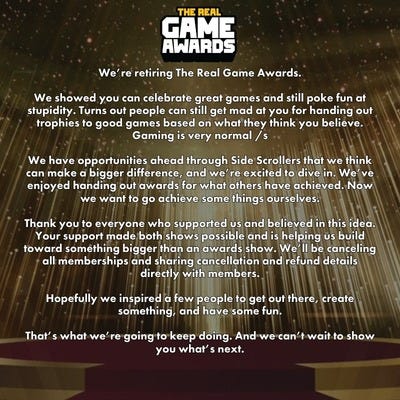
The retirement post leads with a defense:
“Turns out people can still get mad at you for handing out trophies to good games based on what they think you believe.”
The sentence recasts criticism of the show as a political reaction. The complaints that actually forced Craig back to the keyboard were about money. His own follow-up says the feedback about the missing refund instructions was “100% right.” The retirement post’s framing and Craig’s follow-up describe the same weekend in two different ways.
The post then turns to what comes next:
“We have opportunities ahead through Side Scrollers that we think can make a bigger difference.”
This is the pivot, as they’ve been increasingly pivoting away from the culture war to try for “general audiences” as it was clear they didn’t believe in anything they’ve been spouting the last few years. The awards go away and the podcast stays. For members who paid to take part in something meant to outlast one broadcast, the line says the show was a vehicle for the Side Scrollers brand. The post goes on:
“We’ve enjoyed handing out awards for what others have achieved. Now we want to go achieve some things ourselves.”
That reads as an announcement that giving awards ranks below making things, which is an odd verdict to hand to the gamers who paid to vote. The fans did not join to watch a host decide the work was beneath him.
The post also says the team will be “canceling all memberships and sharing cancellation and refund details directly with members.” It promises details later and gives none. Craig’s follow-up fixed that:
“Our announcement should have included clear instructions for getting a refund.”
He tells members to email takegamesback@gmail.com from the address they used to subscribe, and he offers a 100% refund of this year’s membership. He closed with the line “That’s on me. No excuses.” I give him credit for owning the mistake without a lawyer’s phrasing, and I think the refund route is the right call. His opening line was a profane admission of fault, which tells you he knew exactly how bad it looked. Two things keep it from being the full story. The fix came after a lot of angry feedback and not before it. And his offer covers this year’s membership, which leaves anyone who paid in earlier years to ask what they get.
Why the idea deserves a second try
The Game Awards draws its nominees from a jury of more than 150 media outlets, with a public vote layered on top. That structure is the root of the fan complaint. A show about games chosen by the press and the publishers who feed it will reward the games those two groups talk about most. An alternative that puts the ballot in the hands of the people who buy and play the games is a legitimate response. Side Scrollers saw that and built something that was almost a good version of it.
There is an easy retort, and we should meet it directly. The Game Awards in 2025 gave Clair Obscur: Expedition 33 nine trophies and Game of the Year, a game from a small studio that beat several larger productions. The critic’s argument is that the show is not the closed shop its fans claim. Our answer is that one sweep does not settle the question, and that a jury of outlets will always tilt toward the games its members cover. We would rather run the experiment than win the argument in the comments.
How it will work
We will announce categories, nomination dates and the voting rules in the coming weeks: We’re working on categories and nominees now. Subscribers vote, and the results are theirs. If you were a Real Game Awards member, take Craig’s refund offer first. Then come see what the vote looks like when it is built around the readers who show up for the reporting every day.
Can a fan vote beat a media jury without turning into a popularity contest decided by whoever organizes fastest?
Good move, Jon.
Best of luck! Next we need to take on the Hugos and drive a stake through their woke little hearts. Eventually, on to film…