


Independent science fiction and fantasy dates back to the 1970s and earlier, and few people have been involved in as many facets of it as Michael Tierney, whose Wild Stars series has spanned novels and comics long before people had access to online print-on-demand tools. He’s kept the series going for a final trilogy, which is on Kickstarter now, and just teamed with the Edgar Rice Burroughs estate to put out an official Tarzan novel. He talked with Fandom Pulse about his long-running career.
Cirsova just announced Wild Stars is entering its final trilogy, with the entire saga now written and in the can. You started this universe in 1972 in the fan pages of Eerie magazine when you were still in high school. That’s fifty-four years from first publication to sticking the landing. What does it feel like to actually get to finish a story that big?
There were times when I wondered if I’d ever see it finished. The story’s origin actually began when I was watching Neil Armstrong take that “Giant leap for mankind” on the moon, and thought about how outer space was about to become the next Wild West—hence the Wild Stars. That first story published in Eerie is actually an element from the final chapter of the grand finale. I always knew how the story would end. An employee once asked me what it would take for me to finish writing the series. My reply was “An editor who wants to publish it.” Found that with Cirsova. Editor Alex Alexander was a little worried about a possible George RR Martin scenario, where I might not finish on time. So he asked me to go ahead and write the concluding novels right away, instead of waiting on the yearly contract. So last year I delivered the final four volumes all at the same time. It felt good to have them completed. Cirsova’s reaction to the finale was very satisfying.
Wild Stars has transcended almost every medium you can name over four decades. Indie black-and-white comics through the 80s and early 2000s. The Book of Circles as a graphic novel. A tabletop RPG through Troll Lord Games. A board game. Novels through Cirsova. Serialization in Cirsova Magazine. Most creators pick a lane and stay in it. You went the opposite direction. What did each of those formats give you that the others couldn’t?
In the 1970s I wrote half a dozen books set in different time periods of the Wild Stars, but had no luck cracking the 5th Avenue publisher market. In the meantime I’d graduated High School and skipped college to develop a trade skill as a journeyman printer. By the age of 22, I was managing my own printing division of International Graphics. With an entire print shop at my disposal, I’d work after hours on different publications and portfolios—doing all the camera work and printing myself. The Wild Stars Volume 2 from 1988, I printed in my garage and used printer’s techniques to turn each copy into a unique art print by fading a mountain in the background of one page. If you’ve got a solid mountain on your copy, it’s from early in the print run. The more faded the mountain is, the later in the run. I’ve never heard of another comic created, illustrated, lettered, and printed by the same person—let alone employing an aspect to make each copy unique. Plus, that issue was the first ever use of foil stamping on a comic cover, the first ever die cutting on the front cover (cutting out a section of the cover to reveal the page beneath), and the first and only die-cut back cover. Making those comics meant using my diverse skill sets to find other ways to get my Wild Stars story to market. In 2002, I decided to collect all the comics together and had several teleconference meetings with Lightning Source about producing what would be their first graphic novel. It was awkward because digital terminology is different from physical printing. In printing, we referred to heavy black ink usage as Heavy Blacks. When I asked if they had any problems printing pages filled with Heavy Blacks, the other end of the phone went silent. Finally, my representative said, “I think he means heavy ink coverage,” which prompted a lot of embarrassed laughter.
The board game is something I’d still like to get made. Spent a whole year playtesting it and had it contracted. But then the manufacturer also wanted to do another Tarzan-based game that I’d designed, called “I am the Apeman,” where players compete to prove that they are the real Tarzan. It was licensed with ERB, Inc., but then they added the need for an insurance policy in the event that a child might choke on a play piece. That, and the rampant I.P. theft happening from the Chinese manufacturers, who had taken over the industry by that time, scared them away from board games altogether. But it would have been a fun game. They said my Wild Stars Celestial Clockwork game basically put a car engine inside a board game.
Wild Stars has always been an indie operation. You’ve been doing this the hard way for four decades and you’re about to close it out on your terms. What does running something for that long teach you that the guys who chase the big publisher check never learn?
At first, I was determined to publish everything myself. When I was circulating my novels, suddenly I’d start to see my ideas pop up in other places. But the books I never submitted stayed fresh. I was approached by one publisher who wanted to do the comics relaunch in 2002, but I didn’t think at the time that they would be bringing anything extra to the table. Then I had another project, the Edgar Rice Burroughs 100 Year Art Chronology, which was a 1200-page set of four books. I had the option to self-publish, but ERB, Inc. generously offered to help me check out the options with other publishers. At first, everyone wanted different parts of it—one wanted only the text, another wanted only the images, and another only wanted the historical aspects. They all said it was not practical to combine all those elements into one book. But I was determined that, should I fail, it would be while taking my best shot. That’s when Chenault & Gray came into the picture and said they’d print it however I made it. Did all the page layouts myself. That kind of control made the final product into something I am very proud of. But what finally sold me on working with other publishers was the advance sales that they achieved. Both the ERB Art Chronology and my follow-up Robert E. Howard Art Chronology, each racked up nearly $100K in advance sales. Once the books were in print, the publisher next learned how high the bay roofs were at the shipping locations when skid-loaded shipments on forklifts collided with them. I doubt that I could have achieved those kinds of sales as an indie publisher of my own work.
The Kickstarter is live. For the fans who have been with you since The Book of Circles and the ones just now discovering Wild Stars through Cirsova, what does this campaign deliver, and why did you decide to bundle Volume 9 with the never-before-published Volume 10 instead of spacing them out over another year?
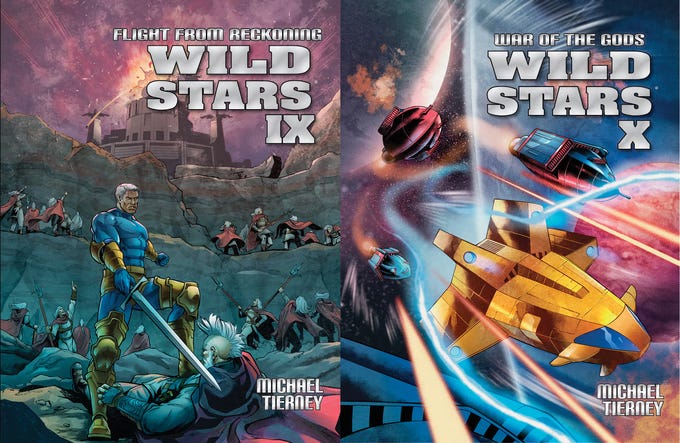
The contract with Cirsova was for me to create a new Wild Stars novel every year, to be serialized in Cirsova Magazine one year, and then collected in book form the next. Unfortunately, Cirsova Magazine is going away, so last year’s Wild Stars 9: Flight from Reckoning was the last to appear in the magazine. Wild Stars 10: War of the Gods was originally supposed to be running as a serialization right now, and since I didn’t want fans to wait a whole year without new material, when it came time to collect Wild Stars 9 into book form, I pitched the idea about doing a dual release with Wild Stars 10. As a retailer, I know how you need to keep feeding the appetites of fans.
Young Tarzan and the Mysterious She is one of the more remarkable stories in modern pulp publishing. Danton Burroughs gave you an unfinished ERB fragment years ago, Dark Horse allegedly said no because “it needed Alan Moore writing and Frank Miller drawing,” the story sat, Danton died in 2008, all institutional memory of the fragment was lost. You later pitched the 100 Year Art Chronology to Jim Sullos and only then did the Young Tarzan story come back into play. Walk us through what it was like completing a piece of writing that Edgar Rice Burroughs himself started?

I’ve had a relationship with ERB, Inc. since I was a kid back in the 1960s, and was sending them my paper route money to buy books directly. When I once again tried to buy directly from them in the 1990s for inventory to stock in my comic book stores, Danton, ERB’s grandson, called to explain how they didn’t do wholesale with retailers. We struck up a friendship, and Danton liked my Wild Stars comics so much, he suggested that I might want to take a shot at a project that no one else seemed to know what to do with. Titled “Young Tarzan Ponders” at the time, I took one look and instantly knew what to do with it. The first Tarzan novel I’d ever read was Tarzan and the Jewels of Opar, where Tarzan suffers a bout of amnesia. As he learned who he was, I was learning right along with him. But then beautiful La of Opar starts throwing herself at him, and the ape-man wanted nothing to do with her. To me, that made no sense. He didn’t even remember Jane at the time. But then, the first time he does see Jane, he charges straight into gunfire to rescue her. As a young reader, I wasn’t buying it. But with “Young Tarzan,” I had an opportunity to explain the reasoning and psychology behind his reactions. I made the story into essential canon that basically serves as a prelude to Jewels of Opar. After I turned it in, that’s when I discovered that, at that time, Dark Horse had an exclusive on the comics, and Del Rey had an exclusive on the text stories. Thomas Yates pitched a comic adaptation to Dark Horse, which drew the response you quoted earlier. So it went on the shelf, and I forgot about it until we were in final editing on the ERB Art Chronology. At first, Jim Sullos, President of ERB, Inc., kept wanting me to take a bigger percentage—thinking this was all my work. But I didn’t realize that at the time. It wasn’t until the final day of working out the contract with Cirsova that everyone understood I was working with a fragment that was forgotten after Danton’s tragic death.
You’ve now written for the Beyond the Farthest Star weekly strip, built the 1200-page 100 Year Art Chronology, and finished a Tarzan fragment. What does Burroughs mean to you as a writer, and what did you learn about your own craft by working inside his sandbox?
