


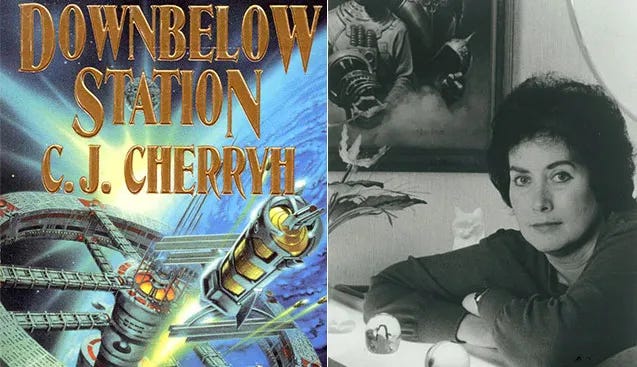
CJ Cherryh is one of science fiction’s most incredible writers, her prose pushing the limits of what’s possible with alien voice in a way no one else has been able to attain. Her carreer features an incredible pedigree beginning with the John W. Campbell Award for Best New Writer in 1977 and Hugo-winning works like Cassandra, Downbelow Station, and Cyteen. Over more than four decades, she has published more than 80 books, especially within the Alliance-Union universe an Foreigner series. For those interested in checking out her work, Fandom Pulse has a reading guide.
Recently, she announced her retirement from writing on Facebook, stating, “The ability to control narrative is just not what it was,” in a shock announcement, finally saying “the body of work is what it is.” With that body of work we wanted to celebrate her career and conducted an interview with the sci-fi legend:
You started writing when the field and the business of publishing was so different than it is now. What does the arc of that look like from the inside, and where do you think the genre stands now versus where it was when you started?
The major change in the field is a) the passing of 'foundational' writers from the scene. And the proliferation of self-published works.
The Foreigner series is 23 volumes across three decades, touches a lot on how difficult understanding between minds is. Do you think science fiction as a genre has gotten better or worse at taking that difficulty seriously and are humans in the technological age getting worse at understanding each other? Can we do anything about it if they are?

All literature has had a go at understanding the mind and the limits of accurate communication. The 'misunderstanding' comedy of Plautus, the works of Shakespeare. ---When I created Bren I explored the gulfs of understanding in language---which I couldn't (without losing the reader) do by using a foreign language---but I could explore the follies of believing we have an exact equivalency of sense or feeling. Yet---they manage peace by giving each other enough latitude and taking each others' tests.
Rider at the Gate is one of the most viscerally unsettling takes on the human-animal bond in science fiction. The Nighthorses are partners, but they’re also predators and they are not remotely safe. Where did that particular darkness come from?

The nighthorses---I grew up around horses, these immensely strong and terribly fragile creatures---and a good cowpony taught me early the workings of an alien but very sensible mind. The incident on the bridge is autobiographical---said cowpony and I nearly ended up upside down in a far-below creek---but I managed to get him to look at the situation before we went over the edge. It's a different mindset---and you have to respect it. I created in Finisterre a really good reason why humans huddle together rather closely---and indeed, it is kind of a spooky place where humans are not being as dominant as they'd like to be.
You’ve described Finisterre as a “bad real estate deal,” placing it in the same category as Pern and Darkover. Readers and critics have noted the clear Pern resonance but where McCaffrey’s dragons are fundamentally benevolent, your Nighthorses are predators that could shred a rider’s sanity. Was that a deliberate inversion of the McCaffrey template, and did you have any conversations with Anne about it?
