


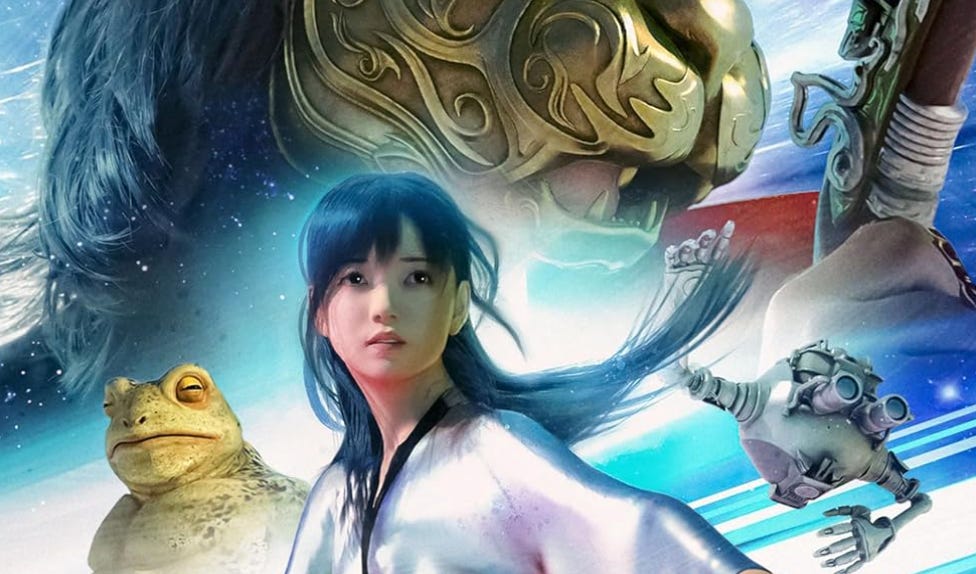
Last year, John C. Wright delighted readers by releasing the first volume of Starquest with his book Space Pirates of Andromeda. Books 2 and 3 have come out of the series; a space opera world meant to replace Star Wars as Disney’s driving the brand into a social justice oblivion.
Many consider John C. Wright to be one of the greatest science fiction writers of our time, a true grand master of the craft, as his prose and imaginative worlds present visions a cut above what many writers can ever hope to accomplish.
With Starquest, Wright is now launching a Kickstarter to cover the cost of art for the next four volumes, as well as copy editing on the books, to polish them. The books are available for pre-order, including an option to get the original four books for new readers.
How did you come at this to recapture the magic of what the original Star Wars had to offer and yet still make this your own?
My wife and kids saw a Disney sequel to Star Wars, and were severely disappointed. On the car ride home, we discussed how we would have done a film sequel to the original trilogy.
It was (in all modesty) better than what Lucas made up, and it was called DARK SUNS RISING.
As a joke, I wrote up a film review of that make-believe film for my journal, and several enthused readers asked me to write the story for real.
Also, I had seen the success of Nick Cole & Jason Anspach's GALAXY's EDGE, and sought to follow in their footsteps.
The original Star Wars was an homage to Buck Rogers, Flash Gordon, Spy Smasher and all the old cliffhanger serial based on pulp space operas. To prepare, I re-watched my favorite cliffhangers, re-read Doc EE Smith's LENSMAN series, a few Maxwell Grant THE SHADOW novels, the film based on Lee Falk's THE PHANTOM, and I was ready.
I took the same basic situation as it stood at the end of Lucas' trilogy, set in the generation after the downfall of an evil Galactic Empire, with an order of mystic space-knights revived but small in number, facing a revival of an ancient evil.
Originally, I had Napoleon Solo be the name of the spy who was the son of Han Solo, but obviously I had to change the names, and alter some background details. An alert reader can tell who is based on whom, but there is not meant to be a perfect one-for-one match.

Are your lead characters built on certain archetypes we might find familiar from Star Wars, if so, which ones?
Since the characters from STAR WARS are unabashedly taken from archetypes familiar to all readers, STARQUEST is unabashedly following the same cues.
STAR WARS has a pair of comedy relief robots, a down-to-earth mechanic and a fussy English butler; a space farmboy; a wise old wizard; a loveable rogue; a spunky princess; and a dark knight with mystic powers, who wears a Nazi helmet, a skull mask, a big black cape, and sounds like an obscene phone call.
Since STARQUEST is set in the generation after the downfall of the Empire, and stars the children of similarly archetypal protagonists. I made slight changes, and filed off the serial numbers.
My version of farmboy-turned-wizard is now the Dumbledor of the mystic space-knight academy, and he is much more rustic and cranky than the original in which he is based. The space princess in my version was the daughter of the Evil Emperor. They married, and their daughter is heir to the remnant of the Empire that exists in hiding in the frontier sector.
My version of the big furry alien sidekick, I made a supergenius engineer more akin to Hank Pym of X-men.
My version of the dashing rogue I made a Duke instead of a smuggler. The Duke was a privateer and pirate-hunter, an aristocratic son of the Dark Lord named Lord Doomshadow. He chased, wooed and wedded Lady Jade, the beautiful and deadly Queen of the Space Pirates. Their children are major characters of the series.
One is an agent of the mysterious crimefighter called Nightshadow, based on a cross between Lamont Cranston and the Scarlet Pimpernel; one is ace agent of Star Patrol based on the Gray Lensman of EE Doc Smith; the daughter is a catburglar based on a cross between the Catwoman and the Daughter of Lupin.
Other changes made include that I set the story in the far future rather than in the long, long ago, and in the nearby galaxy rather than one far, far, away: the tale is set in Andromeda, eons after the murder of Milky Way, all whose stars are collapsed into neutron suns.
As an author, I made a might vow never to invent any wonders of astronomy to wow the reader, since the real wonders of real astronomy were more wonderful than anything I could invent. The map and oddities of Andromeda, and twin supermassive black holes orbiting the galactic core, the Seyfert satellite galaxy, the warp, the captured globular cluster from primordial cosmic collisions – all this is real.
One evil Emperor was insufficient for a twelve-volume space epic, so I have Four Dark Overlords who are named Lord Pestilence, Lord Famine, Lord War, and Lord Death, who serve the emperor as Scientist-General, Chancellor of Economic, Commander in Chief of the Legions, and the Grand Inquisitor. The Dark Overlords control the science, economics, warfare and politically correct thought-conformity.

What do you think of thematically when you have a protagonist? Are you actively attempting to paint a picture of what is good and what is heroic?
Heroism portrays virtue correctly understood. Villainy is vice. Virtues include courage, justice, temperance, prudence. Naturally, in an adventure story courage, raw physical courage, is exemplified above all others, but in an adventure story starring a woman, spiritual courage is portrayed. It is ugly when women fight.
The main heroine is a princess named Lyra Centauri, whose home planet is wiped out by the Empire when she was a child, and she lives as a pickpocket and street urchin in the filthy allies of a second world, raised by her father's sole surviving servant, his robotic chauffer. As a teen, she is found and brought to the Academy of the Order of the Golden Will, where boys receive training as mystic squires to the space Templars, and girls are novices to the Shrine Maidens and exorcists.
Frankly, I was weary of knights being dames, or female psychics being fighting-men, so my mystic Temple Maiden carries a bow and arrow, not a sword, and it is used to banish evil psychic manifestation, force-ghosts and curses and so on. This girl is a novice in Holy Orders.
The second part of portraying virtue is showing either corruption of a noble man going bad (if one is writing a tragedy) or a bad man tempted by goodness to reform himself (if one is writing a comedy). This is an area where Disney was particularly inept, neither able to show what tempts good men to the darkness, nor to show the misery of the darkness, its empty pomps and false promises.
In particular, I thought Disney betrayed the promise of having a stormtrooper turn defector and then do nothing with him. Here, the legionnaire of the Galactic Inquisition responsible for the death of the heroines father and mother later defects. The Inquisition hunts down anyone with psychic powers or sensitivity to Kirlian auras.
So when a clone trooper callsign "Flint" (clones have no names) discovers he has such sensitivity and powers, the Dark Overlords of the Empire take an interest him, as does the Grandmaster of the Templars, an order of mystic knights who maintain peace and order throughout the galaxy.

How does your Catholic faith play a part of your writing? Does this sci-fi world point toward Christ?
My Catholic faith is part of my personality and inspiration, and would show up in my work whether I inserted it deliberately or not. In this particular case, I wanted my knights to be an order of knighthood, Western knights, not space samurai. I have the Arcadian Order serving the Golden Will of the Stars. The stars are regarded to be the mansions of angelic beings created by an unnamed Star-maker, and who guide human destiny on an upward path. Their opponents form the Draconian Order which serves the Dark Will.
The whole flavor and theme of the Dark is much more Lovecraftian and pulpish, and not Taoist nor New-Age. The Golden Order is much more obviously based on a Western religious hierarchy, with sacerdotes and rites, psalms and rituals, with a Pontifex Maximus, than the vaguely Taoist practices of the Jedi.
Because I know some readers have an allergic reaction to Christian things, I took the trouble to cast all symbols in astrological themes, or to dress my nuns like Shinto priestesses, hoping to slip past the watchful dragons of the reason and find their unguarded imaginations. There is, of course, the danger that Christians will be offended by the pagan outer garments, but one always hopes true hearted readers will see to the heart of the matter, and not be deceived by outward shows.
5. You’ve come up in the publishing world through traditional publishing, even having a series through Tor Books and moved to independent. What’s the differences from what you’ve seen and could the traditional publishing world entice you back?
