


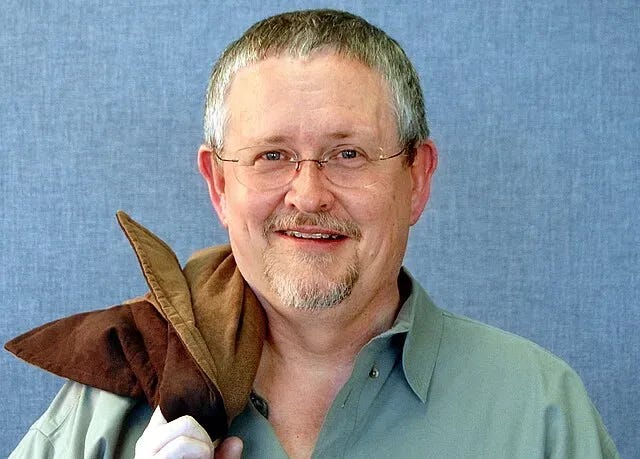
Orson Scott Card is one of science fiction’s greatest living writers. He’s best known for Ender’s Game, but all of his work has depth and writing on levels that few writers in any genre ever can attain. He’s been working on a lot of different projects in his life, and now he’s finally finishing up a historical fantasy series called The Tatles of Alvin Maker that the first book was published back in 1987.
He sat down with Fandom Pulse to talk his incredible career:
Alvin Maker is American mythology at its deepest, a reimagining of the frontier as sacred ground. What drew you to that particular canvas, and why do you think fantasy rarely goes there?
I think you’re being a bit more mystical about my fiction than I am myself. I don’t believe the Alvin Maker books treat America as “sacred ground” within the story — both good and awful things are done on that ground. As a Latter-day Saint, I believe that the whole of the Americas are a chosen land, where free people thrive and tyrants lose the “mandate of heaven.” But I’ve never knowingly put that idea in any of my books except the story “America” in the book Folk of the Fringe.

I chose to write an American frontier fantasy in reaction to the fact that American fantasists seemed to be trapped in Tolkien’s shadow. Robert E. Howard pointed the way toward fantasy that did not have that European feel or use those European tropes. But Americans fell in line behind Tolkien, so that even a magnificent opus like George RR Martin’s A Song of Ice and Fire has a decidedly Feudal European culture, in the main. Brandon Sanderson’s Way of Kings and Words of Radiance are set in the pre-gunpowder world of kings and knights, though his magic systems are quite creative and fresh. And I’m grateful for every writer who NEVER writes a zombie or a vampire into their fiction. I have such a shuddering aversion to those tropes, though I don’t disparage those who are fans of such tales. There’s room for all of us. I’m just not in the audience for those story elements.
Master Alvin completes a journey that started in 1987 with Seventh Son. What does it feel like to finally close that story, and what did you discover about Alvin in this final volume that surprised you?

The Alvin Maker books were more fun to write than any others in my career, because I could indulge my knowledge of and love for the many faces of American history and culture. Since I try never to write the same book twice, I took Alvin to places, in this final book, where Joseph Smith never went: Ireland, most particularly. I had so much fun writing those sections of the book.
Because I had already written Saints, which explored Brother Joseph’s city on the banks of the Mississippi, Nauvoo, I didn’t try to tell that same story again about the Crystal City that Alvin founded. We saw it start in Crystal City, and skipped to the end in Master Alvin. If you want to know more about the real history of Nauvoo, my novel Saints is still there to be read.
The Alvin Maker series is more explicitly tied to American spiritual and folk tradition than almost anything else in fantasy. Do you think today’s readership is equipped to receive that material, or has something been lost in how we read myth?
What’s been lost is a knowledge of our own history. I remember my wife’s and my amusement and shock when we got a fan letter early in the Alvin Maker sequence, in which a reader said how much she loved the way I was dealing with American history, but then added, “And I never knew that George Washington had been beheaded.” What? She thought that bit of alternate history was true? Hadn’t she studied American history in high school? How can an alternate fantasy history of America resonate properly with readers who don’t know real American history in the first place?
Your book Characters and Viewpoint remains required reading decades later. How has your own understanding of character changed since you wrote it?

I think the techniques laid out in Characters and Viewpoint remain true and useful. I’m sad to see some of the nonsense that has begun to pervade the teaching of writing in the universities. Present tense narrative is NOT part of the American tradition. Past tense is the way we tell the truth. Idiotic nonrules of grammar have perverted our language. Yes you CAN and sometimes MUST end sentences with words that are often used as prepositions. To merrily split infinitives is one of the treasured traditions in English; poor Latin couldn’t split their infinitives. But that’s no reason to deprive ourselves of such a useful device. I sometimes think that my seventh grade teacher, Mrs. Johnson, was the last American teacher giving students a grounding in grammar and structure. I did love diagramming sentences.
Ender’s Game has become one of the defining works of 20th century science fiction. At what point did you realize the book had taken on a life entirely outside your control, and how do you not let that dominate your creativity?

Early in the life of the novel Ender’s Game, I was at an event in Utah Valley, when a librarian from a local Junior High School confided to me, “Ender’s Game is our ‘most-lost book.’” I thought: If young readers can’t bear to part with the book, it must be touching something deep in their souls.
I’m happy with the number of people who tell me that Ender’s Game was important in their youth. There are also people who feel that way about Ender’s Shadow and Speaker for the Dead. If I knew what worked so well in those books, I’d do it every time. Instead, I do as I’ve always done: I tell a story I care about and believe in as clearly as I can, and then hope that readers will find value in it.
Prolific authors often say their best work gets buried under their most famous title. Do you have a book or series you wish more readers would find, something you feel hasn’t gotten the attention it deserves?
I don’t resent the popularity or success of Ender’s Game, I’m grateful that any of my books has won readers’ hearts. Yes, I think I’ve written better books; Yes, I’m proud of all my stories. And some few people have told me, over the years, that their favorite of my books is one of the less well-known ones. I’m glad to know that those lesser-known novels or stories worked for somebody; may their tribe increase <grin>
Your Mormon faith runs through so much of your work, from the moral frameworks in Ender's Game to the theological underpinnings of the Alvin Maker series. How consciously do you construct that religious architecture, and when does it arrive on its own?
