


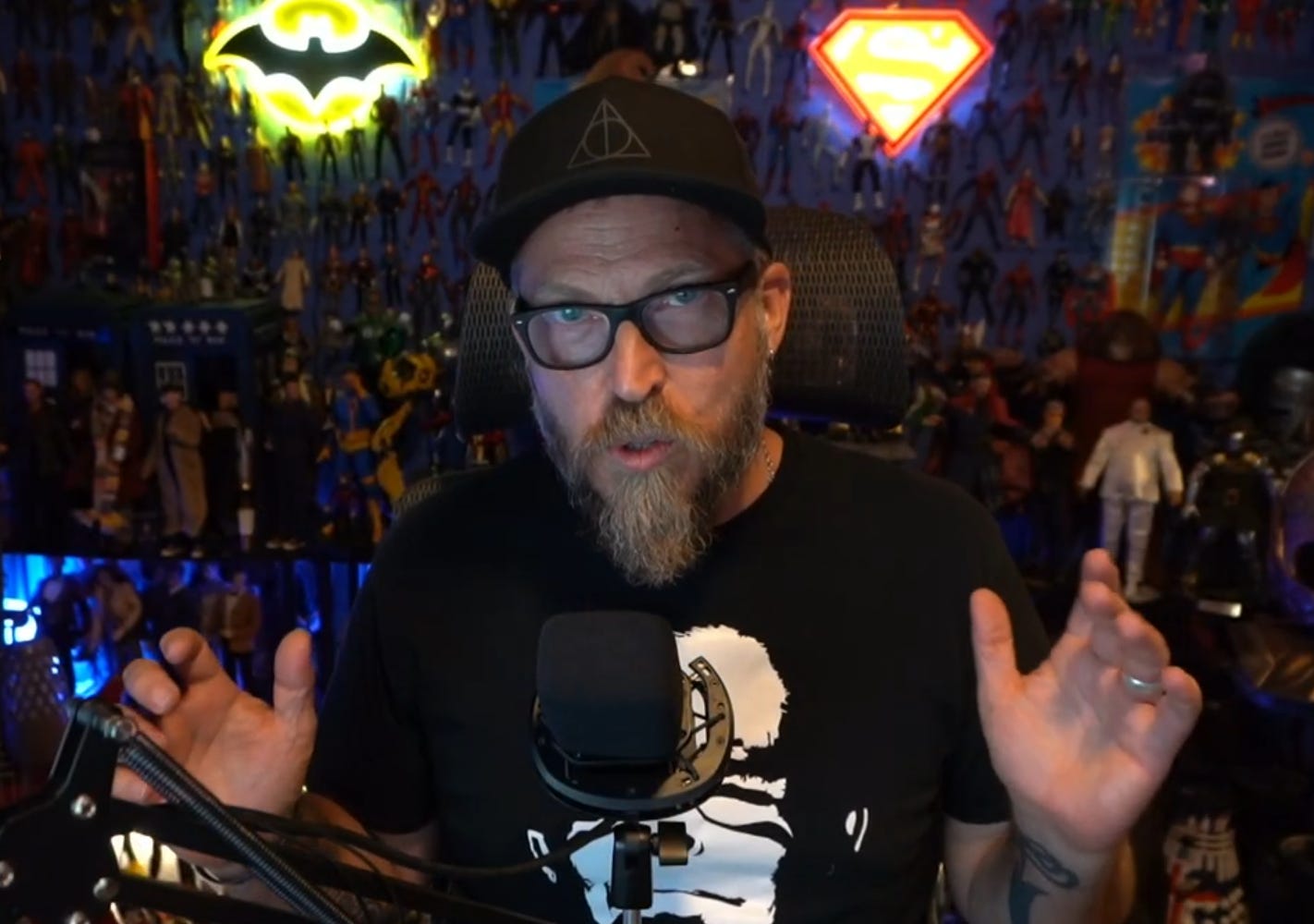
Gary Buechler is the host of the Nerdrotic YouTube channel where he provides commentary and criticism on pop culture films and TV shows including Star Wars, Marvel, DC, Doctor Who, and more.
He recently wrote a memoir, Waiting for Nerdrotic: From Prison to YouTube, about his history that not only includes how he built up his successful YouTube channel, but also how he hit rock bottom after becoming addicted to drugs and eventually arrested and imprisoned. Buechler spoke to Fandom Pulse about the memoir and what he has in store for readers as well as dove into what his thoughts are on the current state of entertainment at the beginning of President Donald Trump’s second term in office.
Fandom Pulse: You’ve written a memoir, Waiting for Nerdrotic: From Prison to YouTube, can you tell me about it?
Gary Buechler: This goes back prior to YouTube. I had been approached by small publishers, but publishers and people who were interested in getting my story out there. I’ve shared it a lot at Speaker Meetings. Like a lot. So this was kind of in my head even before the YouTube thing started. We even thought about doing a graphic novel at one point. Then I just kind of forgot about it. Not really forgot about, just gave up on it because I am not a writer, obviously. And I had a lot of help writing this book. Then Chris Gore and I were talking about a recovery story on the Nerdrotic Nooner and afterwards he’s like, ‘I know a publisher who is independent who can help you out that I think would like your story because that publisher is in recovery as well.’ And that’s what really was the hook for me, was having a publisher who was independent, and gave me better rates, and also who would understand that this is a recovery story and not just some gobbledy gook [about] how I became a YouTuber because honestly I can’t answer that question right now.
It’s basically my [Alcoholics Anonymous] share, which is you share your experience, strength, and hope, what it used to be like, what happened, what I am like now. And it’s not really supposed to be a war story. It’s warts and all. A very troubled past and overcoming quite a few obstacles and most of them self-inflicted. And hopefully be kind of a story of inspiration, not that I’m some inspirational thing, but just to show that a schmuck, an idiot like me can pull himself out of homelessness, drug addiction, despair, anybody can. And there’s lots of paths to do that.
FP: You’ve gone on a number of different shows and podcasts and talked about your history on your own channel in the past, will there be any big surprises for people who have been following you for years?
Gary: I’m such an oversharer anyway. Yes, I think there will be some surprises, some rather big ones especially from my past. I go into what I was arrested for. We got into a little more detail about what the prison experience was like. I do have past abuse although I have shared that on podcasts before. I don’t know how many people have actually heard it or seen it. I think the biggest surprise will be how an idiot drug addict like me survived ‘cause it surprises me everyday.
FP: How detailed do you get?
Gary: Well, we changed everybody’s name to protect the innocent and the guilty. I do discuss my abuse, but we don’t really get into what exactly happened, but we heavily infer that. The most detail I get into is basically being in the thralls of my addiction: what drugs I was doing, how they made me feel, what shenanigans I got up to when I was high. And we get into the detail of my crimes, the arrest, and I think most importantly we get into the details how this affected my loved ones, my relationships, my family. Again, to not try to glorify any of this. This is supposed to be warts and all. And just paint an honest picture of a life.
Honestly, the book, like anybody’s life, could have been thousands of pages so we had to cut out some stuff, but it’s all there. It’s all there for people to see. It’s nothing I’m ashamed of at all as far as like the abuse is concerned. It’s just an honest telling of my life. It’s also not shirking any responsibility. The whole point of the book is every action I made no matter how much I was abused or how high I was, was my responsibility.
We also get into the details of recovery and spirituality and basically how important that is to lead a fulfilled life. Being a religious man yourself, I’m sure you understand that. And that was something that was sorely missing in my life and that’s helped keep me sober to this day.
FP: The trailer includes a number of photos from your past, will these be included in the memoir as well? What’s your favorite one?
Gary: They are not. It’s just something that came down in the printing. What will be included is some original illustrations including one by the great Kelley Jones.

FP: What do you hope readers take away from the memoir?
Gary: This might sound strange, but I have no expectations on what people are going to take away. Maybe they’ll have a few laughs at my expense, which is totally okay. Or maybe they’ll have a better understanding of recovery.
I guess that I would hope that any reader would take away the same thing that any recovering alcoholic or addict would take away from [an Alcoholics Anonymous] meeting. And you don’t have to be an alcoholic or addict. I mean it’s affected everybody through family or friends. Just to show that no matter how bad things can get there is always hope, life does get better through sobriety. It’s partial mindset, but for me mostly it was spiritual. It’s finding a higher power. And finding that meaning in life and setting realistic expectations and learning to live in the now. And the one key that finally hit me in recovery after I relapsed is really understanding, and believing, and practicing gratitude.
FP: You’ve discussed in the past never having the desire to write a fictional story, what inspired you to write a memoir?
Gary: I’ve had stories in the past in my head, I’ve just never had the ability to write them. What inspired me to write the memoir was paying it forward, was gratitude. Alcoholics Anonymous and my higher power have given me so much, given me a third, fourth, and fifth chance at life. So hopefully, again, writing this story will maybe get somebody to a meeting or at least show someone that recovery really does work. It is a lot of work and you have to put the time into it. The same amount of time and effort that I put into addiction and it really worked for me. And if it can work for me it can work for somebody else.
FP: Has writing this memoir changed your mind on whether you might write a fictional story whether that be a novel or a comic or something in some other medium?
Gary: It has. And well, you might be seeing something in the next year or two.

FP: You’re marketing and selling this book through Eric July’s RippaSend, why did you choose it over something more traditional or even a crowdfund campaign through Kickstarter?
Gary: Good question. Well, we still have a traditional publisher. So that is still going to happen. The publisher was very understanding. We decided to do just a presale. And the reason I chose RippaSend is Eric’s a friend and they also do fulfillment, which is the most difficult part of the process. This one’s different. I wanted to make sure the book was all done. It took us two years to write it and get it ready. And I wanted to make sure it was complete before it went through the presale process and all that’s left to do is the printing, which should be starting soon. Nothing against Kickstarter or IndieGoGo, Eric’s a friend.
FP: Since Donald Trump was elected President for the second time there’s a lot of talk about woke is dead, but Marvel just sex-swapped Silver Surfer and are doing the same to Iron Fist in an animated Wakanda series, do you think woke is dead? Or what’s your general thoughts on the state of woke entertainment today?
