


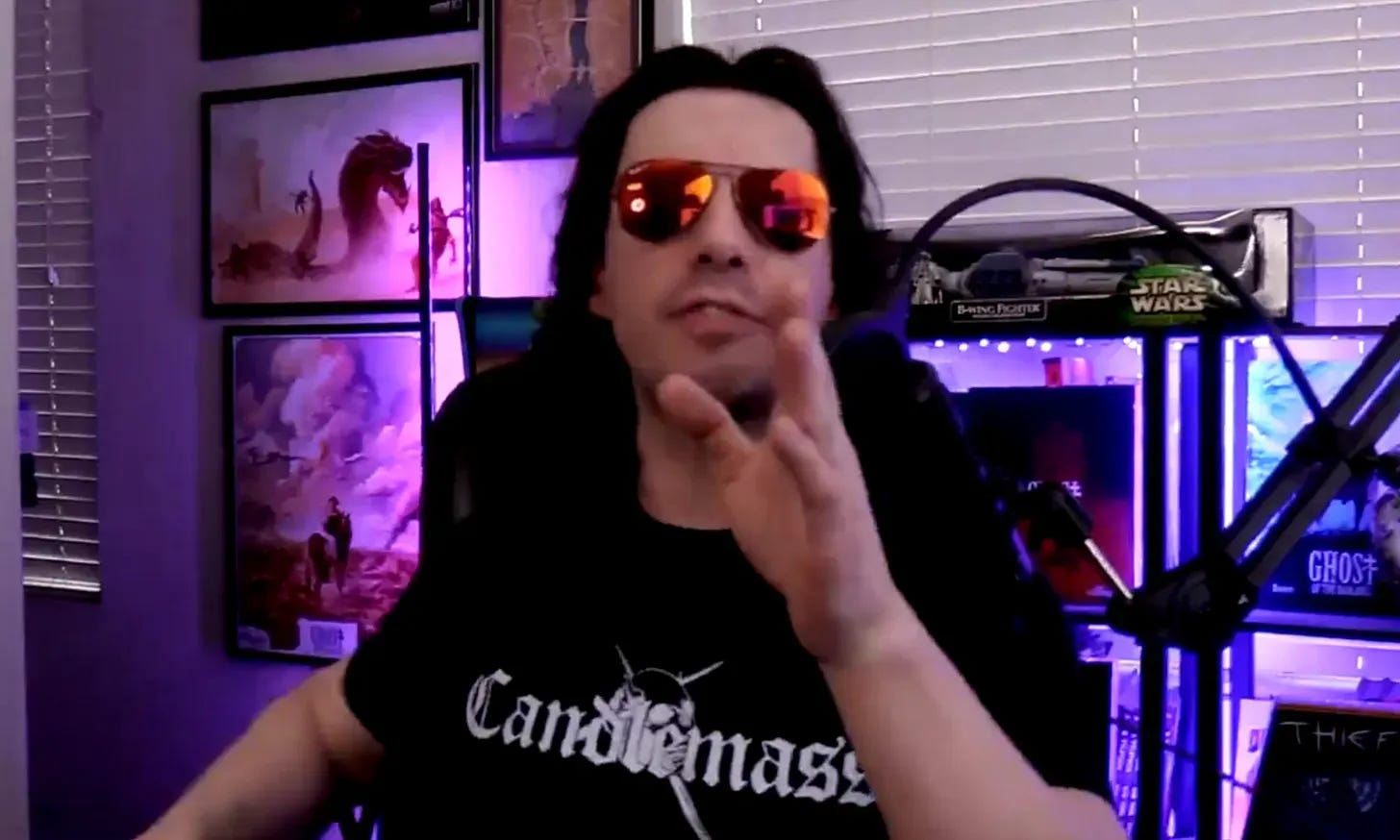
RazorFist is a rare talent in the cultural commentator space. He has much deeper philosophical takes and interests than your average YouTuber, and it can be seen both in the topics he chooses to rant about and in his work, in which he has delved into novels and comics to express his artistry. His first graphic novel, The Ghost of the Badlands, was met with acclaim from fandom, and now the sequel is crowdfunding on IndieCrowdFund, which is looking to be even better than the first. We sat down with RazorFist to catch up and talk about comics:
You’ve been a vocal critic of mainstream entertainment. Is the problem the creators, the corporate gatekeepers, or the audience that keeps buying products based on corporate IPs indiscriminately?
It’s a failure trifecta.
1) Creators emanate from what are, in effect, covens of coastal insularity. Even those who are not avowed propagandists advancing an agenda all attend the same colleges. Are ‘educated’ by the same professors. Attend the same parties and rut with the same sexual partners. They may never see a single MAGA hat outside of a television their entire lives. They truly do not know how anyone in a ‘flyover state’ thinks, nor have they incentive to do so.
2) The fans, whether from ignorance or habit, keep going back to the same failing franchises for a second and third turn at ‘revival’.
3) The corporate structure is almost the least pernicious of the three: These corpos were, in most cases, in fiscal freefall long before they assumed a ‘woke’ sociopolitical posture. They see vanishing profit margins, ascendant alternatives, and in the case of comics, waited entirely too long to transition to digital. So they’re taking the “free” ESG money, and the Faustian checklist items attendant to it.
The internet has taken up the cry of “Get woke, go broke”, but it’s an incomplete formulation: My, slightly fuller, exposition is “Go broke, get woke, ultimately croak.” And, from BioWare to DoubleFine, we see daily reenactments of this truism.
Do you see the independent, creator-owned scene as a true alternative to Marvel and DC, or as a separate market that will always be smaller? Is there any way to get people to wake up and move over?
Marvel and DC have slowly sunk to the status of an IP piggy bank, which their parent entities plunder for movie and video game material periodically (less frequently these days, as the superhero film trend has plummeted earthward). Independent creators should not aspire to be the decayed husk DC and Marvel have been relegated to. We should be building something else entirely; something more akin to a culture, with comics almost as an adjunct. New franchises or comic series are less key to the prosperity of the same than is the creation of an independent media environment where they can be reviewed, discussed, discarded, or championed. The underground has been festooned with new projects since time immemorial. That’s nothing new.
It’s the mouthpieces to let passionate people become fans of such - that separate the stellar stuff from the trash - that we need. A modern, digital variant of that killer ‘Zine culture - somewhat elitist, but oriented around the honest interests of its adherents - led to the ‘80s black-and-white comics explosion, and seems to precede every such creative revolution.
You’ve talked a lot about European comics and lesser-known pulp works (as far as modern public zeitgeist), what drew you to these and why is it so difficult for American readers to catch on to them?
Whereas Manga was imported to America, rather ingeniously, as an exotic item; something uncensored and slightly verboten, the European books were treated as ‘just another western comic’. Quietly dropped onto the same store shelves as Spider-Man and Superman with little fanfare to recommend them.
It’s a shame; Europe publishes the best comics in the world, and it isn’t particularly close. And many of their biggest titles - from Asterix to the Smurfs - would be franchises that almost anyone would recognize. But to the extent they’re marketed at all, the ‘exotic’ quality is generally downplayed or ignored entirely.
Pulp is a different thing. It suffuses most American entertainment, especially in comics. You can’t read a Batman comic or watch a vigilante film without detecting its influence. So it’s almost like a dead comedian whose jokes every modern comic steals - making it more alive than ever, in an ironic sort of way.
Last fall there was doubt about whether Ghost of the Badlands would get a sequel. What changed, and how did book 2 come together?
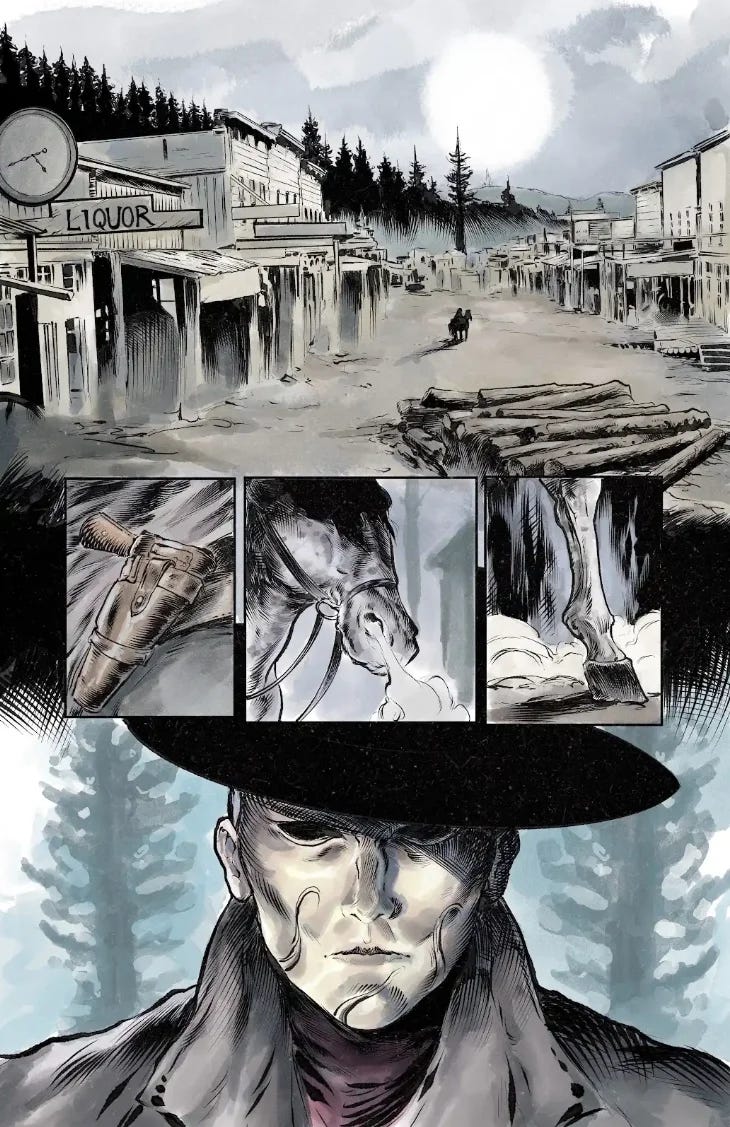
I was supremely satisfied with the first volume, and the subject matter inspired me to such a degree that I had a second, even longer, volume written before the first volume was even published. If the first dealt with corruption among Whites in a frontier town, this second would ask the question “What if the Natives needed to suffer a reckoning of their own?” Like the first story, it came together quickly and fluidly.
Thus, when the previous artist decided to move on to other projects, I found myself in an enviable position: I had created a completely encapsulated narrative in volume 1. I therefore had the luxury of waiting to find the proper collaborator, or simply leaving it alone, if I so wished. I flirted with the idea of drawing it myself - even drafting a few sample pages - and had a couple possible collaborators drift in and out of contact, but nothing fully materialized, as I busied myself with other things.
Then a very gifted artist, Ryan Gutierrez, reached out to me privately and explained he’d wanted to work on the book ever since he read Volume 1: Brimstone. He, too, was creatively engaged by Gothic Westerns, having recently published one called ‘Blackmarrow’, and better still, he was also a Christian. Once I saw a few samples of his work, I knew this was a draftsman of singular talent, who absolutely measured up to the high standards set by his predecessor. Once you read it, I think you’ll all agree.
Ghost is getting a high-end leather-bound edition that very few comics have ever seen anything similar to this quality. How does it feel to have your work in such a prestige format?
This, too, is part of the Bandes Dessinées influence: In France and Belgium, it isn’t out of the ordinary to release and re-release oversized, black-and-white, or even leatherbound editions of comics, and the massive market over there absolutely gobbles it up. Particularly for more detailed, pre-Raphaelite-style renderings like this, the oversized format really makes the cinematic images pop. The plan is to distinguish the leatherbound editions still further by making them monochrome ‘artist editions’, and I think when you get your hands on it, you’ll agree Ryan’s artwork has been well served by the format.
The Ghost is a mute, masked avenger, so the story has to carry its meaning through images and action instead of dialogue. What made you choose that, and what does it let you say that a talking hero wouldn’t?
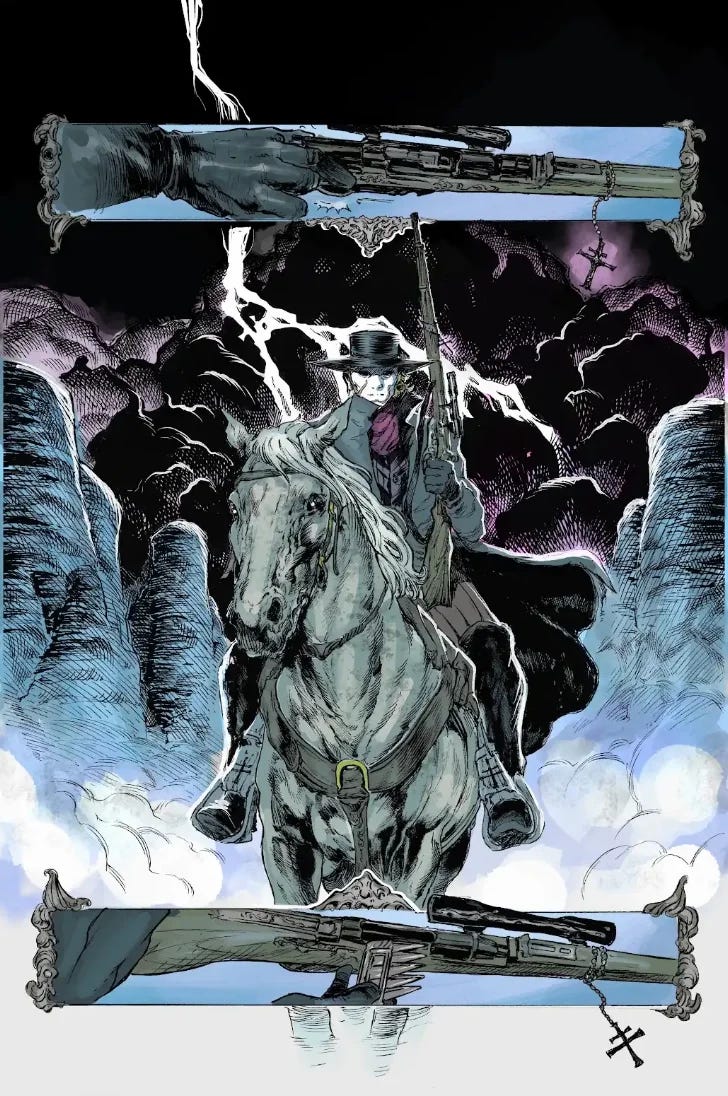
He is both mute and loquacious. He says a lot. But they’re never his words. (Unless he is writing)
This being a Western, I wanted to play with the formula:
Instead of a grizzled tough guy, we have a rather wiry-framed figure in a dapper suit and a puff tie.
Instead of a laconic bounty hunter, I wanted him to be quite chatty, but not with his own verbiage: As the Gothic Western has always been steeped in biblical allegory and imagery, the Bible verses the Ghost quotes suggested themselves almost immediately.
Ghost of the Badlands was a study in narrative chiaroscuro: I wanted to see how little I could explain, or have my character say, or even how few scenes I could put him in... and have the reader finish the thought out of pure anticipation. And it turns out the answer is “Quite a lot”!
Which pulp writers and characters shaped the Ghost most?
