


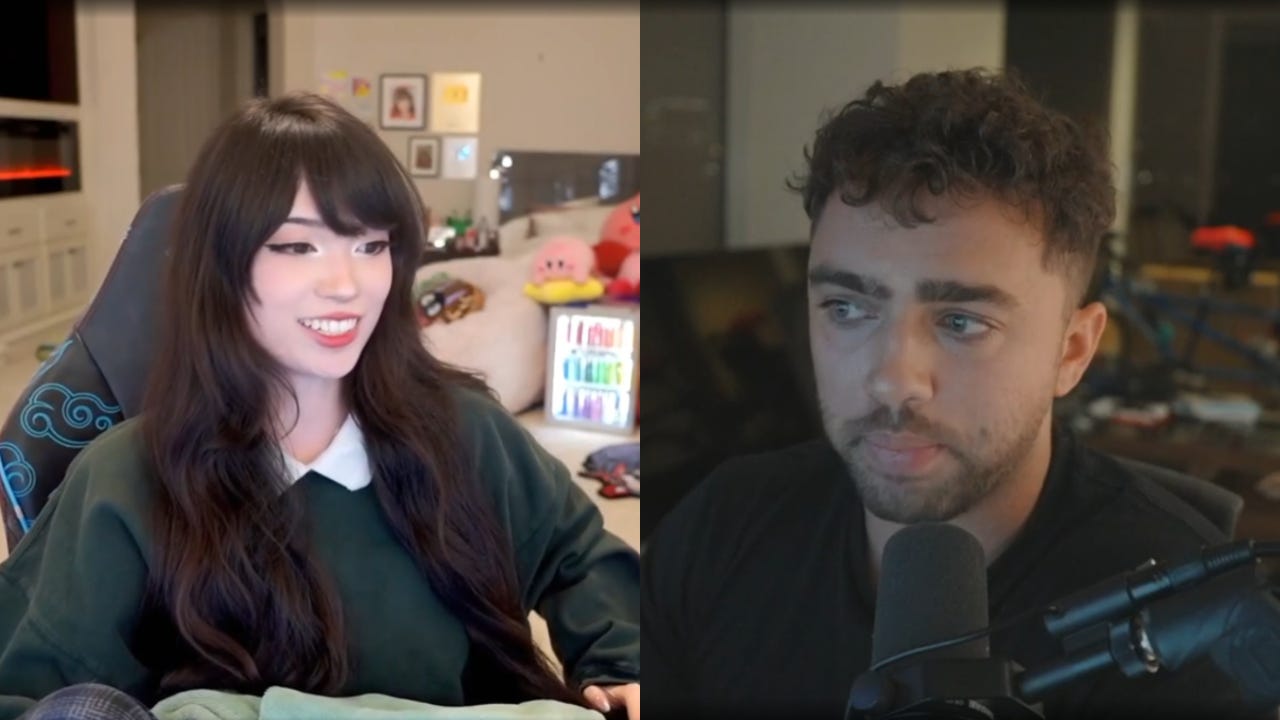
On October 25, Twitch streamer Emiru (Emily Schunk) publicly accused fellow creator Mizkif (Matthew Rinaudo) of sexual assault, psychological abuse, stalking, and threats of blackmail. The allegations were delivered during a livestream and have not, at the time of writing, been accompanied by any formal legal complaint or police report.
The next day, October 26, Mizkif posted his own statement on Twitch, addressing the allegations, describing their relationship as “deeply toxic and emotionally damaging for both of us,” and acknowledging that arguments between them sometimes escalated to aggressive behavior. However, he denied any criminal wrongdoing and emphasized that the emotional volatility was mutual. He further claimed that threats of self-harm were exchanged during their time together and suggested that both parties contributed to the dysfunction. He also shared personal anecdotes, including one in which Emiru allegedly told him she wanted to have children with him within five years, a detail he used to underscore the complexity of their relationship and to challenge the framing of him as a unilateral abuser.
While some viewers have expressed support for Emiru’s decision to speak out, others question if proper procedural steps are being followed including Emiru’s use of a public platform to disclose such a serious claim. The absence of institutional involvement has prompted renewed debate about how justice is pursued in the age of social media. Past streamer dramas involving Mizkif, like the 2022 CrazySlick case, relied on online claims without immediate law enforcement involvement. This is known as “trial by interface” where allegations are broadcast to wide audiences before being vetted by legal systems. Moreover, the platforms can amplify these claims regardless of their evidentiary foundation.
Prudently, one should ask if either party went to the police before making statements on social media. Granted, some critics may argue there is an ongoing collapse in institutional trust and that when victims believe the legal system will not protect them, they must turn to the only tool left: their audience. The problem with this is that audiences are emotionally invested, often tribal, and frequently influenced by parasocial relationships and platform dynamics. Additionally, the accusations and responses may also be strategically timed or selectively framed for their audiences, revealing the objective is not legal resolution but reputational damage.
And, lest anyone think someone is “blaming the victim” here, the question is only begged because the motives behind these disclosures are not always transparent. Additionally, there is always more than one side to every story.
The 2022 defamation trial between Johnny Depp and Amber Heard serves as a prominent example. Heard’s public essay in The Washington Post became the centerpiece of a legal battle that scrutinized not only the claims she had made but of the method and medium of her disclosure. The case highlighted how reputational harm can be pursued outside traditional legal frameworks and how public narratives often precede or even replace institutional adjudication. Similar dynamics have emerged in other high-profile disputes, where social media becomes the venue for accusation, defense, and judgment. These cases underscore the need for due process and a distinction between justice pursued through legal systems and justice is all based on public perception.
The timing of Emiru’s disclosure is also worth mentioning because, just days earlier, she was assaulted by an attendee during a TwitchCon meet-and-greet. This incident was captured on video and widely shared online. The TwitchCon assault may have served as a catalyst or springboard for Emiru to lodge more serious allegations against Mizkif with public sympathy generated by the earlier incident creating conditions in which Emiru felt safer or more supported in coming forward.
Veteran streamer Asmongold, a longtime peer of Mizkif, has also publicly supported Emiru and hinted that he had prior knowledge of the situation. In a YouTube clip, he stated, “I think people are going to be shocked by what comes out. I’ve known some of this for a while.” His comments have raised questions about why such information was not disclosed earlier.
As the situation continues to unfold, it raises difficult questions about the nature of justice in digital spaces. Is public disclosure a form of accountability, or a substitute for it? Are creators obligated to speak out earlier, or are they justified in waiting until conditions feel safe? And what role should platforms play in mediating these conflicts?

As a self-appointed judge in the Court of Public Opinion, I hereby rule *caveant fornicatores*, "let fornicators beware". You might as well ask me to rule between a John and a pimp over compensation in proportion to how good the sex was.
For those who just jumped to the comment section before reading the article, let me sum it up and save you some time: Cluster B THOT doing Cluster B nonsense.