


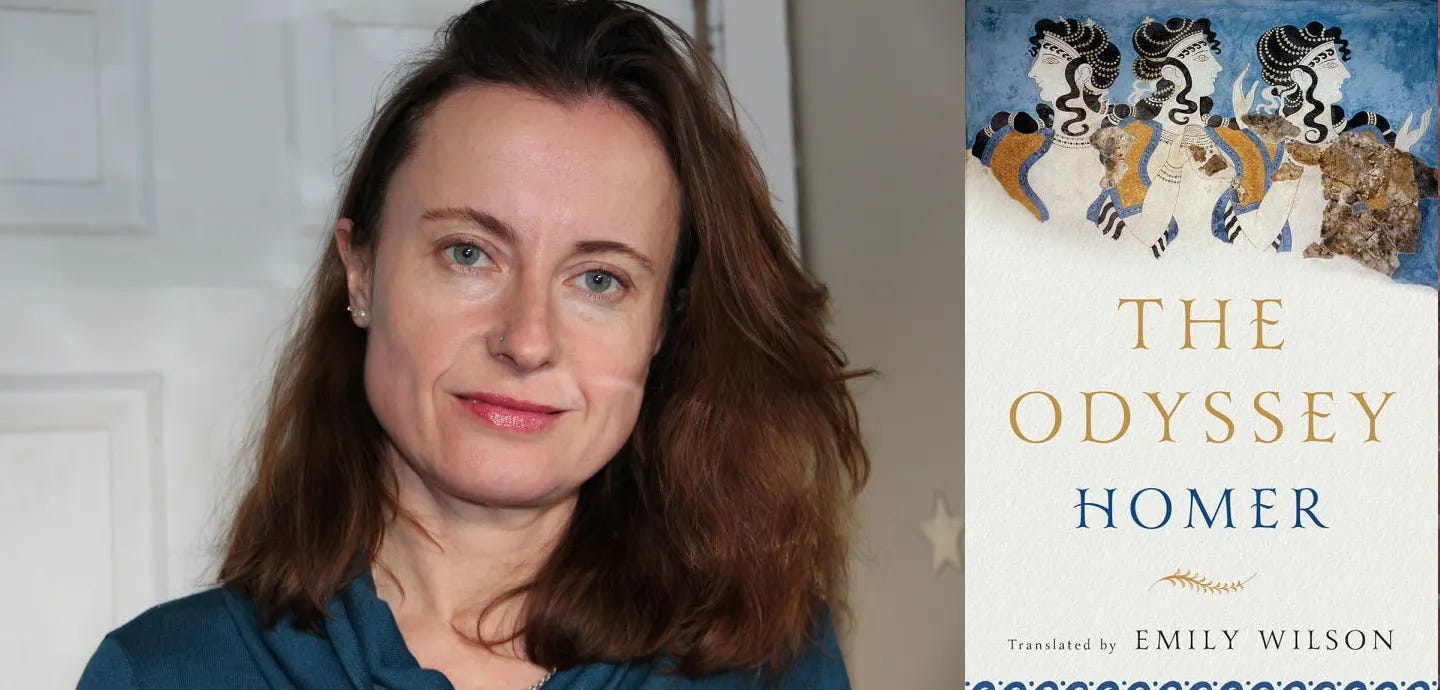
Christopher Nolan built his entire Odyssey around Emily Wilson’s 2017 translation, crediting her famous opening line, “Tell me about a complicated man,” as one of his biggest points of inspiration going into the project. Wilson has now seen the finished film. Her review, a 4,000-word essay published this week in the London Review of Books under the title “An Uncomplicated Man,” is one of the harshest takedowns Nolan has received in his entire career, and it comes from the one scholar whose own work he explicitly built this movie on top of.
Wilson opens with something close to a compliment before the knife goes in. “I was humbled to learn that Nolan has read at least the first line of my translation,” she writes. “But I would be ashamed to have written any part of this script.” That single sentence has already become the pull quote defining coverage of the piece, and it earns that status. It’s not a critic taking a shot from a distance. It’s the translator whose language Nolan quoted in press interviews telling him, in print, that she wants no association with what he built from it.
She spends the next several thousand words explaining exactly why. Wilson describes the overall experience of watching the film as “family-friendly audiovisual spectacle, like an elaborate Fourth of July fireworks display, and with about the same level of narrative and emotional depth.” She connects it to a pattern she sees across Nolan’s career: “As in his previous films, Nolan is interested in the discontinuities of space and time, in magic, tricks, craft, technology, rivalry, substitution, masks, miscommunication, what we remember and what we choose to forget.” That’s not dismissive on its face, but the verdict that follows is blunt: “It lacks psychological, emotional, political and ethical depth. Its narrative structure is gimmicky. The writing is abysmal. None of the characters has convincing motivation for their actions or words. There are no sex scenes, and all the food looks horrible.”
She goes performer by performer. Matt Damon’s Odysseus, the character whose “cleverness” and “wiliness” Nolan repeatedly cited as the reason he wanted to adapt this story in the first place, gets called “lummoxy,” “neither a master storyteller nor a flirt.” Odysseus and Anne Hathaway’s Penelope have, in Wilson’s words, “neither chemistry nor a deep connection.” Tom Holland’s Telemachus reads as a man “20 going on 12.” Even the film’s animal work draws a jab: “My eyes stayed dry, even for Argos the dog, whose adorableness as a puppy is predictably amped up to suit our animal-loving times. If only the human characters had been treated with such serious attention.”
The gods get some of her sharpest analysis. Wilson writes that “even Zendaya’s underwritten Athena turns out to be a vulnerable victim of war, or perhaps a projection of Odysseus’ conscience, not a scheming and bloodthirsty war goddess,” and that the rest of the pantheon barely registers at all: “Other goddesses appear in cameo, Calypso, the seal-lady Sirens, Circe, Scylla and Charybdis, but there is no sign that we are supposed to realise they are goddesses. Poseidon, Hermes and Helius do not appear in person, although there are some scary storms and shipwrecks.” She singles out one line for a particularly dry aside: “One of my favourite moments was when Zendaya assures Damon that gods are not hard for mortals to understand: ‘Who doesn’t understand thunder? Fire?’” That sarcasm sets up her larger structural complaint: “But the film wants to have it both ways. There are no gods, and yet shipwrecks and death are presented as the inevitable consequence of blinding the son of Poseidon and devouring the Cattle of the Sun. Zeus’ law is portrayed as being crucially important, and yet there is no Zeus.” That’s Wilson identifying the exact contradiction at the center of Nolan’s script: a film that wants the moral weight of a universe governed by divine law while refusing to actually put gods in it.
Lupita Nyong’o doesn’t escape either, despite months of press interviews in which she argued Nolan’s film gave women more space than Homer did. Wilson’s read is the opposite: “Nyong’o’s double part as Helen and Clytemnestra is hugely underwritten; she is given only a few minutes of screen time to perform a set of brief tableaux of female victims.” A film whose own cast spent its press tour insisting it corrected the poem’s treatment of women is, in the view of the scholar whose translation supposedly informed that correction, still shortchanging them.
The most serious charge in the entire essay has nothing to do with pacing or character work. Wilson writes: “The most troubling ethical problem with Nolan’s Odyssey concerns the decision to film part of the movie in the occupied territory of Western Sahara, thus normalising the ongoing violence against the indigenous Sahrawi people. It is particularly galling that Nolan used this land simply as a visually striking backdrop for a film that centres, aggrandises and redeems the hero of a territorial war on account of his belated and partial acknowledgment of his own guilt.” That’s not a complaint about tone or characterization. That’s an accusation that the production’s actual filming location replicates the exact dynamic of conquest and displacement the story is supposedly wrestling with.
Wilson closes the essay by pulling back from all of it, crediting the film for something bigger than its own execution: “Despite all this, the release of The Odyssey is still an event to celebrate. In what we are told is the streaming era, this epic is bringing audiences back to cinemas... Nolan, who studied English at University College London, where students still study The Odyssey as a first-year ‘foundational text,’ is doing his best to get the general public reading again, and I am grateful.” That’s a generous landing for an essay that spent 4,000 words methodically dismantling almost everything else about the film.
Here’s where Fandom Pulse parts ways with Wilson, and it’s worth saying plainly: her own translation took real liberties with Homer’s actual text in the name of a modern, explicitly feminist reading of the poem, softening and reshaping choices specifically to fit that framework. She’s not a neutral custodian of some untouched original standing in judgment of a director who defiled it. She’s a translator who reworked Homer in her own image, reviewing a director who reworked her reworking in his. The difference is one of degree, not of kind, and her essay would carry more weight if it grappled with that instead of writing as though she’s the last honest voice defending a text she’d already reshaped herself.
That said, degree matters, and the degree here is not small. Wilson at least kept the poem’s actual events, characters, and outcomes intact while shifting tone and emphasis. Nolan cut the entire ending Homer wrote, invented scenes with no basis anywhere in the text, renamed the poem’s central moral concept outright, and confirmed in a separate interview this week that he excluded material specifically because he judged it “misogynistic.” Wilson bent the frame. Nolan replaced the picture entirely. When the scholar whose own modernized translation Nolan cited as inspiration says, at 4,000 words of length, that she’d be ashamed to have her name on the result, that’s not a small thing to wave off, even from someone who took her own liberties with the same 2,700-year-old poem first.
First contact with the Oridians was supposed to be humanity’s proudest moment. Instead, their chief engineer is dead, their ship is sabotaged, and an ancient alien technology is stealing souls. Book one of the Valiant Frontiers series delivers exploration, mystery, and the kind of crew you’ll want to follow across the galaxy. Read The Soul Catcher on Amazon and start the adventure.
NEXT: Brandon Sanderson Calls Out J.K. Rowling’s Fantasy Snobbery: With a Terry Pratchett Assist
The hold on this turd of a movie is insane. It's up over 600 million after its second weekend.
Shameful.
It feels like an Avatar movie or Jurassic World where you wonder who in the heck is actually buying these tickets?
I want to accuse it of fraud, money laundering, fake ticket sales, astro-turfing, the works. But sadly, I think the movie going public really is this stupid and will line up squealing at the trough as more slop is poured in.
I’d be ashamed to have written it” was perfectly constructed to exploit authority transfer, consciously or otherwise. It isn’t an argument that readers can inspect. It’s a verdict whose entire force depends upon the identity of the person delivering it. Remove her name and it’s an obnoxious sentence. Attach “Emily Wilson, acclaimed translator of The Odyssey,” and thousands of people can borrow the prestige without doing any thinking themselves.