


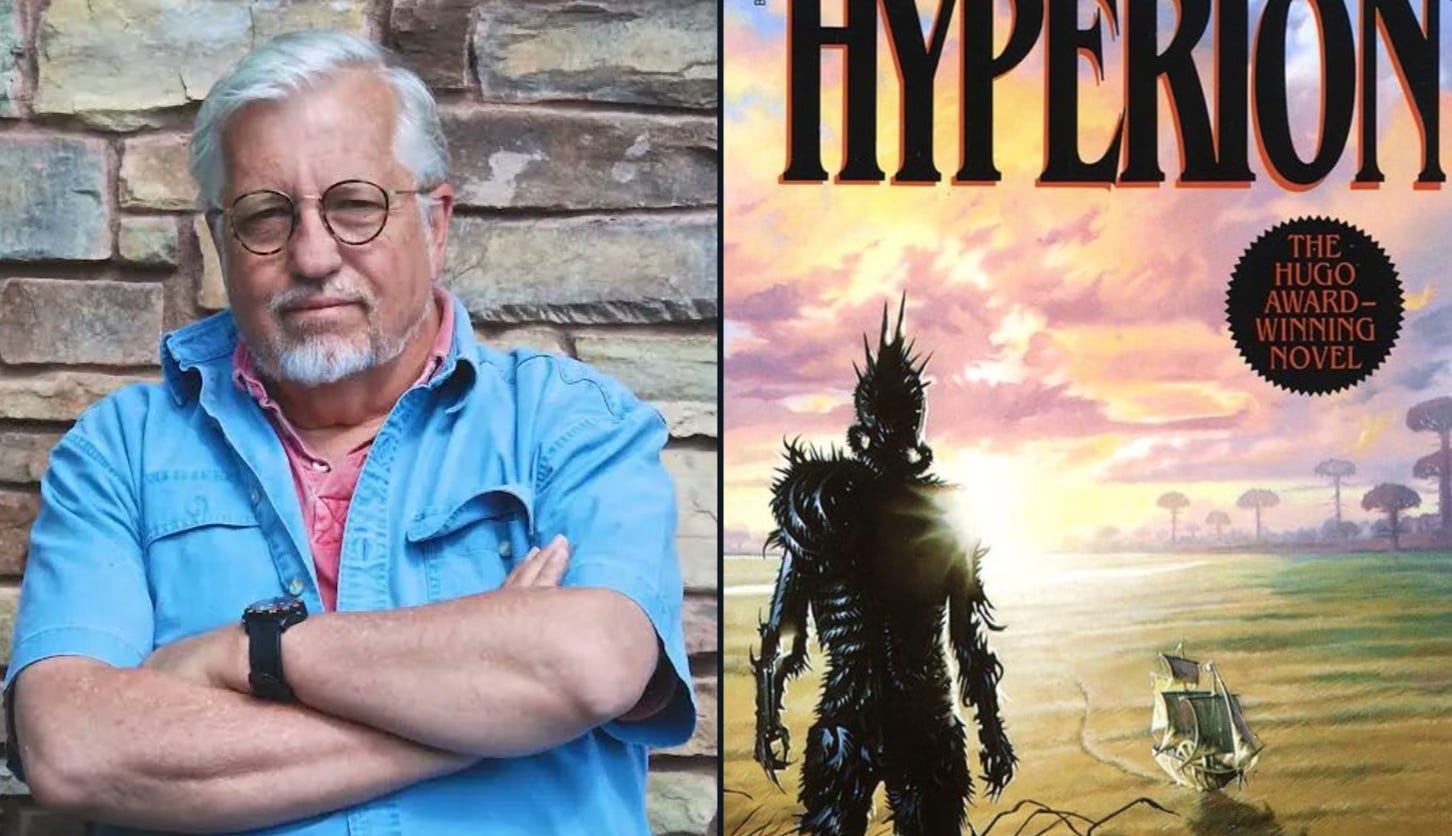
Dan Simmons, the author of more than three dozen books including the acclaimed Hyperion Cantos, died on February 21, 2026, from complications of a stroke. He was 77 years old.
Simmons died in Longmont, Colorado, with his wife Karen and daughter Jane at his side, according to his obituary. He is also survived by his grandchildren, Milo and Lucia Glenn, and his brother, Wayne.
His death marks the loss of one of science fiction’s most versatile and accomplished writers—a man who won every major award in the genre, crossed boundaries between science fiction and horror with ease, and created what many consider one of the greatest science fiction novels ever written.
The Hyperion Achievement

Hyperion, published in 1989, is Simmons’ masterwork. Structured after Chaucer’s Canterbury Tales, the novel follows seven pilgrims traveling to the Time Tombs on the planet Hyperion, where they may encounter the legendary and terrifying Shrike. Each pilgrim tells their story in a different subgenre, creating a mosaic narrative that showcases Simmons’ range as a writer.
The novel won the Hugo Award for Best Novel in 1990. Its sequel, The Fall of Hyperion (1990), won the Locus Award and the British Science Fiction Association Award. The series continued with Endymion (1996) and The Rise of Endymion (1997), completing a four-book cycle that explored themes of religion, artificial intelligence, time, and the nature of consciousness.
Hyperion stands alongside Dune, Ender’s Game, and Neuromancer as one of science fiction’s literary peaks as a work that transcends genre conventions to achieve something genuinely profound. Its influence on subsequent science fiction is immeasurable, and it remains a touchstone for readers seeking intellectually ambitious, emotionally resonant storytelling.
A Career of Range and Excellence
Simmons didn’t limit himself to science fiction. His 1985 debut novel, Song of Kali, won the World Fantasy Award. The book, inspired by three days Simmons spent in Kolkata, India, is a horror novel about a poet who travels to the city and encounters an ancient cult. It’s brutal, disturbing, and announced Simmons as a writer willing to go to dark places.

Carrion Comfort (1989), a massive horror novel about psychic vampires who can control human minds, won the Bram Stoker Award. The Terror (2007), a fictionalized account of the lost Franklin Expedition to the Arctic, became a bestseller and was adapted into an acclaimed AMC limited series in 2018.
Simmons also wrote historical fiction (Drood, The Fifth Heart), hard science fiction (Ilium and Olympos, which reimagine Homer’s Iliad in a far-future setting), and detective novels. His work defied easy categorization. He was a genre writer who refused to be confined by genre.
Simmons wrote 31 novels and short story collections over his career. His books have been published in 28 countries and translated into at least 20 languages. Before becoming a full-time writer, he spent 18 years as an elementary school teacher in Missouri, New York, and Colorado, where he co-created a districtwide program for gifted students and was named a finalist for Colorado Teacher of the Year.
The Cancellation and Retreat
In recent years, Simmons became increasingly reclusive. His later novels took on more explicitly conservative political themes, and his public statements, particularly regarding climate change and Islam, drew criticism from the leftist science fiction establishment.
His 2009 short story “The Time Traveler” depicted a dystopian future where Islamic extremism had conquered Europe. The story was controversial, with critics accusing Simmons of Islamophobia. His blog posts and public statements on climate change skepticism further alienated him from a genre community that had become increasingly progressive.
The backlash was real. Simmons was disinvited from conventions. His work was excluded from award consideration by voters who disagreed with his politics. The same establishment that had celebrated Hyperion and The Terror now treated him as persona non grata.
What Made Him Special
Simmons was a writer of extraordinary range. He could write hard science fiction with rigorous attention to physics and technology. He could write horror that genuinely disturbed. He could write historical fiction that felt researched and authentic. And he could combine all of these modes within a single work.
Hyperion is science fiction, but it’s also horror (the Shrike sequences), literary fiction (the structure and prose), and philosophical inquiry (the questions about faith, time, and consciousness). The Terror is historical fiction, but it’s also horror and survival thriller. Simmons didn’t respect genre boundaries because he didn’t need to. He was skilled enough to work in multiple modes simultaneously.
His prose was elegant without being precious. He could write action sequences that were clear and propulsive. He could write character moments that were emotionally resonant. He could write ideas that were intellectually challenging without becoming didactic. This combination of skills is rare.
He was also willing to take risks. Hyperion is structured in a way that could have failed spectacularly. It’s seven separate novellas, each in a different style, with no resolution at the end of the first book. Ilium and Olympos reimagine Greek mythology in a far-future setting with quantum mechanics and post-human evolution. Drood is narrated by Wilkie Collins and suggests that Charles Dickens may have been a murderer. These are not safe choices. They’re the work of a writer confident enough in his abilities to attempt things that might not work.
Dan Simmons was one of the finest writers science fiction has produced. His death is a loss for the genre and for literature. His work remains.
What do you think? Does an author’s political views affect how you engage with their work, or should the art be judged separately from the artist?
Hyperion blew my mind, and it's strange that I don't think about it from time to time, twenty years later. I didn't know about the cancellation, and it broke my heart. Rest in peace. Now he lives on in his books.
Man, I loved The Terror (the book, not the subpar series). RIP sir. You won't be replaced anytime soon.