


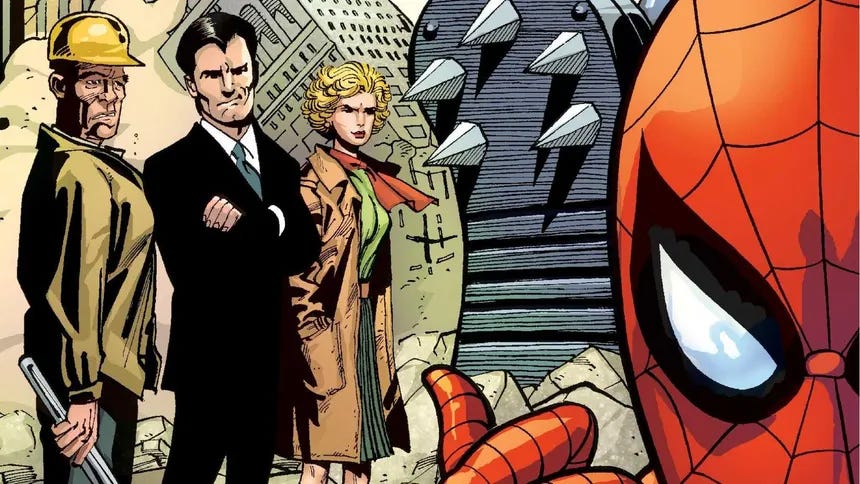
Damage Control is the main villain of Spider-Man: Brand New Day, and the reveal has a lot of readers scratching their heads, as it’s a very niche group of characters many viewers aren’t aware of. For most of the movie runtime, Sadie Sink’s mystery telepath looks like the threat. She hijacks Bruce Banner’s mind and forces his first Hulk transformation in years. She possesses MJ and lets Peter believe she remembers their relationship, only for the truth to gut him later in the film. By the third act, audiences learn Sink is playing Jean Grey, and that her rampage through the city traces back to one target: the Department of Damage Control.
Jean isn’t hunting Damage Control for its tech or its files. She’s looking for her sister. Bill Metzger, played by Tramell Tillman, runs the agency, and he has spent the film abducting powered individuals to harvest their abilities for Damage Control’s arsenal. He kidnapped and tortured Jean’s sister Sara in pursuit of that goal, a program that gets her killed. Metzger spends the movie posing as an ally to Spider-Man while his scientists quietly build weapons designed to take Peter down if the partnership ever sours. He escapes at the end of the film, positioned as a recurring threat tied to the franchise’s coming anti-mutant storylines. Damage Control shows up earlier in the film too: a stolen tank crashes into one of its buildings, which is how Spider-Man first crosses paths with Metzger and starts asking questions about a mysterious program called “V-Max.”
For anyone who grew up on the comic book version of Damage Control, watching it get cast as a covert human-experimentation program is a considerable tonal reversal. The organization did not start as a menace. It started as a joke, and the distance between that joke and the Brand New Day black site says something about how far Marvel Studios has been willing to stretch a forty-year-old punchline.
An Insurance Sitcom Born In The Marvel Universe
Dwayne McDuffie and artist Ernie Colón created Damage Control for a five-page story in Marvel Age Annual #4 in 1988, inked by Jon D’Agostino. The pitch asked a question nobody else in the industry had bothered with: who cleans up after the Avengers fight Ultron in the middle of Manhattan? McDuffie followed the debut with a seven-page serialized story in the anthology title Marvel Comics Presents #19 in early 1989, and the concept earned its own ongoing life with Damage Control Vol. 1 #1-4 that same year, still written by McDuffie with Colón on art. That first miniseries followed the company’s founding cast, adjusters and account executives billing supervillains for property damage, and folded in a tie-in to the demonic “Inferno” crossover then running through the rest of the Marvel line.
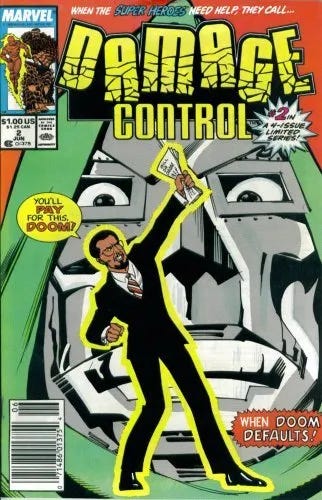
McDuffie was a comics historian as much as a comics writer, and he used the book to settle old scores with continuity he disliked. In the second issue, comptroller Albert Cleary visits Doctor Doom over an unpaid invoice, a direct answer to the infamous “Where’s my money, honey?” Luke Cage story from the 1970s where Doom had stiffed Cage on a bill. McDuffie revealed it was an embezzling underling, not Doom himself, who had skipped the payment.
The humor came from ordinary employees like Robin Chapel and John Porter treating cosmic destruction as a Tuesday afternoon accounting problem, and it stayed that way through Damage Control Vol. 2 #1-4, published December 1989 through February 1990 as a tie-in to the company-wide “Acts of Vengeance” crossover. This is where the company’s ownership structure became a plot in its own right.
The Stark And Fisk Ownership Fight
Founder Anne Marie Hoag sold Damage Control to Tony Stark and Wilson Fisk in the first volume, splitting the company fifty-fifty between two men who had no business being business partners. Stark’s discomfort with Fisk proved justified fast. During “Acts of Vengeance,” a group of supervillains conspired to swap targets so heroes would face unfamiliar enemies, and Fisk had helped organize the whole operation, knowing full well that the resulting citywide destruction would land as a repair contract for a company he still partly owned. Stark eventually sold his stake rather than keep doing business with the Kingpin, and Fisk later engineered a scheme to buy the company back at a discount once Hoag stepped away to take a government job and handed the reins to Robin Chapel.
McDuffie closed the loop with a third miniseries, Damage Control Vol. 3 #1-4 in 1991, credited on the trades as “Damage Control: The Movie,” this time drawn by Kyle Baker. Guest stars ranged from Spider-Man and the Silver Surfer to the Hulk, and the plot had the company fending off accusations that it was manufacturing disasters on purpose to keep the repair contracts flowing, a satire of media cynicism aimed squarely at the company’s own workers rather than its executives.
Major Appearances In The Comics
Marvel Age Annual #4 (1988). The character debut, written by McDuffie, art by Colón and D’Agostino.
Marvel Comics Presents #19 (1989). A seven-page serialized follow-up establishing the company ahead of its first ongoing miniseries.
Damage Control Vol. 1 #1-4 (1989). McDuffie and Colón’s founding miniseries. Introduces Hoag, Chapel, Porter, and Cleary, and ties into the “Inferno” event.
Damage Control Vol. 2 #1-4 (1989-1990). The “Acts of Vengeance” tie-in that introduces the Stark/Fisk ownership fight and reveals Fisk’s scheme to profit from a crossover he helped orchestrate.
Damage Control Vol. 3 #1-4 (1991). McDuffie and Kyle Baker close out the original trilogy with “Damage Control: The Movie,” featuring She-Hulk, Captain America, and Nick Fury alongside accusations that the company manufactures the disasters it profits from cleaning up.
Wolverine (2003) #42. Wolverine investigates Nitro’s attack on the New Warriors that triggers “Civil War” and uncovers a scheme running through Damage Control’s resources.
Civil War: Front Line #1-11 (2006). Reporters Ben Urich and Sally Floyd cover the Superhuman Registration Act fallout that eventually turns Damage Control intern Robert Baldwin into Penance.
Irredeemable Ant-Man #9 (2007). Reveals that Eric O’Grady, then operating as Ant-Man, moonlighted for Damage Control under the alias Slaying Mantis.
WWH Aftersmash: Damage Control #1-3 (2008). McDuffie’s fourth and final run on the property, with art by Salva Espin. Damage Control lands the contract to rebuild Manhattan after “World War Hulk,” complete with a rampaging, newly sentient Chrysler Building and a new Goliath joining the Search and Rescue team.
Civil War II: Choosing Sides #1 (2016). Damage Control tries to rehabilitate its public image in the aftermath of the second “Civil War” event.
Damage Control (2022) #1-5. A revival written by The Goldbergs creator Adam F. Goldberg with Hans Rodionoff, backup stories by Charlotte Fullerton, art by Will Robson and Jay Fosgitt. The main story follows new hire Gus navigating a staff that regularly crosses paths with Moon Knight, She-Hulk, Nightcrawler, Quicksilver, and Ghost Rider, while the Fullerton/Fosgitt backup covers the company’s cleanup after the original Infinity Gauntlet storyline.
From Punchline To Federal Apparatus
That register, a grounded, working-class outfit navigating a universe of demigods, mostly played for laughs, held for over three decades of sporadic comics appearances. The MCU broke from it almost immediately. Spider-Man: Homecoming introduced Damage Control in 2017 as a Stark-owned operation that displaces Adrian Toomes’s independent salvage business, the inciting insult that pushes him toward becoming the Vulture. Where the comics split ownership between Stark and Fisk for satirical tension, the film simplified it to Stark alone.
The agency’s role kept expanding after that. It reappears briefly in Spider-Man: No Way Home in 2021. The Disney+ series Ms. Marvel in 2022 casts Damage Control agent Sadie Deever as a proactive antagonist who raids a New Jersey high school hunting Kamala Khan, using Stark-sourced sonic weapons and racially profiling the students she searches, before getting relieved of duty for exceeding her authority. She-Hulk: Attorney at Law, also in 2022, gives the organization its own supermax prison holding Emil Blonsky’s Abomination. Secret Invasion in 2023 has Skrulls infiltrating a Damage Control facility to steal the severed arm of the Black Order’s Cull Obsidian. By the time Brand New Day puts Bill Metzger at the head of a black site running experiments on telepaths, the MCU has walked Damage Control from insurance clerks joking about Doctor Doom’s unpaid bills to a government body running covert human trials on mutants, with rumors already circulating that it becomes the franchise’s central anti-mutant agency once the X-Men era gets underway.
That is a wide gap to cross for an organization McDuffie built as a workplace comedy, and it raises the obvious question for anyone tracking where the franchise goes next: does turning the punchline into a surveillance state say more about where Marvel Studios wants the X-Men era to go, or about how far the MCU has drifted from the grounded, human-scale premise McDuffie and Colón put on the page in 1988?
Disney loves the CIA. Pizzagate involved kids and drugs outta cuba. CIA and DISNEY are bedfellows.
I appreciate this! I remember reading DAMAGE CONTROL limited series in the late 1980s/early 1990s and then simply forgot about it. Then I see they migrated into this dark federal agency in the MCU upon watching SPIDER-MAN: BRAND NEW DAY and wondering, "What did I miss?" Thanks for filling in all of the blank spots. Also - I never knew who Dwayne McDuffie was. It turns outs he was an extremely gifted storyteller and a very creative man who never made it past his 50th birthday. This is an excellent overview. You have my gratitude.