


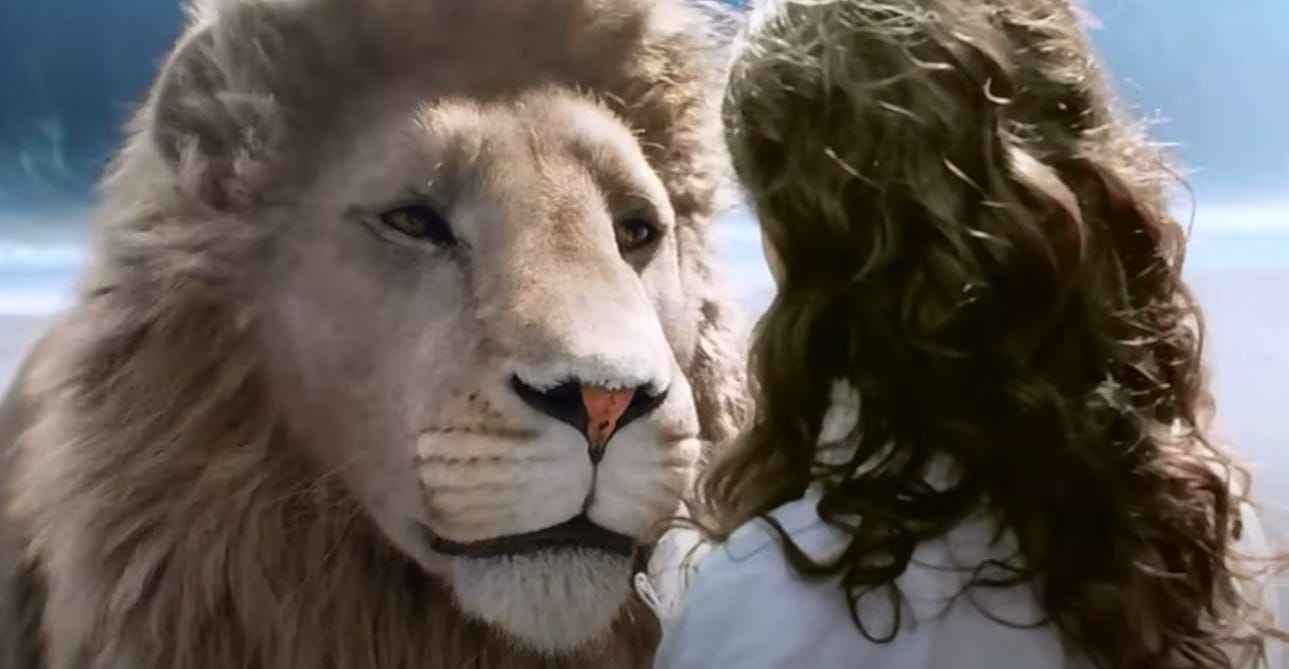
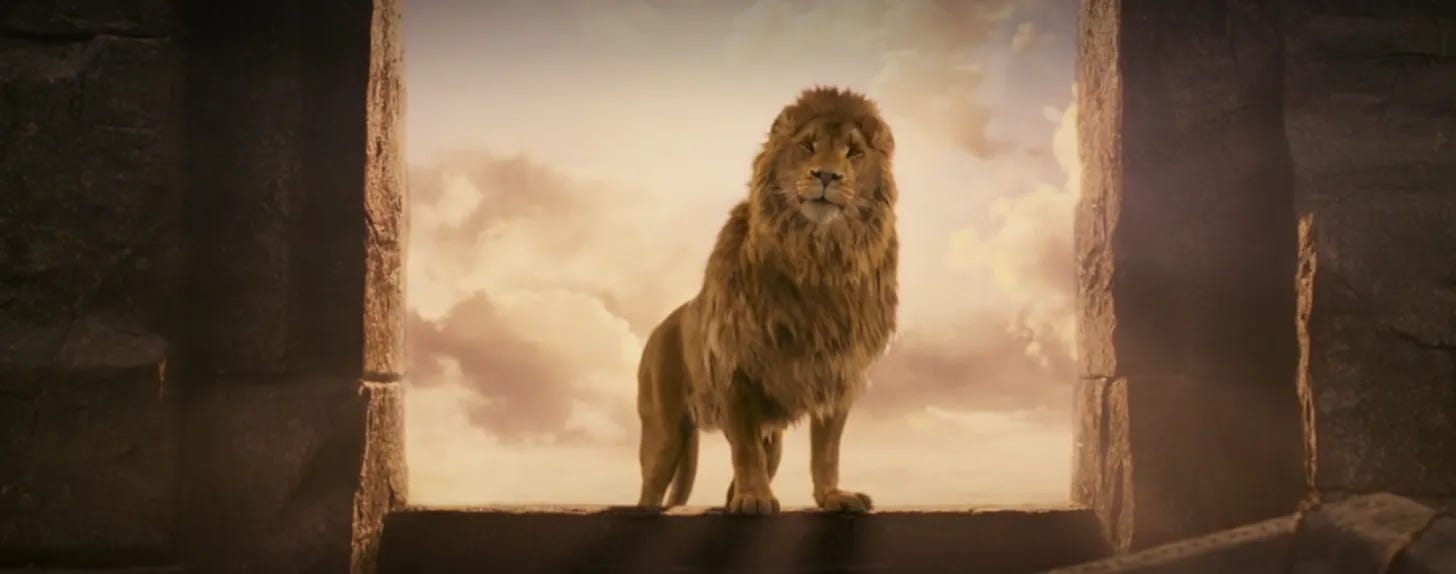
C.S. Lewis scholar Dr. Crystal Hurd recently argued that there are positives for sex-swapping Aslan in Greta Gerwig and Netflix’s upcoming The Chronicles of Narnia adaptation.
A little over a month ago it was originally reported that Meryl Streep was being cast to play a sex swapped Aslan. Nexus Point News reported that “an offer has been made to Meryl Streep to portray a central character in the series: Aslan, the Great Lion.”
The outlet added, “Streep is in talks to portray Aslan, who will be female in the series.”
This report was followed up by one from Deadline, which claimed, “Oscar winner Meryl Streep is in talks to play Aslan the Great Lion in Greta Gerwig and Netlfix’s Narnia movie, we have confirmed with sources.”
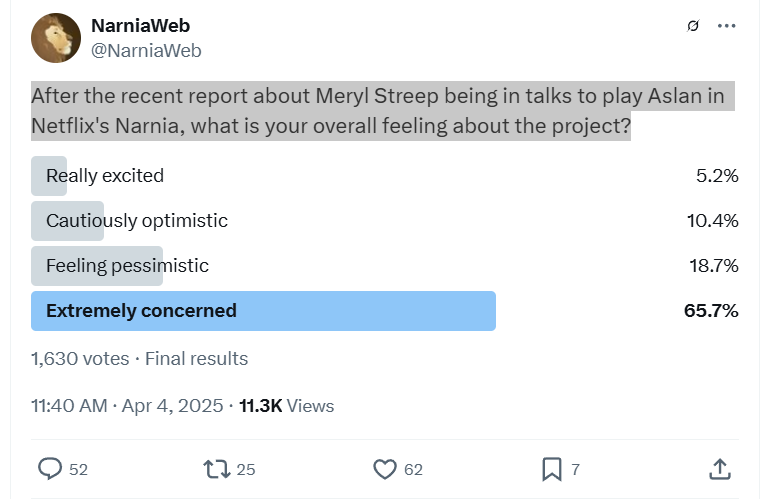
Reaction to these rumors has been negative with a Narnia Web X poll revealing that over 65% of respondents were “extremely concerned” about the rumor.
Now, Dr. Crystal Hurd, in an editorial on Narnia Web argues there are positives of sex-swapping Aslan.
She first argues that the story is a fantasy story and make-believe and thus it should not “be held to the same standard as catechism.”
This is a ridiculous argument given Lewis himself made it abundantly clear the stories were about evangelizing the Christian faith. In On Stories and Other Essays on Literature Lewis wrote, “Then of course the Man in me began to have his turn. I thought I saw how stories of this kind could steal past a certain inhibition which had paralysed much of my own religion in childhood. Why did one find it so hard to feel as one was told one ought to feel about God or about the sufferings of Christ? I thought the chief reason was that one was told one ought to. An obligation to feel can freeze feelings. And reverence itself did harm.”
“The whole subject was associated with lowered voices; almost as it if were something medical. But supposing that by casting all these things into an imaginary world, stripping them of their stained-glass and Sunday school associations, one could make them for the first time appear in their real potency? Could one not thus steal past those watchful dragons? I thought one could,” he concluded.
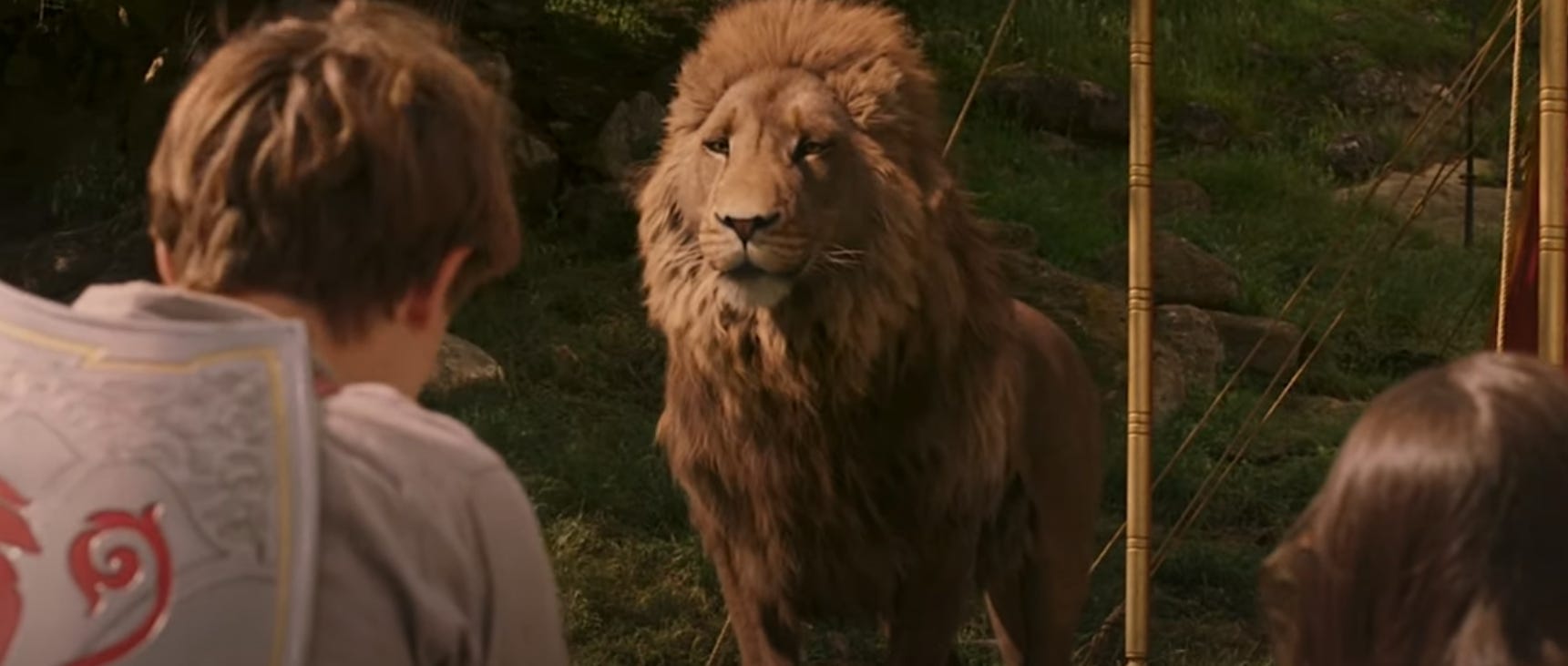
Nevertheless, Hurd then cites the aforementioned essay to claim that Lewis did not set out to “write an overtly Christian tale.”
She quotes Lewis, “Some people seem to think that I began by asking myself how I could say something about Christianity to children; then fixed on the fairy tale as an instrument; then collected information about child-psychology and decided what age-group I’d write for; then drew up a list of basic Christian truths and hammered out ‘allegories’ to embody them. This is all pure moonshine. I couldn’t write in that way at all. Everything began with images; a faun carrying an umbrella, a queen on a sledge, a magnificent lion. At first there wasn’t even anything Christian about them; that element pushed itself in of its own accord.”
While the inspiration for The Chronicles of Narnia came to him in images at first, he makes it abundantly clear he did set out to write a Christian tale.
Additionally, in The Voyage of the Dawn Treader, Aslan informs Edmund and Lucy that they will meet him in their world, but he is known by another name, “But there I have another name. You must learn to know me by that name. This was the very reason why you were brought to Narnia, that by knowing me here for a little, you may know me better there.” It is clear that Lewis is referring to Jesus Christ. Hurd’s claim is objectively not true.
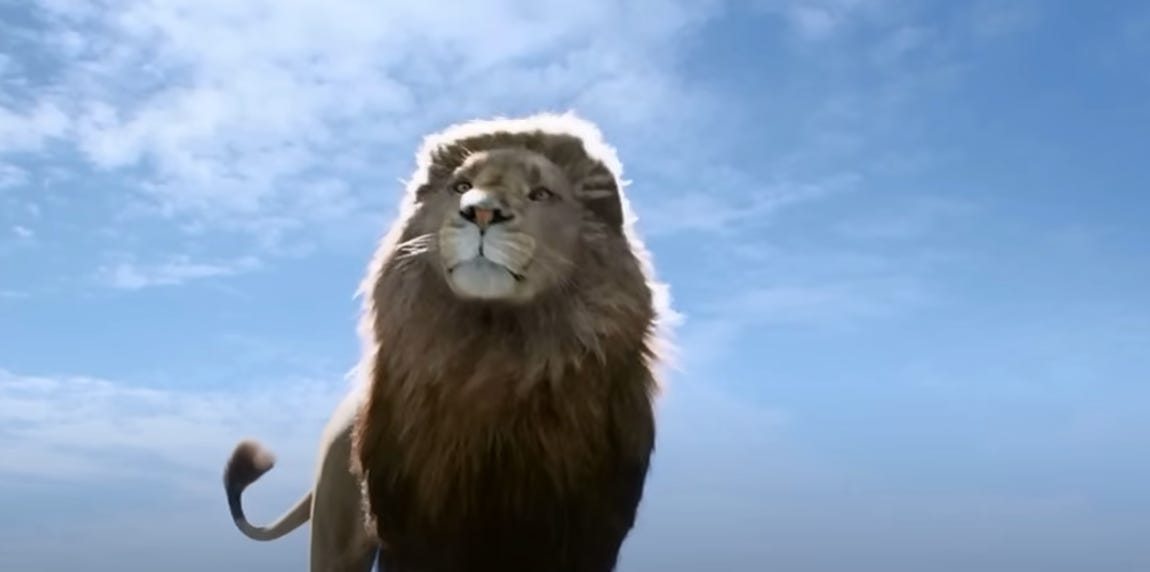
From there, Hurd argues that in The Magician’s Nephew Aslan exhibits female traits given he sings Narnia into existence and then instructs Digory to retrieve an apple that will heal his mother. She claims, “It is no stretch of imagination to consider a female character ‘birthing’ one of the worlds or nursing a sick person back to health.”
She adds, “These are, in fact, very ‘feminine’ qualities according to convention. Both Egyptian and Hindu mythology feature lionesses as symbols of power, community, and fertility. In ancient mythologies, this is nothing novel or extraordinary.”
Aslan singing Narnia into existence is a clear reference to the Book of Genesis, where God creates the world. Jesus Christ, the Living God-Man is also the master healer. The idea these are “feminine” qualities appears to be complete and utter nonsense used to justify the sex swap and stems from her apparent refusal to acknowledge that the books were created to evangelize Christianity and thus reference it repeatedly.
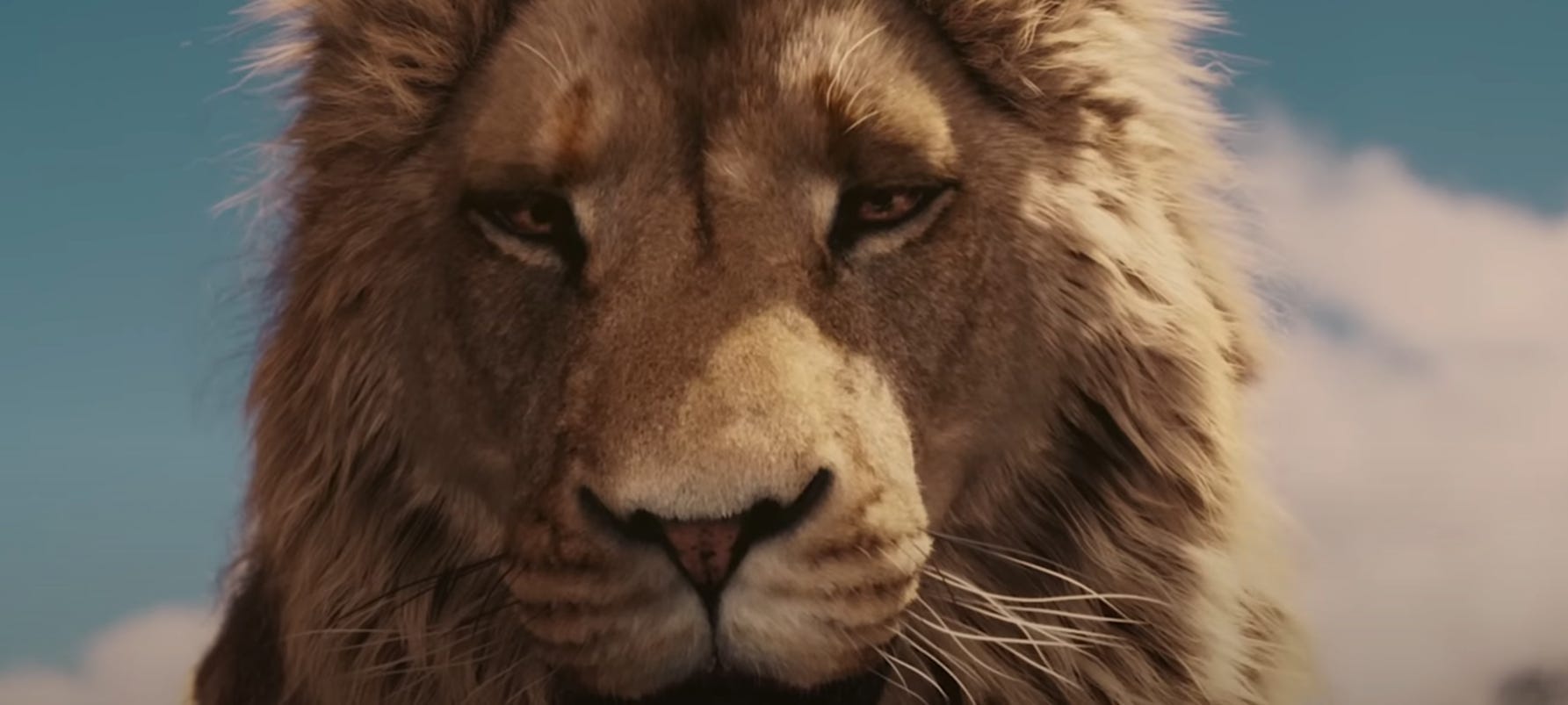
Next, Hurd points to feminist DEI ideology as a justification for the sex-swap, “Similarly, contemporary fantasy features a menagerie of strong, fierce female characters who have built a following on their own popularity. Perhaps this is why the Netflix series is reconsidering Aslan’s voice as a female, to align with this trend.”
After mentioning the pornographic romantasy genre, she adds, “Now more than ever, women are reading fantasy and hoping for more depictions in the media that they consume. Installing more females in the story could attract more girls and women to watch the series.”
As we’ve seen with Star Wars, Marvel, and other major franchises embracing this DEI ideology has for the most part led to declines at the box office as well as total number of viewers. Furthermore, feminist ideology is incompatible with Christianity. Dale O’Leary explains, “The feminist analysis is nonsense. Women aren’t going to be better off when there are no families. There is no evidence that any of this will work.”
He asserts, “From the beginning the goals of feminism were clear: destruction of patriarchy; control of reproduction including contraception, abortion, and reproductive technologies; destruction of the fatherheaded family with divorce and illegitimacy made normal; all women in the workforce, no man able to support his family and free 24 hour day care; destruction of all-male institutions; total sexual liberation including sex for children, homosexuality, and bisexuality; destruction of worship of God as father.”
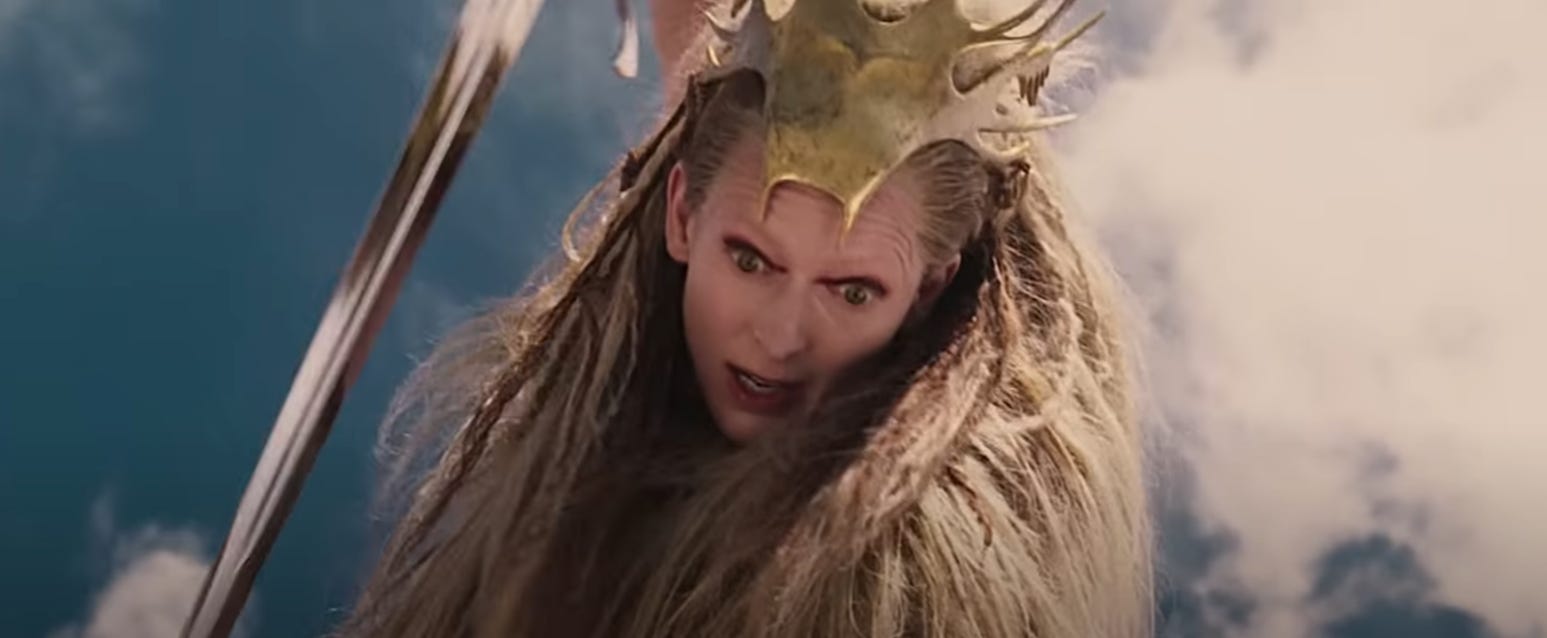
While those are all the positives that Hurd lists for sex-swapping Aslan, when she discusses the negatives, she discounts the fact that the stories were purposely made to evangelize the Christian faith.
She writes, “For fans with no religious preconceptions, this change wouldn’t matter, but those who have already established Aslan as a Christ figure would certainly be upset. These associations cannot be untangled now. One cannot alter religious representation and not anticipate some negative feedback.”
This too is utter nonsense given Lewis himself made it clear that Aslan is Jesus Christ in Narnia. He wrote, “If Aslan represented the immaterial Deity in the same way in which the Giant Despair represents despair, he would be an allegorical figure. In reality however he is an invention giving and imaginary answer to the question ‘What might Christ become like if there really were a world like Narnia and He chose to be incarnate and die and rise again in that world as He actually has done in ours?’ This is not an allegory at all.”
In another letter responding to a mother concerned that her son, Laurence, was loving Aslan more than Jesus, Lewis wrote, “Laurence can't really love Aslan more than Jesus, even if he feels that's what he is doing. For the things he loves Aslan for doing or saying are simply the things Jesus really did and said. So that when Laurence thinks he is loving Aslan, he is really loving Jesus: and perhaps loving Him more than he ever did before.”
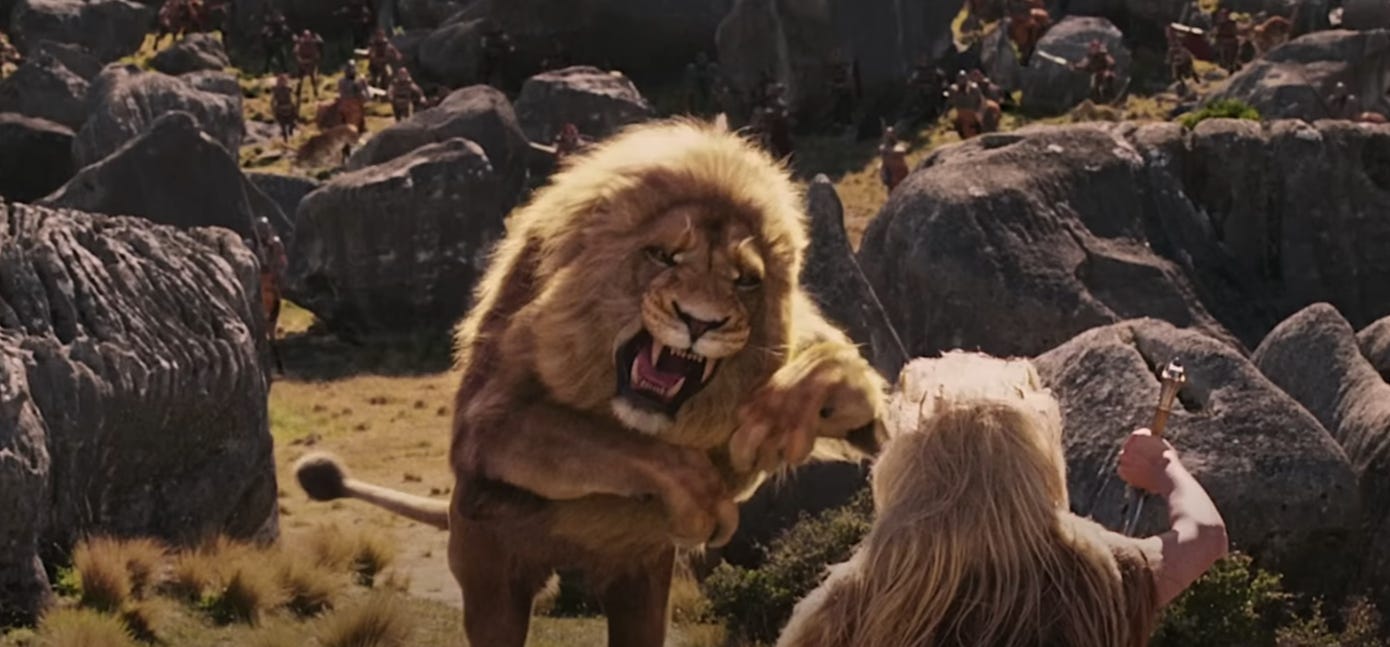
Hurd then goes off on a tangent to ask why Lewis chose a lion. She points to a church he attended in his youth, St. Mark’s Dundela, and a winged-lion being the symbol of St. Mark. She also points to the lion being a symbol of the English monarchy as well as being a symbol of Scottish king Robert the Bruce, of which Lewis is descended.
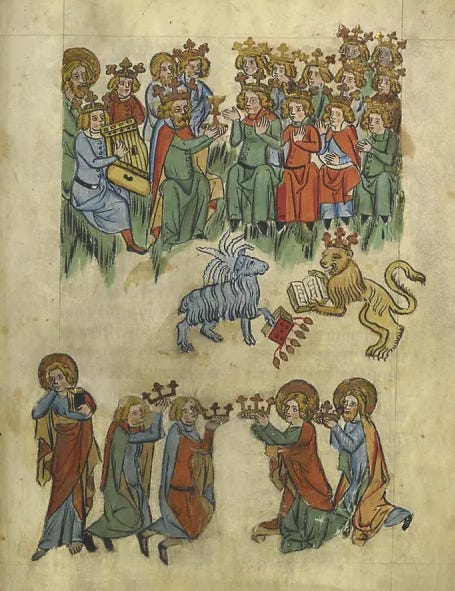
Of note, she does not include that Jesus Christ is referred to as the Lion of Judah in Revelation 5:5, “One of the elders said to me, ‘Do not weep. The lion of the tribe of Judah, the root of David, has triumphed, enabling him to open the scroll with its seven seals.’”
READ: Marvel Blames Disney For Recent Film And TV Failures, Uses Same Excuses As Star Wars
The entire essay appears to be a way of justifying the sex-swapping. No justification can be made for it. It is evil.
There are no positives for it given it is a subversion of Lewis’ work and the goals he had for it.
What do you make of Hurd’s claims?
NEXT: Cannes Film Festival Bans Nudity On Red Carpet And Other Areas "For Decency Reasons"
"Scholar."
I'm done giving any credence to logical fallacies.
The appeal to authority by the media is overdone to the point of cliche. Whenever I see it, I automatically take the opposite position.
How many times have all these "EX-PURTS" been wrong? Just about every time. I think the appeal to authority only really works on weak minds.
It’s just the same old tired trope of “Yes, this is screwed up … and that’s a good thing!”
Yawn.