


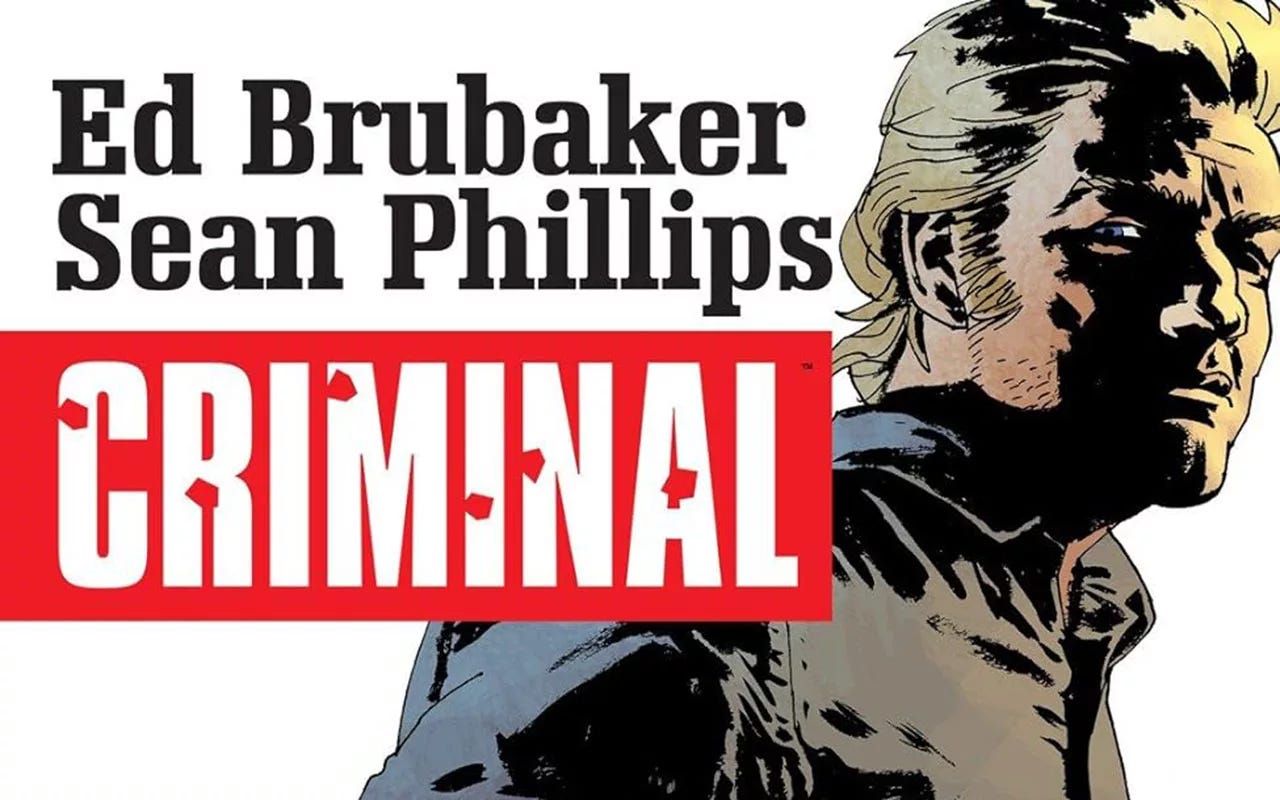
Ed Brubaker and Sean Phillips’ Criminal is what comics should be—tight writing, atmospheric art, and interconnected storytelling that rewards careful readers. The series, collected in four deluxe editions, is a masterclass in noir fiction that proves the medium can deliver literary quality without sacrificing entertainment. This is crime fiction at its best, and it belongs on the shelf next to Chandler, Hammett, and Leonard.
Criminal isn’t just good—it’s perfect. The writing is economical and precise, the art is moody and evocative, and the world Brubaker and Phillips have built across dozens of issues feels lived-in and real. Every story stands alone, but they’re all connected through recurring characters, locations, and themes. It’s a shared universe built on crime, consequence, and the idea that nobody gets away clean.
If you care about comics as a storytelling medium, you need to read Criminal.
The Structure: Interconnected Crime Stories
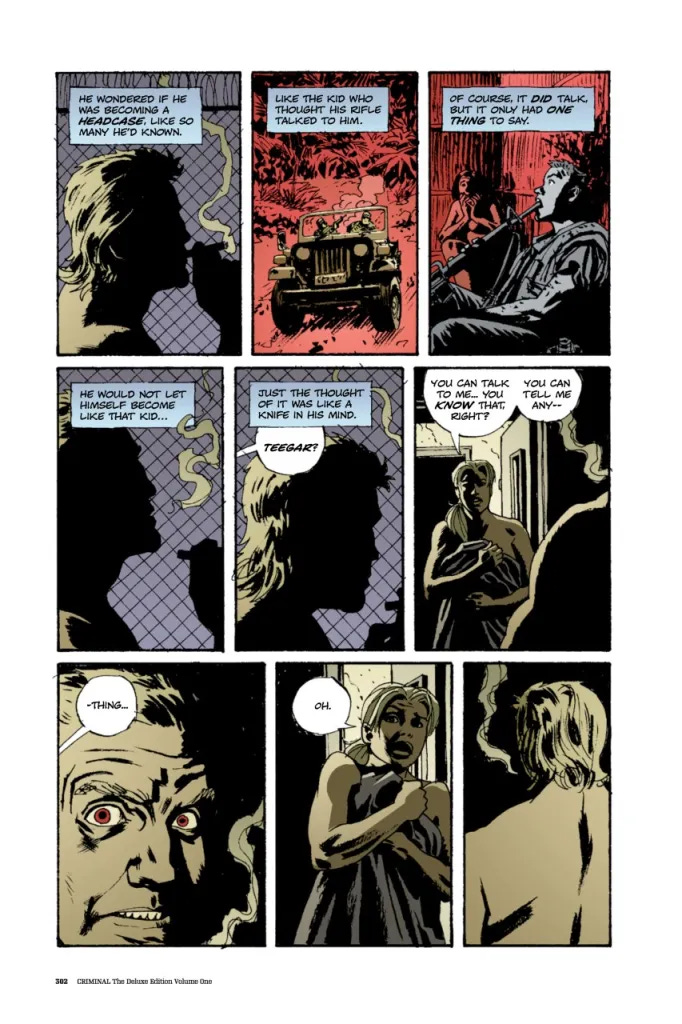
Criminal doesn’t follow a single protagonist or linear narrative. Instead, it’s a series of crime stories set in the same unnamed city, with characters appearing and reappearing across different arcs. A minor character in one story becomes the lead in another. A heist mentioned in passing becomes the focus of a later arc. The bartender at the Undertow—the series’ recurring location—witnesses events that connect across decades.
This structure allows Brubaker to explore different aspects of crime fiction—heists, revenge, corruption, addiction, Hollywood noir—while maintaining thematic and narrative cohesion. The stories are self-contained enough that you can read any arc and understand what’s happening, but reading them in order reveals connections and callbacks that deepen the experience.
The series is collected in four deluxe editions:
Criminal Deluxe Edition Volume 1 - Collects the first three arcs: Coward, Lawless, and The Dead and the Dying
Criminal Deluxe Edition Volume 2 - Collects Bad Night, The Sinners, and Last of the Innocent
Criminal Deluxe Edition Volume 3 - Collects Wrong Time, Wrong Place and Cruel Summer
Cruel Summer - Collects Cruel Summer
Criminal: The Knives - A standalone graphic novel released in 2024
The recommended reading order is Volumes 1, 2, the first few issues of Volume 3 (Wrong Time, Wrong Place), then Cruel Summer (also in Volume 3), then finish Wrong Time, Wrong Place, and finally The Knives. This order preserves the chronological connections between Wrong Time, Wrong Place and Cruel Summer while saving The Knives for last as a capstone to the series.
The Writing: Economical, Precise, and Devastating
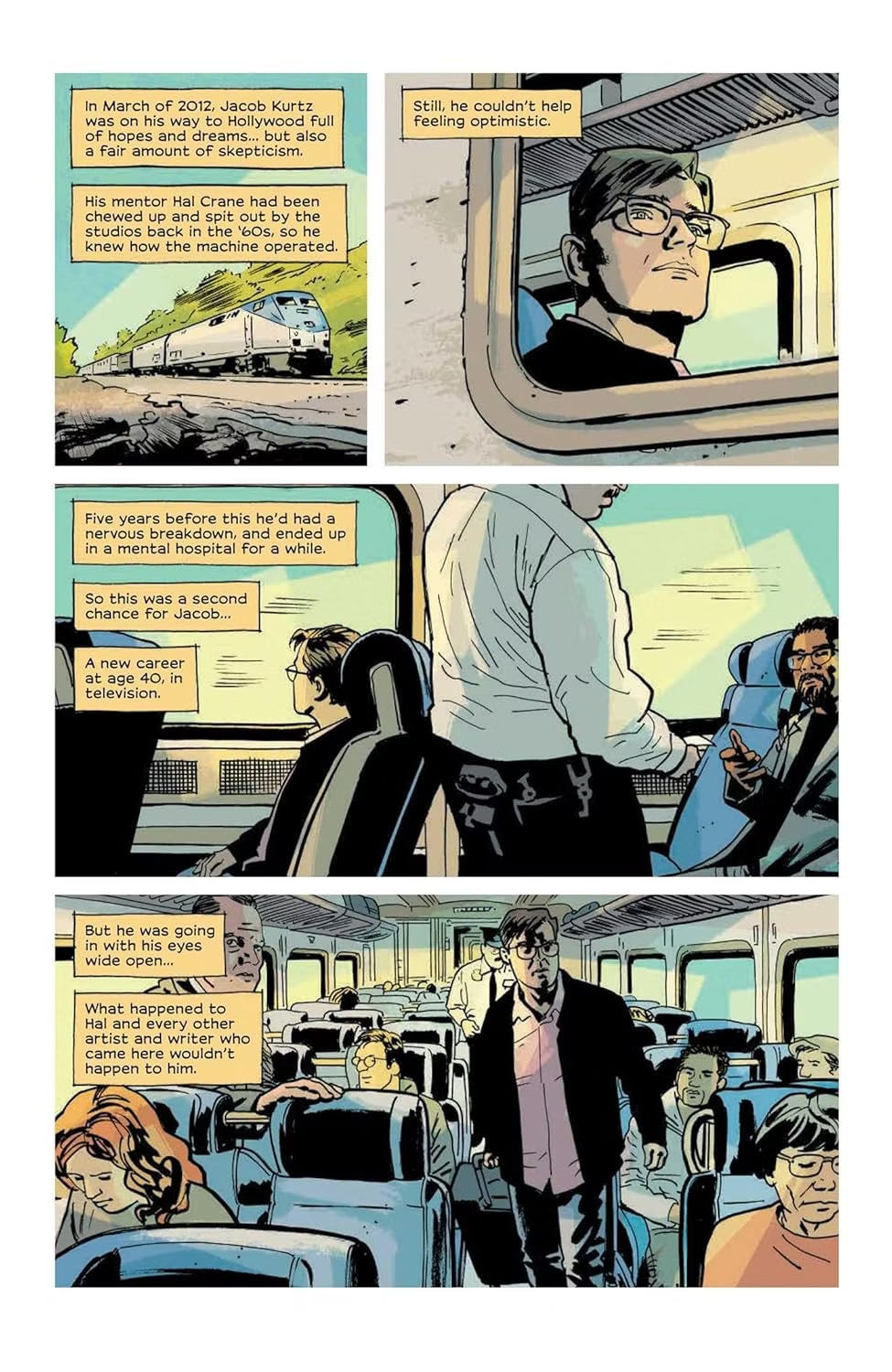
Ed Brubaker writes noir the way it’s supposed to be written—lean, mean, and without a wasted word. His dialogue is sharp and naturalistic, his narration is evocative without being purple, and his plotting is tight. Every scene serves the story, every line of dialogue reveals character, and every plot point pays off.
Brubaker understands that great crime fiction is about character, not plot. The heists, murders, and cons are just vehicles for exploring who these people are and why they make the choices they do. Leo Patterson in Coward is a professional thief who plans every job meticulously and never takes unnecessary risks—until he does, and it destroys him. Tracy Lawless in Lawless is a soldier who returns from war to avenge his brother’s death, only to discover that revenge doesn’t bring peace. Teeg Lawless in Lawless is a career criminal who’s spent decades in prison and comes out to find the world has moved on without him.
These are people trapped by their choices, their pasts, and their natures. Brubaker doesn’t judge them, but he doesn’t romanticize them either. They’re criminals, and crime has consequences. Some die, some go to prison, some escape but lose everything that mattered. Nobody wins in Criminal—they just survive, and sometimes not even that.
The narration is first-person, with different characters narrating different arcs. This allows Brubaker to get inside their heads and show how they justify their actions to themselves. Leo tells himself he’s a professional who doesn’t take risks. Tracy tells himself he’s avenging his brother. Ricky Lawless in Last of the Innocent tells himself he’s a good guy who’s been pushed too far. They’re all lying to themselves, and Brubaker lets readers see the gap between what they say and what they do.
The prose is economical. Brubaker doesn’t waste words on description or exposition. He trusts Sean Phillips’ art to convey setting and mood, and he trusts readers to pick up on subtext. When a character says one thing but their body language says another, Brubaker doesn’t explain it—he lets the art do the work. This is visual storytelling at its best, with writer and artist working in perfect sync.
The plotting is meticulous. Brubaker plants details early that pay off later, sometimes issues or even arcs later. A character mentioned in passing in Coward becomes central to The Sinners. A location introduced in Lawless reappears throughout the series. The Undertow bar is a constant, a place where criminals gather and where the past is always present. Brubaker builds a world where everything connects, and careful readers are rewarded for paying attention.
The Art: Sean Phillips’ Perfect Noir Aesthetic
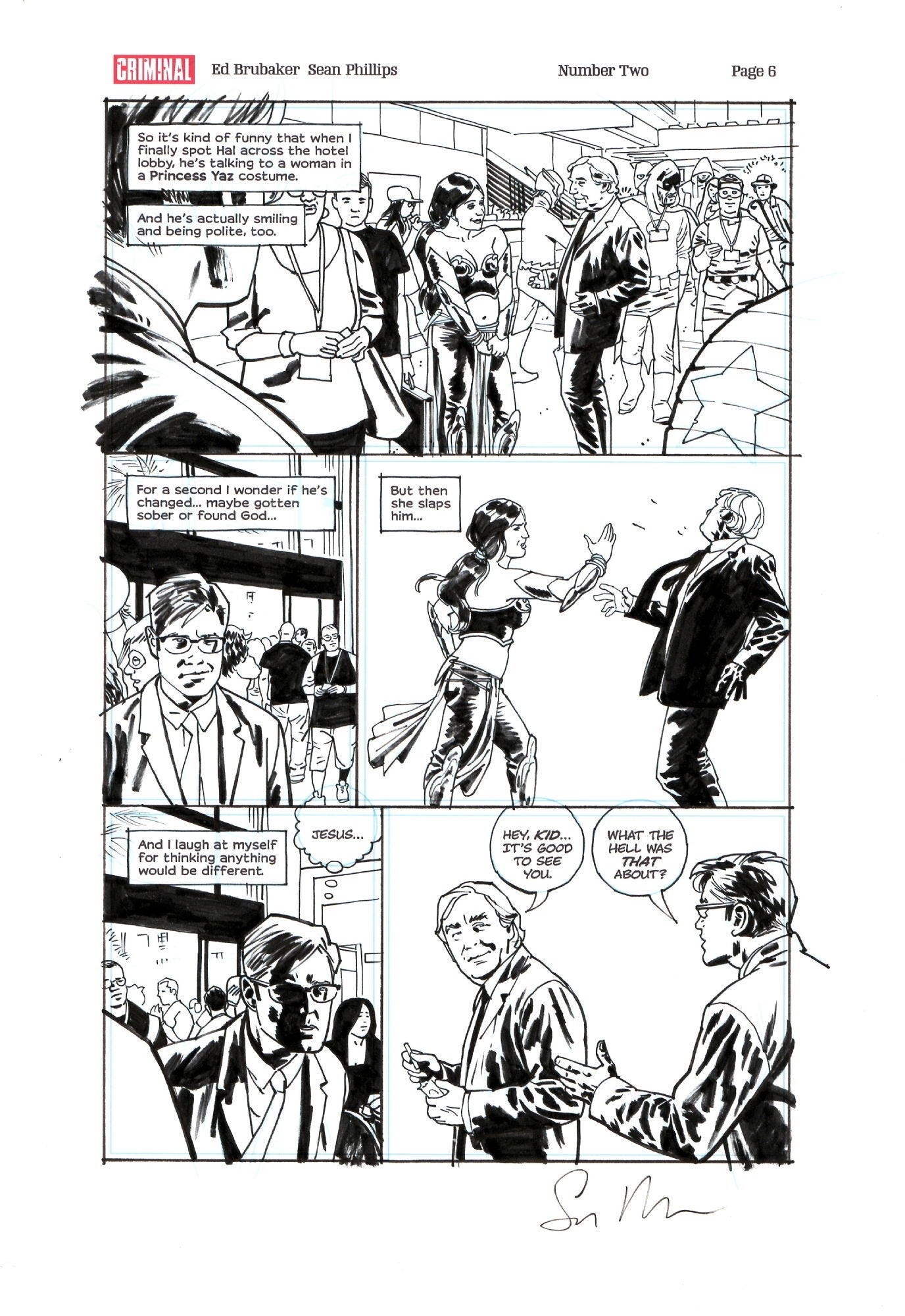
Sean Phillips is the perfect artist for Criminal. His style is dark, moody, and atmospheric, with heavy shadows, muted colors, and compositions that evoke classic film noir. Every page drips with mood, and his character work is expressive without being exaggerated. You can read emotion in a character’s posture, their eyes, the way they hold a cigarette.
Phillips uses shadow like a noir cinematographer. Characters are often half in darkness, their faces obscured, their expressions hidden. This creates visual tension and reinforces the moral ambiguity of the stories—these are people operating in the shadows, and Phillips’ art reflects that literally. The lighting is always motivated, always purposeful, and always beautiful.
The color palette is muted—grays, browns, deep blues, and blacks dominate. Phillips colors his own work, and he uses color to set tone and mood. Flashbacks are often sepia-toned or desaturated, distinguishing them from the present. Moments of violence are stark and brutal, with splashes of red against gray backgrounds. The overall effect is a world that feels cold, hard, and unforgiving.
Phillips’ panel layouts are clean and functional. He doesn’t use flashy page designs or experimental layouts—he uses traditional grids and straightforward compositions because they serve the story. Noir is about clarity and inevitability, and Phillips’ layouts reflect that. You always know where you are in space and time, and the storytelling is always clear.
His character designs are realistic and grounded. These aren’t superheroes or caricatures—they’re people. They have weight, they age, they carry scars. Tracy Lawless looks like a soldier who’s seen combat. Teeg Lawless looks like a man who’s spent decades in prison. Ricky Lawless looks like a suburban dad who’s let himself go. Phillips draws real people in a real world, and that realism makes the violence and tragedy hit harder.
The action sequences are brutal and unglamorous. When people get shot, they bleed and die messily. When people fight, it’s ugly and desperate. Phillips doesn’t glamorize violence—he shows it as painful, chaotic, and final. This is noir, not action cinema, and the violence has weight and consequence.
The Themes: Crime, Consequence, and the Past
Criminal is about the past and how it shapes the present. Characters are haunted by their choices, their families, and the people they’ve hurt. Leo Patterson is haunted by his father’s death and his own cowardice. Tracy Lawless is haunted by his brother and the war. Teeg Lawless is haunted by the decades he lost in prison. The past is never past in Criminal—it’s always present, always pressing on the characters, always demanding payment.
The series is also about family and legacy. The Lawless family appears across multiple arcs, with different generations making the same mistakes. Crime is a family business, passed down from father to son, and nobody escapes it. Tracy tries to leave, but he’s pulled back. Ricky tries to be normal, but his family’s criminal past catches up with him. The sins of the fathers are visited on the sons, and the cycle never breaks.
Brubaker explores different facets of crime fiction across the arcs. Coward is a heist story about a professional thief. Lawless is a revenge story about a soldier avenging his brother. The Dead and the Dying is about aging criminals facing mortality. Bad Night is a one-night thriller about a junkie trying to survive. The Sinners is about corruption in Hollywood. Last of the Innocent is a suburban noir about a man who thinks he can escape his past. Cruel Summer is about teenagers getting in over their heads.
Each arc explores a different genre within crime fiction, but they’re all connected by theme—crime has consequences, the past never dies, and nobody gets away clean.
The Deluxe Editions: Premium Presentation
The Criminal deluxe editions are beautifully produced. They’re oversized hardcovers with high-quality paper, excellent reproduction, and extensive backmatter. Each volume includes Brubaker’s essays on crime fiction, film noir, and the creative process, as well as Phillips’ design sketches and process notes. The backmatter adds context and depth, showing how much thought went into every aspect of the series.
The deluxe format is the definitive way to read Criminal. The oversized pages allow Phillips’ art to breathe, and the production quality does justice to his moody, atmospheric visuals. These are books you’ll want to keep and reread, and the deluxe editions are built to last.
Cruel Summer and The Knives: Standout Arcs
Cruel Summer is one of the series’ best arcs. Set in the summer of 1988, it follows Jane, a teenage girl whose father is a career criminal. When her father’s partner is murdered, Jane gets pulled into the criminal underworld and discovers that the adults in her life are more dangerous than she realized. The arc is a coming-of-age story filtered through noir, and it’s heartbreaking. Brubaker captures the confusion and vulnerability of adolescence while showing how crime destroys innocence.
The Knives, released in 2024 as a standalone graphic novel, is a perfect capstone to the series. It follows multiple characters across different time periods, including more about the bar and the girl who inherited it. “The Knives” is a mention that we’re all under the knife and it’s going to catch up to us ventually.
The Knives also features extended commentary on Hollywood corruption. One storyline follows a screenwriter navigating the industry’s moral compromises, and Brubaker doesn’t pull punches. Hollywood is depicted as a place where talent is exploited, creativity is commodified, and everyone is complicit in maintaining a corrupt system. The irony is that Criminal is being adapted into a television series, and Brubaker is clearly aware of the contradictions. The commentary feels personal and earned, and it adds depth to the story.
The TV Adaptation: Hollywood Meets Noir
Criminal is being adapted for television, which is both exciting and concerning. The series’ episodic structure and interconnected storytelling are well-suited to TV, and if the adaptation is faithful, it could be excellent. But Hollywood has a track record of sanitizing noir, removing the moral ambiguity and adding redemption arcs that undermine the genre’s fatalism.
The fact that Brubaker has written extensively about Hollywood corruption in The Sinners and The Knives makes the adaptation particularly interesting. He knows how the industry works, and he’s not naive about the compromises required to get a show made. Whether the adaptation preserves Criminal’s bleak worldview or softens it for mainstream audiences remains to be seen.
Why Criminal Matters
Criminal is what comics should be—smart, well-crafted, and uncompromising. It’s proof that the medium can deliver literary quality without abandoning entertainment. Brubaker and Phillips have created a body of work that stands alongside the best crime fiction in any medium, and they’ve done it with consistency and craft that’s rare in comics.
If you care about crime fiction, if you care about comics as a storytelling medium, if you care about craft and consistency, you need to read Criminal. It’s a masterpiece.
Rating: 10/10
Perfect writing, perfect art, perfect execution. This is what comics should be—smart, atmospheric, and uncompromising. Ed Brubaker and Sean Phillips have created the definitive noir comic, and it belongs on the shelf next to the best crime fiction ever written.
What do you think? Have you read Criminal, or are you picking up the deluxe editions?
Will have to reread all of it.
Absolutely agree! Tremendous!