


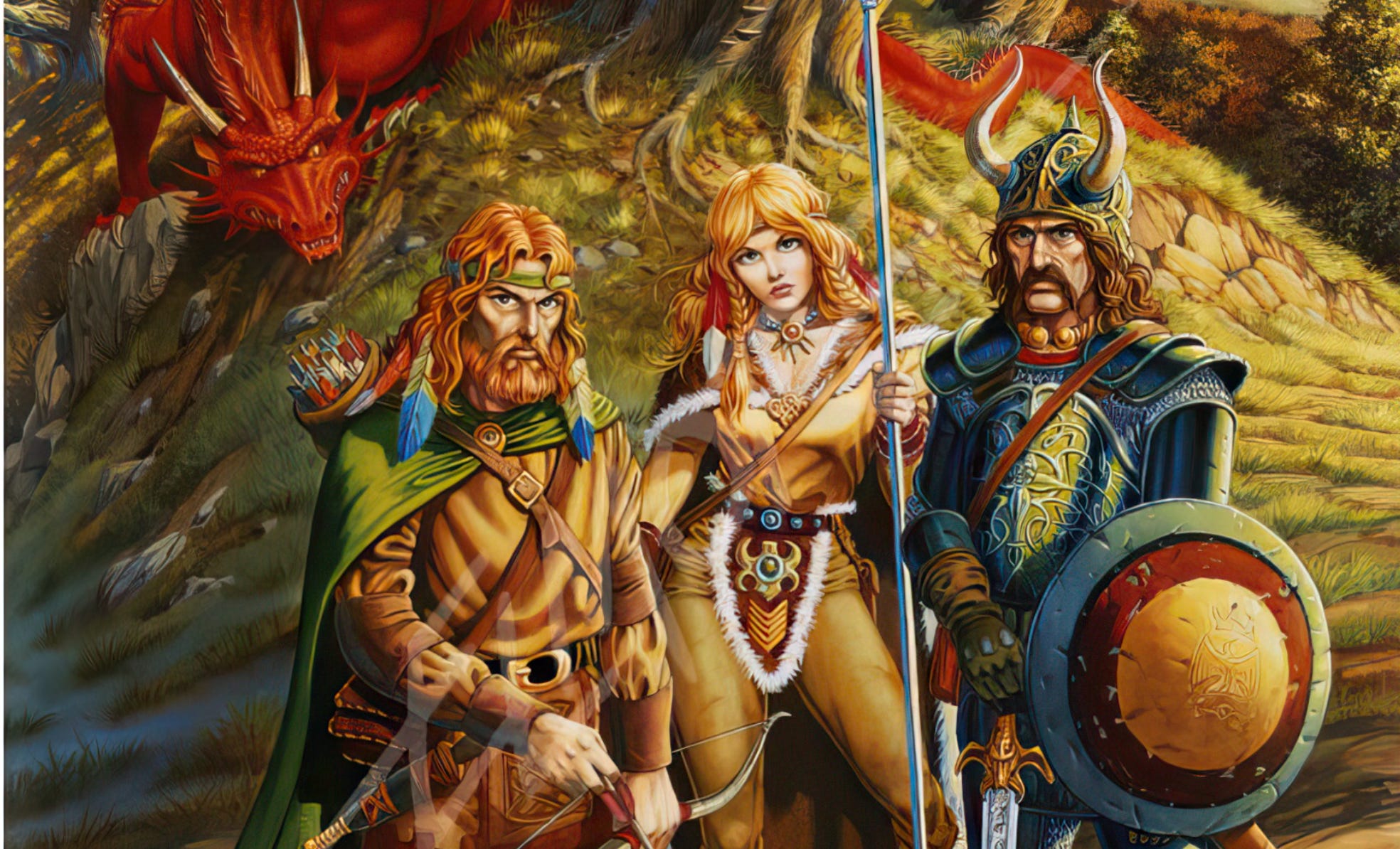
Dragonlance fans have a collector’s edition to look forward to. Conversation Tree Press has announced a signed, limited edition of the Dragonlance Chronicles, the trilogy by Margaret Weis and Tracy Hickman that began with Dragons of Autumn Twilight in 1984 and continued with Dragons of Winter Night and Dragons of Spring Dawning in 1985.
The press says it is “over the moon (all three of them, actually)” to be publishing the books, and every copy will carry the signatures of both authors. For readers who grew up with Tanis, Raistlin, Sturm and Tasslehoff, it means the original trilogy getting the full fine press treatment: letterpress printing on the upper tiers, hand binding in England and the complete artwork in color.
The Edition Details
Each of the three volumes will be limited to 1,326 copies, split across three states:
Collector’s Edition: 1,000 unnumbered copies, offset printed.
Deluxe Edition: 300 copies, hand-numbered 1 to 300, letterpress printed.
Lettered Edition: 26 copies, hand-lettered A to Z, letterpress printed.
All copies will be signed by Margaret Weis, Tracy Hickman and the artist, whose name has not been announced yet. The signatures come on a tipped-in signature page, which the press does with all of its books.
Each volume will feature:
Fine paper, upgraded to mould-made on the Deluxe Edition and handmade on the Lettered Edition.
Durable Smyth-sewn bindings with a ribbon marker, headbands and tailbands.
Premium binding materials, upgraded on the Deluxe and Lettered Editions.
Handmade enclosures, included at no additional cost.
Hand binding by Ludlow Bookbinders in Shropshire, England, for the Deluxe and Lettered Editions.
The complete artwork, in full colour, in all three states.
There is no publication date yet. The press says it is “hard at work” on the editions and points readers to its publishing schedule page and newsletter for updates. Pricing was not listed on the announcement page.
The Press Behind It
Conversation Tree Press is a Canadian fine press based in Kitchener, Ontario, run out of a workshop in the backyard of a home built in 1895. The name comes from a tree in Belair, a village on the northern coast of Guyana, where the founder grew up. The tree stood at a crossroads near the seawall, and villagers gathered under it to “gyaff,” the Guyanese word for chatting, telling stories and trading gossip. The press says it hopes to “bring people together, touch their lives, and have a good gyaff” around finely made books.
The founder is a longtime book collector who left a career in design and project management to turn that collecting into a business. The press says it aims to use the traditions of fine press bookmaking, meaning letterpress printing, hand binding, fine materials and harmonious design, for books of historical, cultural and social significance across fantasy, science fiction, horror, weird fiction and contemporary fiction. Small editions are printed in the founder’s own workshop, which has a Heidelberg Windmill, a Saroglia “Canuck” cylinder proofing press and a selection of metal type. Larger editions are published under the Conversation Tree Press imprint, with partners including Nomad Letterpress, Hand & Eye Letterpress, Ludlow Bookbinders and illustrator Charles Vess. The press is a member of the Fine Press Book Association.
Its first publication, in early 2023, was a letterpress limited edition of Peter Pan, collecting Peter Pan in Kensington Gardens and Peter & Wendy by J.M. Barrie. It was illustrated by Charles Vess, limited to 726 copies and priced at $275, and a portion of the proceeds goes to the Great Ormond Street Hospital Children’s Charity. The Lettered Edition, at $2,695, had already sold out when Fine Books Magazine covered the launch.
The press’s schedule also lists Octavia Butler’s Kindred, Neal Stephenson’s Snow Crash, Lord Dunsany’s The King of Elfland’s Daughter, Cormac McCarthy’s The Road, qntm’s There Is No Antimemetics Division and Joe Haldeman’s The Forever War as upcoming books. Its Chronicles of Elric series opened pre-orders for Volume 1 this month.
How the Chronicles Came to Be
The Dragonlance Chronicles started as a game before they were books. Tracy Hickman came to TSR in 1982, and the company soon announced plans to develop his series of dragon-themed role-playing adventures. The novels were meant to tell the story of the game world the designers were building, something TSR agreed to only reluctantly. Hickman’s storyline was chosen for the Dragonlance books because of its twelve-part structure, and the project was first called “Project Overlord.”
Margaret Weis was assigned to edit it, and she and Hickman began plotting the novel together. They hired an author who did not work out, and by then they were so invested that they decided they had to write it themselves. TSR’s book department editor Jean Black picked the pair to write Dragons of Autumn Twilight and the rest of the trilogy. The overall storyline had been plotted and outlined before either the novels or the game modules were written.
Dragons of Autumn Twilight arrived in November 1984, Dragons of Winter Night in July 1985 and Dragons of Spring Dawning in September 1985. They follow the Heroes of the Lance through the War of the Lance, in which the free peoples of Krynn fight the armies of the dark goddess Takhisis, led by the Dragon Highlord Verminaard, in a world whose gods seem to have abandoned it since the Cataclysm. The press describes the trilogy as the first of more than 190 novels set in the Dragonlance world, with more than twenty million copies sold. The trilogy was later adapted as an animated film, Dragons of Autumn Twilight, released in January 2008 with Kiefer Sutherland, Michelle Trachtenberg, Lucy Lawless and Michael Rosenbaum in the voice cast.
What the press highlights about the books is the cast: Raistlin and his hunger for power, Sturm and his unbending honour, Tanis and his divided heart. Forty years on, it says, “we still think of them as old friends.”
Forty years after Tanis, Raistlin and the rest first walked into the Inn of the Last Home, they are getting hand-bound, signed volumes with the full artwork in color. Which tier would you go for, the 1,000-copy Collector’s Edition or one of the 300 numbered Deluxe copies? And who should the unannounced artist be? Tell us in the comments.