


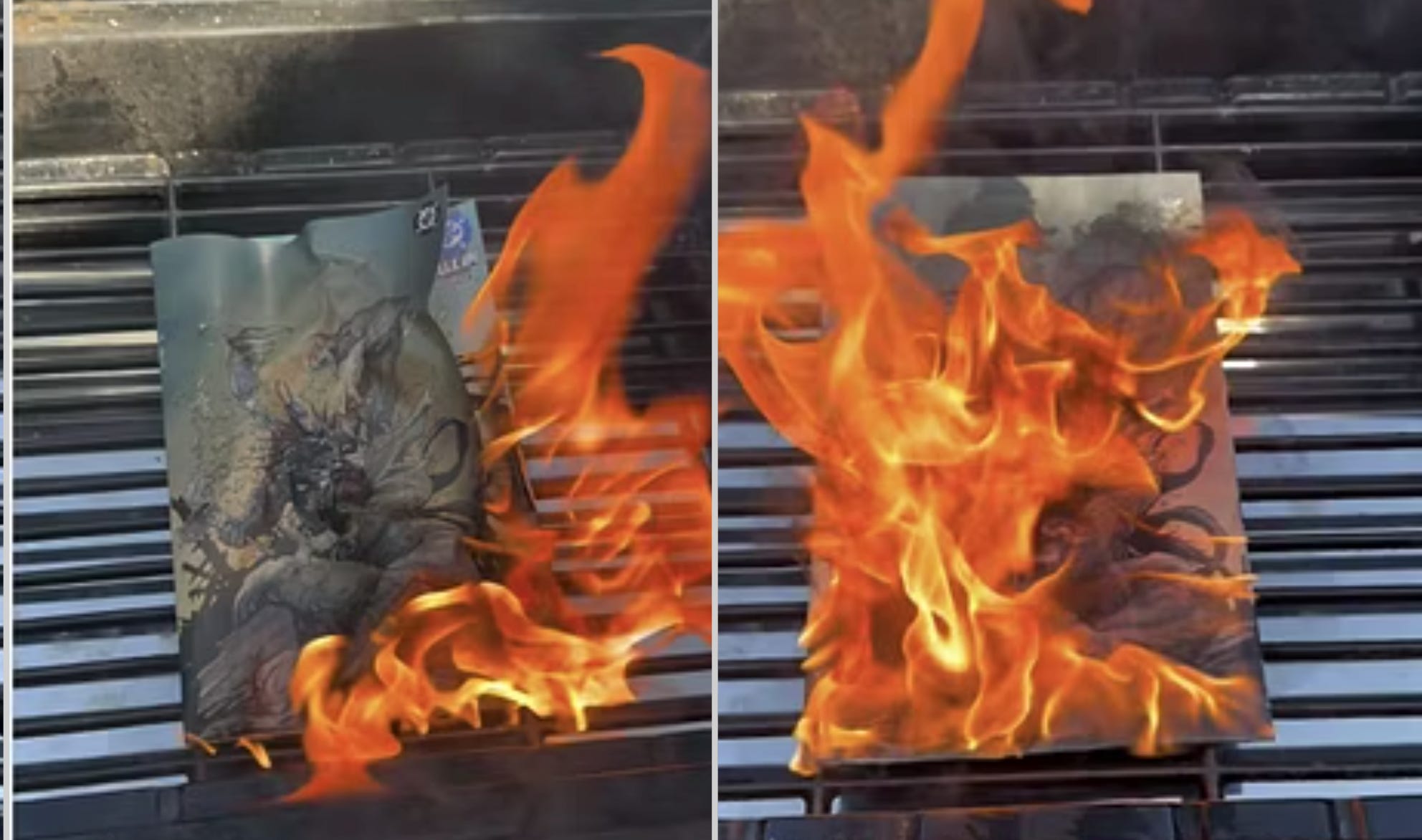
A comic retailer burned its own copies of the Frank Cho retailer-exclusive variant of Absolute Batman #23 on a Whatnot live stream to cut supply and raise the price of what was left. DC Comics answered by banning the shop from any further exclusive retailer variants, a penalty that cost it the planned Alex Maleev cover for Absolute Batman #25, according to Bleeding Cool on October 5. The shop’s Whatnot channel now appears to be gone.
The cover shows Absolute Batman fighting Absolute Clayface. The shop promoted the burn with AI-generated Absolute Batman fire imagery and a live-sale countdown. After the backlash, its operator wrote online: “yeah because zero retailers in the history of comic books ever destroyed comic books they purchased. I’m just an outlier….” The shop is still listed for New York Comic Con at booth #3822.
This Is Not About Frank Cho
Cho’s name carries history, but it’s not about that in this interest. In April 2015 he posted a sketch cover of Spider-Gwen in a suggestive pose that mirrored the Milo Manara Spider-Woman cover from November 2014. Writer Robbi Rodriguez criticized it, and Sam Maggs of The Mary Sue objected because the character is a teenager. J. Scott Campbell and Rob Liefeld defended him. Cho answered by drawing Harley Quinn in the same pose, and he repeated the idea with Cammy for Street Fighter Legends #1 in April 2016. According to Wikipedia, Cho said the publicity tripled his website traffic and brought in more job offers.
In 2016 DC hired him for variant covers on the first 24 issues of Wonder Woman under Rebirth. He quit that July after the sixth, citing conflicts with writer Greg Rucka, who objected to sexualized depictions of the character.
Nothing in the reporting ties the burn to Cho’s past, and the shop’s stated purpose was to reduce supply. This was not a protest and not a statement about an artist. It was inventory management with a lighter: destroy copies, and the ones left in the shop’s hands become rarer and more expensive.
The cynicism runs deeper than any grudge. Cho’s own account of 2015 is that controversy paid. The shop applied the same math to paper.
The Rarity Racket
Scarcity is the business model, and DC wrote the rules. Retailer exclusives, ratio variants as steep as 1:1000 and embargoed reveals exist to manufacture rarity without shrinking the standard print run, according to one speculation analysis. DC’s new terms for retailer exclusives, reported by Bleeding Cool on July 12, bar shops from altering variant artwork, putting it on merchandise, building composite images, revealing covers before DC’s embargo date, or placing variants in blind bags, mystery packs and sealed bundles. DC “strongly encourages” caps of five times cover price on unsigned variants and ten times on signed ones, and says: “DC does not wish to support price-gouging of DC’s customers.” Fandom Pulse’s July coverage pointed at the contradiction. DC punishes shops for charging what the market will pay on books whose scarcity DC designed.
The lengths people go to for rarity have turned strange. Bleeding Cool reported that Scott Snyder receives complimentary copies of every issue of Absolute Batman, including every retailer-exclusive cover, in three-figure quantities, and sells them on his Whatnot show. The same report says his sales rep appears to be wholesaling some of those copies to a retailer, who then offers the books for sale before the original retailer has publicly revealed the exclusive. Bleeding Cool calls the flap CompGate. Separately, DC has told artists it is done with homage covers unless the homage is to something Warner Bros. owns.
Then there are blind bags. A blind bag is a sealed pack of comics where the buyer does not know what is inside until it is opened. Planet Comics says the contents can include standard covers, variants or ratio variants such as 1:25 or 1:50, and admits: “You’re not guaranteed a rare book.” Marvel has built promotions around them. Under its 2026 changes, the True Believers blind bags for books such as Queen In Black #1 and Avengers Armageddon #1 hold only exclusive variants that cannot be ordered through normal channels, including ultra-rare hand-drawn sketch covers by artists and celebrities. The Marvel 616 Day mystery bags for DoomQuest #1 hold black-and-white pencil versions with extremely limited print runs, plus foil Doctor Doom masks. After forged Robert Downey Jr. sketch covers from earlier Ultimate Endgame blind bags sold for $3,500, Marvel added authentication measures to its new sketch covers.
The structure is a loot box. The buyer pays a fixed price and takes a chance at a rare item, then does it again. DC forbids its retailers from putting DC variants into blind bags. Marvel builds a promotion around them. Either way, the reader who came for a story is being sold odds.
Comics have been here before. In the early 1990s, holofoil and die-cut covers and first issues like X-Force #1 and Spawn #1 ran to millions of copies on the promise of future value, and the market crashed when that value never arrived.
A Market Leaning on One Book
The business underneath all this has taken real damage. Diamond Comic Distributors filed Chapter 11 on January 14, 2025. It had been burning $1.3 million a week and had lost a $40 million annual revenue stream when its Wizards of the Coast exclusive ended. It shut down on December 31, 2025, according to BleedingFool. Publishers still cannot reach millions of dollars in consigned inventory locked in a Mississippi warehouse. Dark Horse and IDW laid off staff, and IDW reported a 12.5% sales decline that it blamed on Diamond. Marvel and DC had already moved to Penguin Random House during the pandemic, and comic shops lost the Previews catalog and its ordering tools. Elsewhere, the Tapas webtoon platform will shut down on March 31, 2027, and Popverse has closed, The Comics Beat reports.
The headline numbers tell a different story, and they point at the same book. Publishers Weekly reports direct market sales reached $2.2 billion in 2025, up nearly 30%, and analyst Milton Griepp credited an influx of new readers drawn to DC’s Absolute Batman and other relaunched titles. Bleeding Cool puts Absolute Batman at roughly half a million copies a month and says it would rank as the fourth-best-selling publisher in the direct market on its own. Skybound’s Robert Kirkman told Publishers Weekly: “I think we could do better at nurturing the new books that today will become the reliable mainstays.” SKTCHD’s David Harper wrote that 2025 was a good year for the direct market but that the gains were not spread equally among stakeholders.
That concentration explains the fire. The title carrying the growth is also the title whose variants shops are fighting over, so the temptation to game scarcity sits on the one book carrying the market. Add a collapsed distributor, shuttered platforms and a field this dependent on a handful of hits, and a shop burning stock on camera reads as the end point of the rarity economy, not an outlier.
What the Fire Shows
A shop destroyed new product from the title credited with driving the direct market’s growth because the math said fewer copies bring a higher price. DC answered by banning the shop. The same DC sets the ratios, controls the exclusives and writes the embargo rules that make a scarce cover worth burning for in the first place. Marvel sells sealed bags of odds and adds authentication after forgeries reach $3,500. Retailers and publishers both feed an aftermarket that rewards whoever controls supply.
None of it needs a grudge against Frank Cho or anyone else. It needs a number on the cover and a buyer willing to pay it. The 1990s showed where an industry ends up when the collectible becomes the product. The shop on the Whatnot stream did not invent that logic. It took it at its word.
When publishers sell rarity as the product and shops answer by destroying the product, who is left selling comics to readers?
Sign up for the Ayla Rin: Gateway to Doom Crowdfund, coming soon for great cosmic comic books with a cover by legendary Green Lantern artist, Ethan Van Sciver:
