


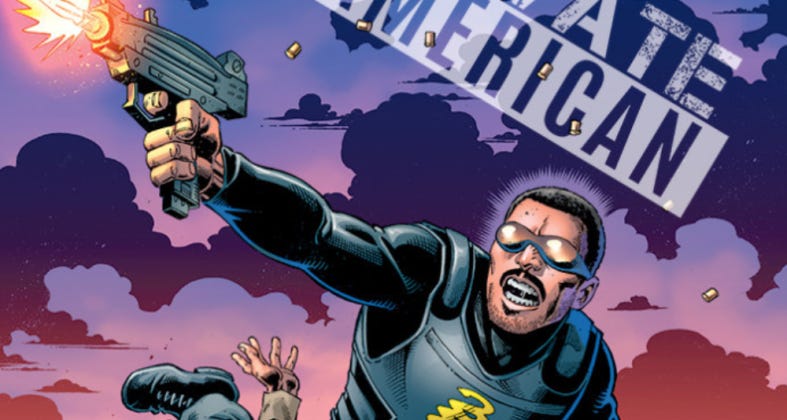
What if the Punisher deployed to America's southern border and brought smoke on the cartels, coyotes, traffickers, and terrorists? It would probably play out similarly to the story in this 73-page graphic novel. (Without the sidekicks and other allies, perhaps.)
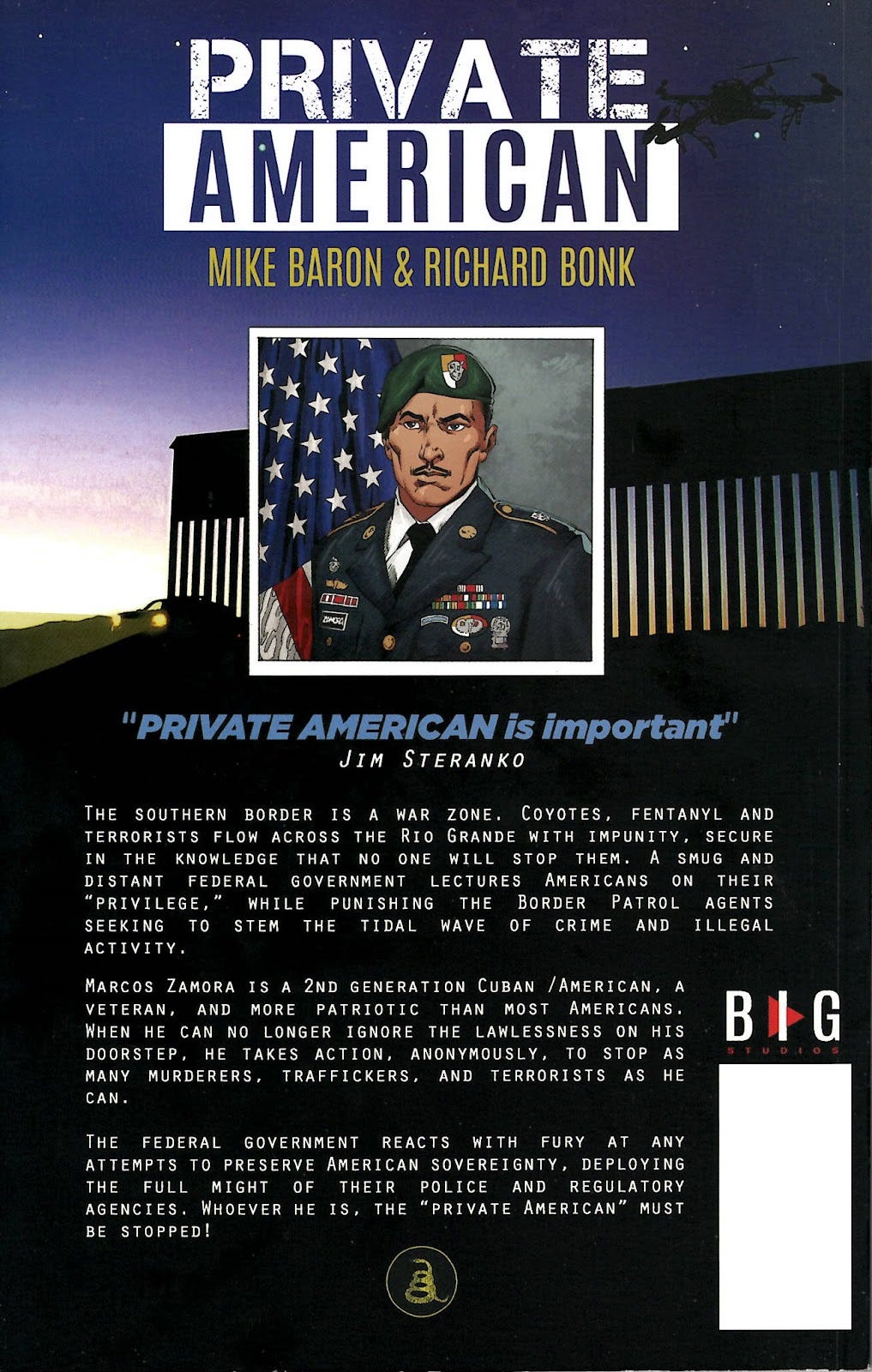
The Scenario:
As the story opens, Marcos Zamora, a US Special Forces vet of Cuban descent, is waging war on the southern border against the unchecked multitudes of invaders. It's a private war, because a typical America Last administration is more interested in destroying the country than defending it.
This book was published in '23. Yes: it was obviously inspired by then-current events and the status quo during the Dark Winter of the Biden Occupation.
THE HERO'S MOTIVATION:
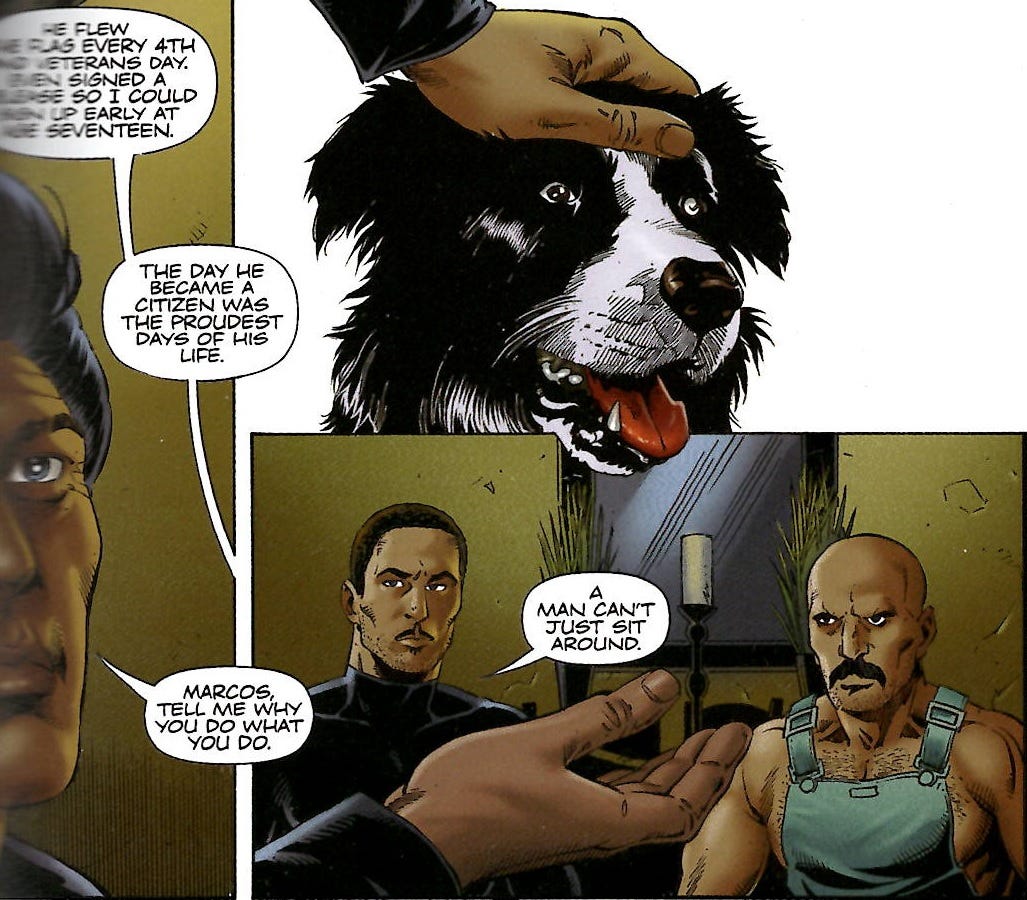
Zamora is operating on his own initiative, with no support or backup...at first. As he informs those who ask about his identity, he is simply a private American. When asked about his motive for this quixotic campaign, he usually replies, "A man can't just sit around." Sit around while his country is invaded and his countrymen terrorized and replaced, as one might finish the thought for him. Later, he adds, "They're going to come for me sooner or later. Might as well give them a reason." (Emphasis mine.)
Trump or no Trump, there are perhaps millions of Americans who mirror this attitude right now. Many are already there. Many are almost there. And more join us every time our domestic enemies let the mask slip.
STORY:
A cartel south of the border, and the Cabal north of it, realize their assets are being taken out by an unknown operative dealing out vigilante justice. Both mobilize forces to stamp out this resistance to the New Normal. Two competing assassins are a part of this counteroffensive. This transforms the Private American's Bolanesque war-on-the-mafia-adjacent mission to something more personal.
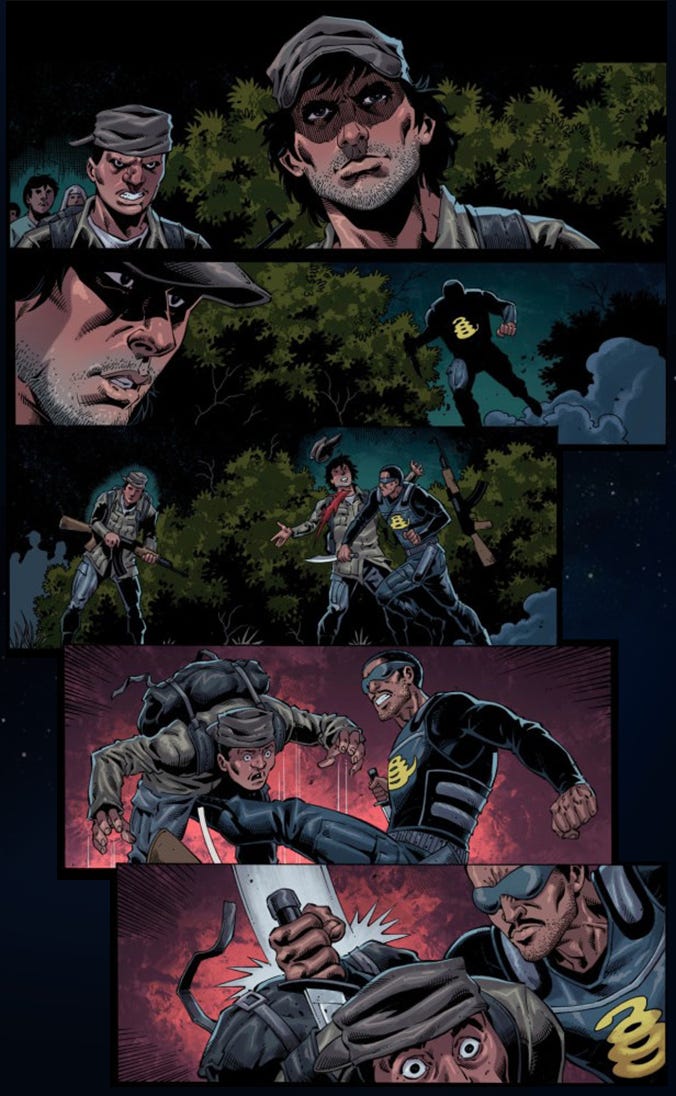
Walleye and the other assassin are nobody you'd want to mess with. But then, neither is the Private American.
Baron wrote a solid and believable men's adventure banger. The Woketard Hive Mind's hysterical efforts to cancel this book should tell you this is an honest and relevant tale, told well.
ART:
Richard Bonk's line art and Marco Freire's colors are top-tier. The art exudes a satisfying blend of realism, pulpy action, and a dark, hardboiled aesthetic. The interior pages look as good, if not better, than the cover of my copy.
Perhaps because of so much dark ink being necessary, those pages are exceptionally robust. They are thicker and stronger than the cover pages on the classic comics of years gone by. I'm far from an expert, but they remind me of cardstock, with a semi-gloss finish.
NITPICKS:
As good as Baron's writing is here, it is not without weaknesses.
A lost and captured aerial drone plays a crucial role in driving the plot, but there's never any reference to it until a member of the opposing force mentions it was recovered near the scene of a vigilante action. As a reader, this would have struck me as less of a plot device tacked on after the script had been started if we had seen Zamora using it in an earlier scene. Then, he remarked that it had been lost, but he had to exfil without searching for it due to time constraints. Then worrying about it being recovered and traced back to his friend and him.
In this and other places, this is one of those rare books that would benefit not from trimming, but from adding pages here and there to help the reader keep his bearings.
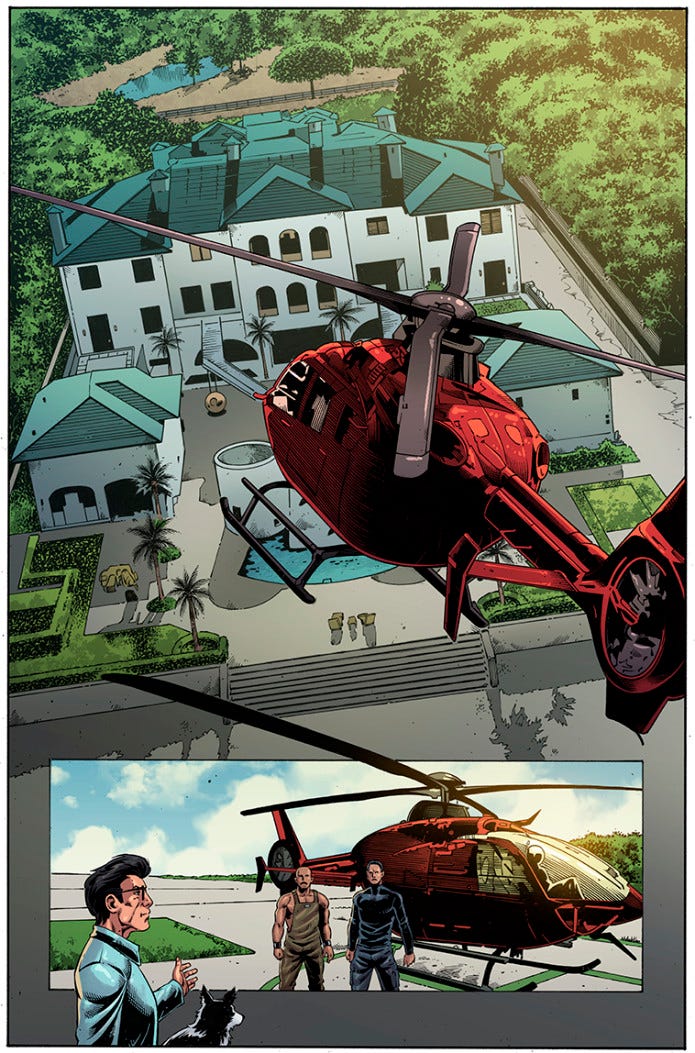
Dialog sometimes confused me. Topping the list was an early reference to "the fentanyl sentinel." It would make sense if this was their name for Zamora, since he's been confiscating shipments of fentanyl during his bushwhacks of the smugglers, then dropping them off anonymously to the feds. But in the conversation, they use the phrase "on a bike." Private American drove a truck to his objective. It was one of the assassins who traveled by motorcycle--but he was a hit man, not a drug mule. Maybe the characters are confused about who was who and did what, which would make sense. But the reader isn't told if they are or not, which shifts that confusion to us.
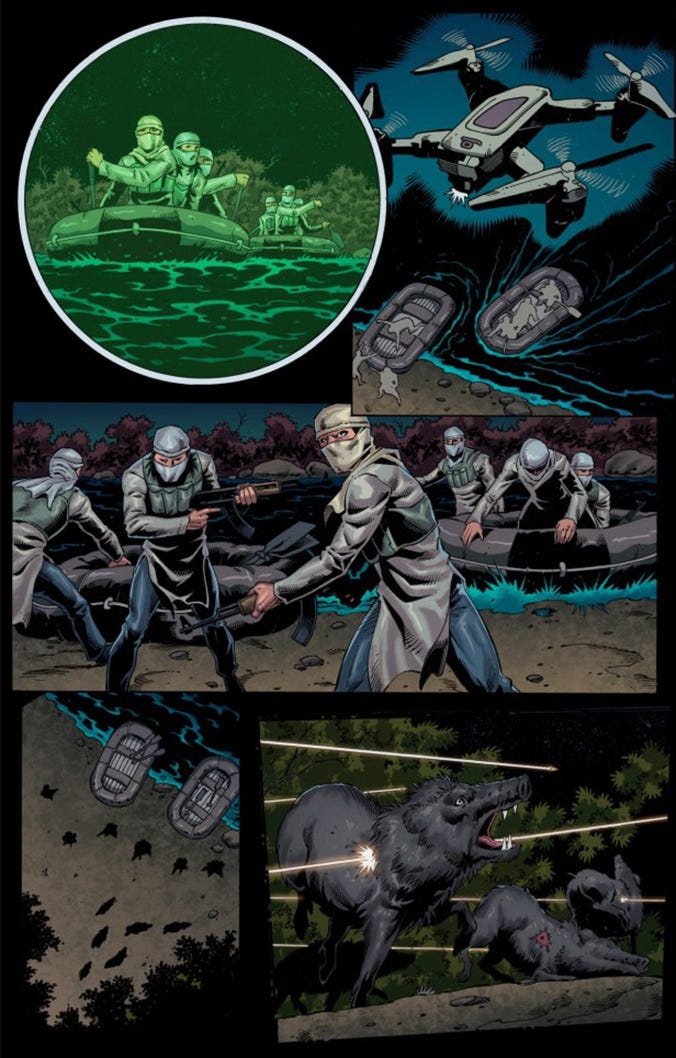
Occasionally It's difficult to discern who is saying what. There's a rather consistent issue with the balloon tails not pointing at the speaker with precise accuracy. In one panel the tail simply terminates into the margin between panels and, combined with the content of the dialog, renders it unclear whether it's the dialog of a character outside the panel, or meant to be part of the monologue by the talking head within it. It's possible, the way the image is composed, the layout implies these balloons are extended from a balloon below them. But who knows?
The art also suffers some anomalous mistakes--such as a character eating a slice of pizza from a pizza pie clearly not missing a slice.
IN CONCLUSION:
Regardless of any nits I and others can pick, this is an outstanding work of sequential art storytelling. You should buy a copy, read it and decide for yourself.
SPEAKING OF GRAPHIC NOVELS...
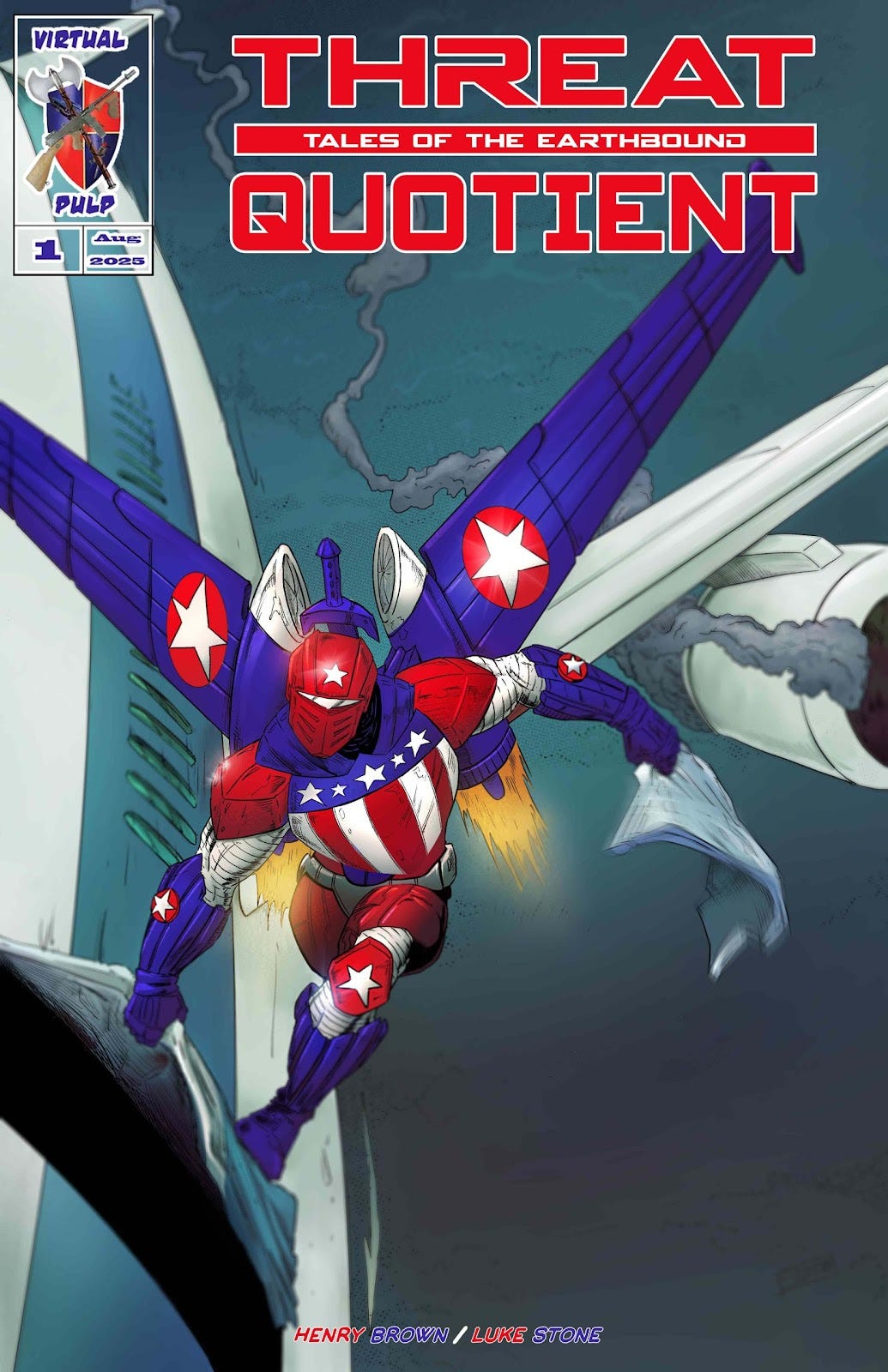
I have kicked off Tales of the Earthbound, a planned series of graphic novels. The first one, Threat Quotient, is drawing closer to a crowdfund campaign. I share episodes online every week and you should treat yourself to a superheroic escape.

I thought the art was great and the action solid, but the story was to clipped, and there's a preachy, tryhard quality to it, in terms of the simplistic way it too-easily vilifies its "close to real life" targets. Ever see those liberal productions that make you roll your eyes at the barely-changed parodies of Trump or Musk? Yeah, this feels like that, just for our side.
No no no! That's just the first issue split into three floppies! The new Pvt American is 72 pages of brand new material. Richard's working on it now.