


In the Current Year, legacy characters are “re-imagined” seemingly every other week. The parasitic SJWs controlling pop culture are unable to create anything new. The best they can manage twist what is already established to their own purposes. Quite often, this involves reboots with retcons. But reboots are not exactly new.
The origins of Batman and Superman were re-told during the Silver Age. Details like the identity of Thomas and Martha Wayne’s killer (Joe Chill) were added. Before Clark Kent arrived in Metropolis, he had a career as Superboy in Smallville, readers were told. Holy big fish in a small pond!
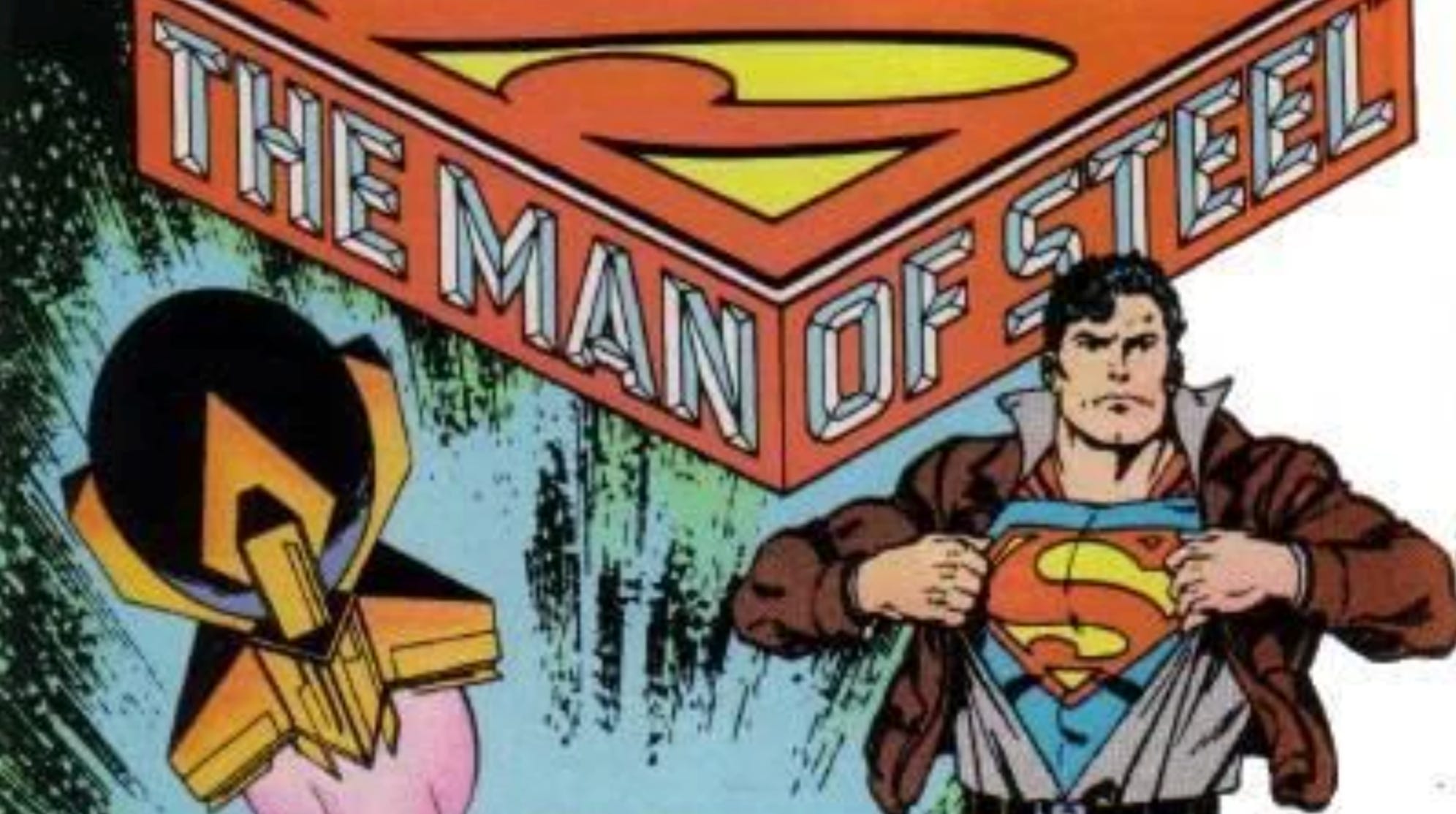
Reboots occurred more frequently during The Bronze Age. Then, in the mid-’80s, after Frank Miller’s Dark Knight Returns did it yet again, John Byrne (along with inker Dick Giordano) produced The Man of Steel mini-series, which would update Superman’s origin for the umpteenth time. This might be what triggered the mudslide of reboots we’re still suffering, 40 years later.
Some of the changes Byrne made are worth highlighting.
CHANGE #1–JOR-EL, LARA, KRYPTON AND KRYPTONITE:
Byrne’s Krypton was basically the planet Vulcan as explained in a Trek Classic episode: Society there made almost a religion out of keeping their passions in check. Everyone is disciplined, cold, sober, Victorian and boring. They never experienced a consciousness revolution, hippie movement or counterculture takeover, you see.
More commendable is Byrne’s modification to the doomed planet narrative and the origin of Kryptonite.
Kryptonians are worried because a plague (“the Green Death”) is ravaging their population. Jor-El explores beyond the symptoms to identify the core problem: some sort of “chain reaction” in the planet’s core is causing the eruptions of poisonous green gas; which is also irradiating underground ore deposits (presumably turning it green in the process?); but even worse, the chain reaction is progressing toward a cataclysmic super-eruption that will break Krypton apart.
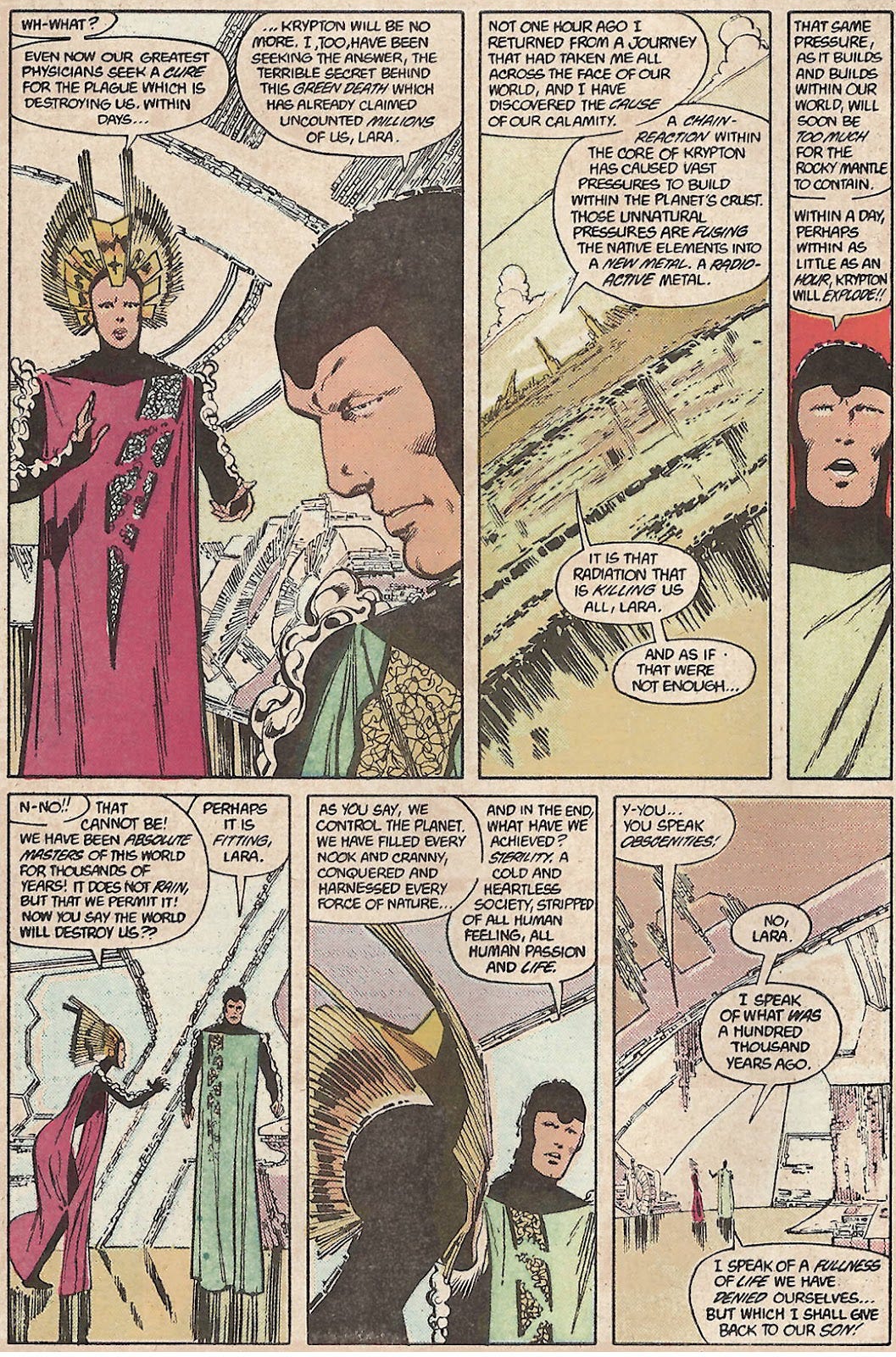
I’m not so sure about the scientific plausibility, but this explanation is an improvement on the previous mythology, which purported:
Rocks on Krypton were a luminous green color.
A Kryptonian exposed to rocks from his native planet would grow weak or even die.
Jor-El was a laughing stock on Krypton for insisting disaster was imminent, because nobody else witnessed any evidence that something was amiss.
CHANGE #2–LIFE WITH THE KENTS IN SMALLVILLE:
In this update to the origin story, Clark didn’t grow up pretending to be a wimp as his powers developed. In fact, he was a popular jock hero.
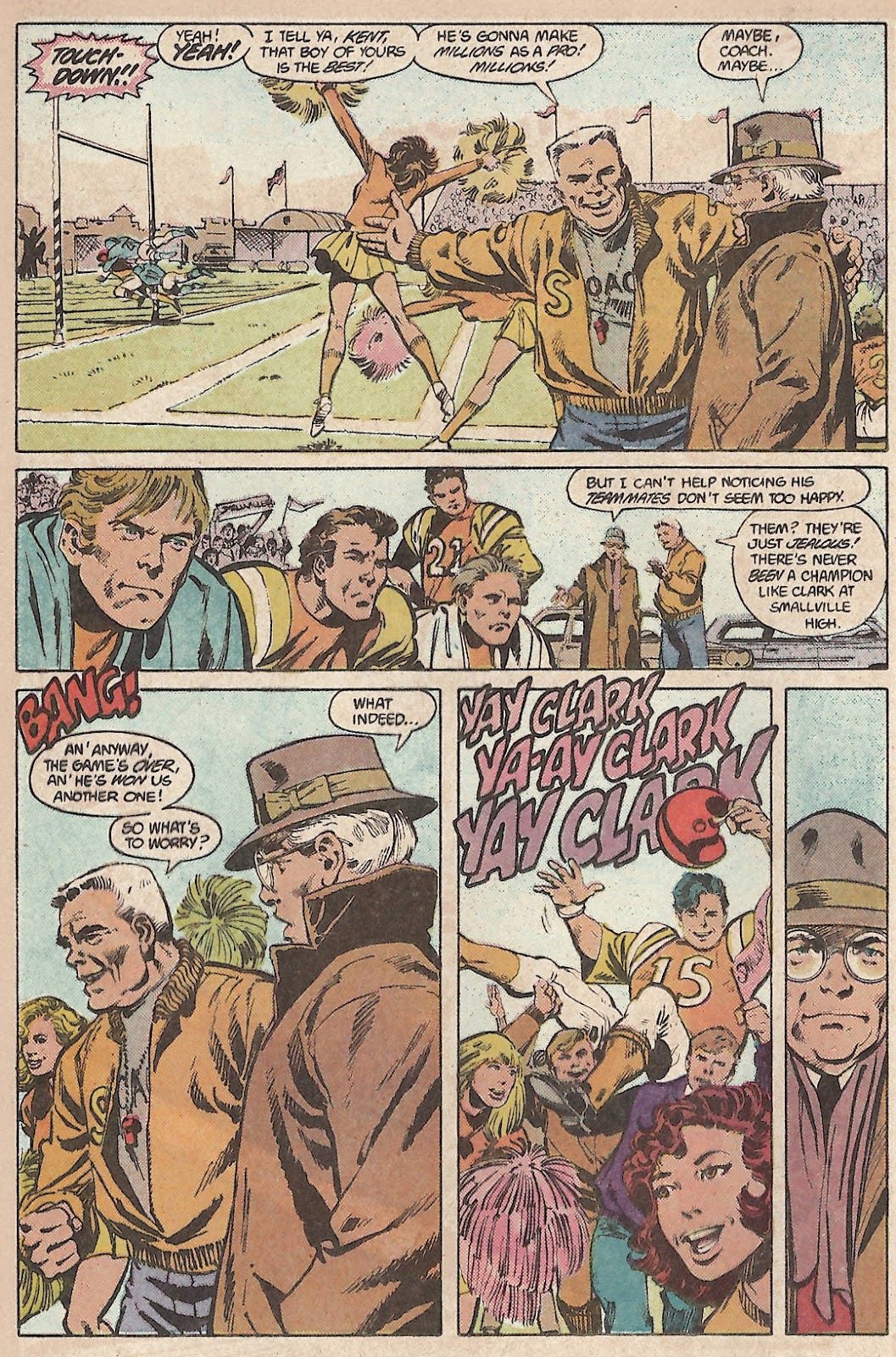
Jonathan Kent is disappointed in Clark because (ostensibly) he was blessed with powers to help people–not to win acclaim. Pa Kent says as much to Clark, who agrees and commits to hiding his superiority from then on. Because that’s so totally what a super-healthy teenage boy full of rampaging super-hormones in that situation would do.
In the DC continuity that followed Man of Steel, Lois would learn Superman’s secret identity. She and Clark would get engaged, later married. And that’s what the mythology has maintained through all the years and re-imaginings since. It was already canon by the time the Lois & Clark TV show came out.
I specifically remember Lois visiting Clark’s Metropolis apartment, noting his football trophies, and remarking that his free weights weren’t much heavier than what she used. (He bought the weights as an implied explanation for his hulking physique in just such situations. But all available weights were so light to him, he couldn’t tell the difference between 50 and 500 pounds.)
CHANGE #3–THE COSTUME:
In the 1978 movie, another modification had been introduced: the curvy shape in the shield emblem on the cape and chest was not an “S”–it was the El family crest that just coincidently resembled an “S”. When Jor-El addressed a group of his colleagues, he himself bore that emblem, while other Kryptonians all wore their own family crests with various symbols.
Not a bad retcon. I’m surprised Byrne didn’t adopt it.
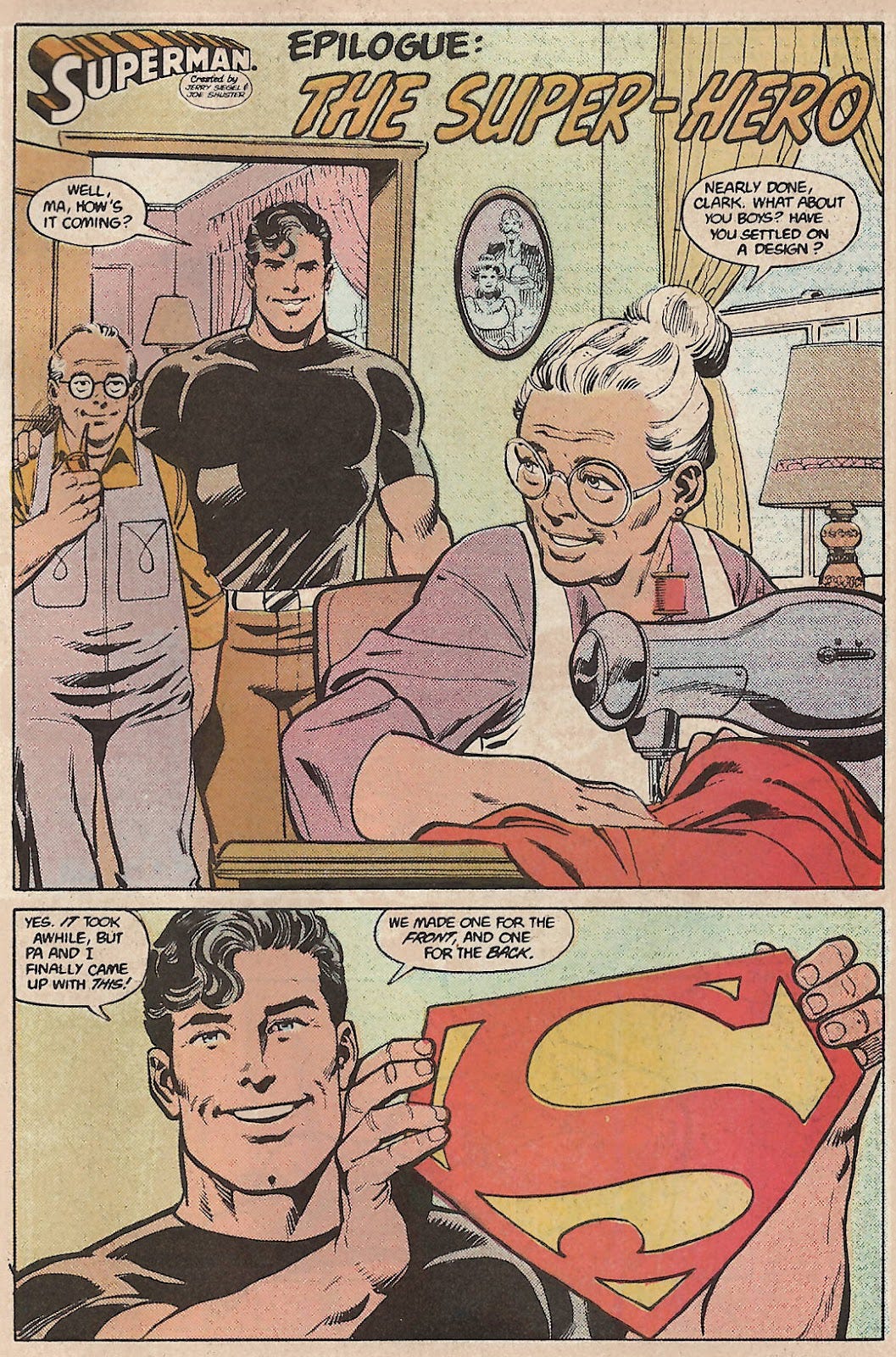
For whatever reason, Byrne had Ma Kent design the costume while Clark and Pa came up with the emblem. It’s not a Kryptonian family crest, so it must be an “S”. But the term “Superman” won’t be coined until Lois dubs him that later, after he’s moved to Metropolis and rescued a spacecraft with her onboard. He will then accept it as a moniker. So why the heck is there an “S” on the emblem beforehand?
GENERATIONAL FINGERPRINTS:
If I hadn’t named the writer or mentioned the year of its publication, astute readers would still be able to identify this comic as Boomer fare. One of the Boomer fingerprints is on Krypton.
THE HANDBUTLER’S TALE:
One of the dystopias feared by Boomers is a society where passions and emotions are suppressed (as also depicted in movies like Equilibrium and Pleasantville). The roots of this phobia, ironically, probably originate in the peaceful, prosperous, high-trust society the Boomers grew up in but found “boring” or “oppressive”--until they ushered in “the Summer of Love,” taking full advantage of ubiquitous hallucinogens and the newly available birth control pill.
Also ironically: plenty members of younger generations have invested in Boomer phobias, attitudes, and narratives. We’ve been immersed in Boomer sensibilities all our lives and it only makes sense that some of it would rub off on us. Some of us more than others.
THE SHAME OF EXCELLENCE:
Pa Kent’s platitudes about humility (or whatever his problem with Clark winning football games actually was) are just a smokescreen for another Boomerism: competition is wrong unless the best, most masculine, or most American competitor loses.
Remember “the Dream Team”? Other countries were sending professional athletes to the Olympics while Americans were sending amateurs. (That’s one reason why the 1980 USA Hockey Team’s undefeated Gold Medal run was so miraculous.) But in the ’90s, the USA fielded an Olympic Basketball Team made up of professionals, like the other countries did. Boomers went apoplectic about how unfair and unsportsmanlike it was for America to send its best athletes to compete against the best athletes from other countries. They screeched like it was Vietnam again in microcosm (except Americans were allowed to win this time).
All this from people who insist America was never exceptional.
Notice Clark didn’t hurt anybody on the football field. The disapproval projected into Jonathan Kent by the writer is because Clark’s superior athleticism made other players feel bad.
Clark Kent is an extreme example, of course, but sports are dominated by those with genetic advantages. Just like wars are won (or at least can be won if policy makers allow it) by countries with advantages in leadership, manpower, technology, and industrial capacity. In either case, those who are not so advantaged have to suck it up and drive on.
There are other Boomerisms at work, too, but you get the idea. Suffice it to say that Man of Steel #1 is a mixed bag of a reboot.
If you happen to find one at a yard sale or flea market, it might be worth your while.
Check out my graphic novel, Threat Quotient. It’s set in a reality much like ours, except not only do superheroes exist, many of them are used as special operators by the globalist Establishment to enforce regime change, conduct humanitarian operations, but most importantly, to crush resistance. Unfortunately for them, there are superpowered dissidents who are not easily crushed.
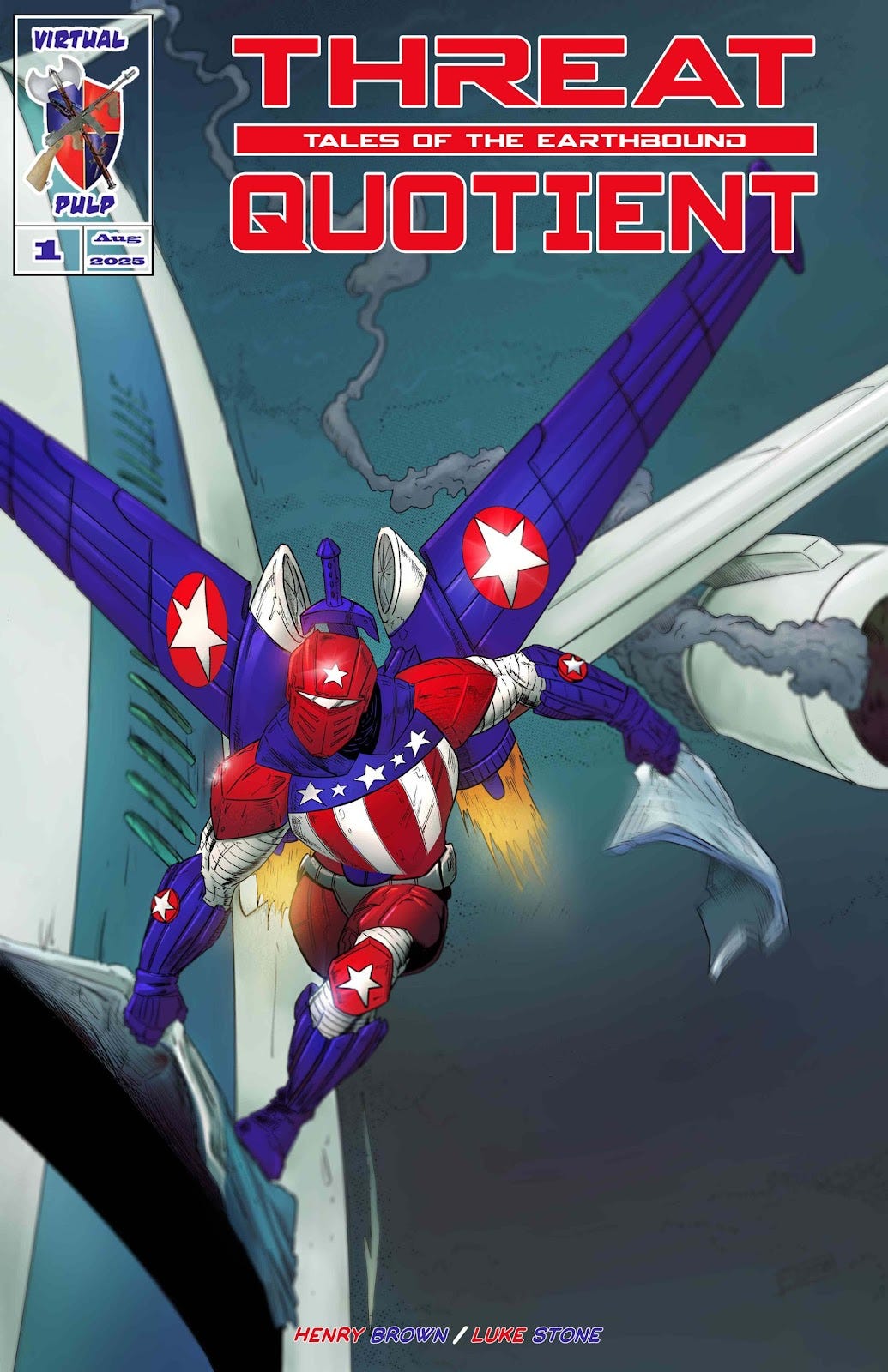
The print version is more than halfway to getting published. I’m sharing episodes digitally for free on Tales of the Earthbound, lest anyone be unaware of what this 108 page graphic novel is about. Binge yourself up-to-date and see if you like it!

I disagree about Superman playing sports. It is as unfair as when male transvestites play against women in sports -- the genetic advantage is beyond the natural variance for the group the sport is meant to be a fair competition among. A Kryptonian vs human men is as unfair as a human man vs human women.
John Byrne's GENERATIONS was good. It got me up to speed on not only the Superman canon but the Batman canon as well.