


Since Digimon: Story Time Stranger came out, I’ve had people ask me about Digimon in general and how best to get into the franchise. As in, which season should they start with as far as the TV show should go? Of course, I would recommend starting with the original show, Digimon Adventure (1999) and, preferably, the Japanese version with English subtitles.
Why the Japanese version?
The tone of the Japanese version retains the original emotional nuance and seriousness of the story. Dialogue is also more mature and thematically consistent. On the other hand, the English dub is infamous for adding jokes, puns, and pop culture references that dilute dramatic scenes. It often shifts tone toward comedy, especially in tense moments.
Moreover, the Japanese version features a more atmospheric and emotionally resonant soundtrack, including iconic insert songs like “Brave Heart” and “Butter-Fly.” The English dub replaces most of the original music with a generic score and the “Digimon Theme” (“Digimon, Digital Monsters…”), which is catchy but can become grating or repetitive over time.
The Japanese version also preserves character arcs with subtlety. It explores darker themes like death, existential fear, and familial tension. Sadly, the English dub often simplified or censored those themes. In addition, the Japanese version keeps cultural references, naming conventions (like honorifics), and setting details (like the Japanese setting) intact. The English dub localizes heavily, changing names (e.g., Taichi to Tai), removing Japanese text, and sometimes completely altering plot points.
Finally, watching the Japanese version helps maintain continuity across Adventure, Adventure 02, and later entries like tri and Last Evolution Kizuna, which were released with more faithful subs.
The Animation
The animation for the show was economical. Digimon Adventure was produced on a tight budget, typical of serialized anime at the time. This means there are lots of static shots and reused transformation sequences. Backgrounds are often flat, sparse, or looped, especially in digital world scenes. Character motions are also highly simplified and dialogue scenes rely heavily on mouth flaps and still poses.
But, again, this was all “economical” because the series used its constraints strategically. Emotional beats often land through strong composition and lighting and not fluid animation.
Much of the design was also driven by the show’s motif which means the digital world’s surreal minimalism reinforces its alien logic. Moreover, the show’s narrative pacing leans more on character arcs than battle scenes, letting story carry where visuals economize.
Overall, Digimon Adventure is a great case study in how low-budget aesthetics can still support mythic storytelling, especially when paired with strong voice acting and music.
Story and Themes
Spoilers ahead...
The show’s story is about seven children from Odaiba (Tokyo, Japan). They go on a school camping trip into the mountains where they are suddenly thrown into the Digital World. There, they are befriended by several Digimon (Digital Monsters) and are paired with them via handheld electronics called a “Digivices.” From there, the children set off to find their way home, only to be confronted with unthinkable dangers.

The children are pitted against many threats, each proving stronger than the next and requiring the children to enact virtue so that their Digimon partners may evolve into stronger creatures. As their journey continues, they eventually learn that they were specifically chosen to save the Digital World from forces of evil. Noteworthy is that that the franchise utilizes many literal incarnations of evil creatures as the primary villains, including a devil (Devimon), a vampire (Vamdemon), a clown (Piedmon), and hell itself (Apocalymon).
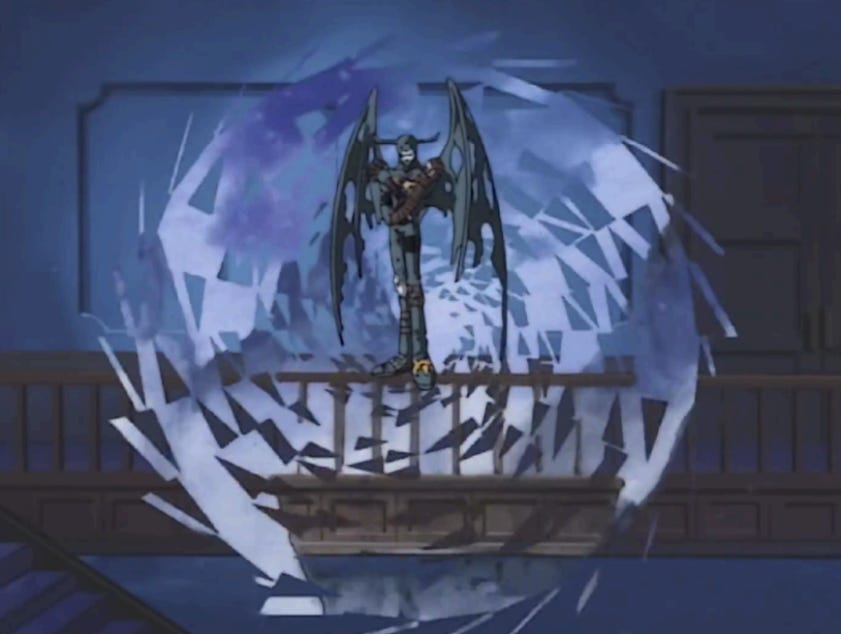
The show’s writers forwent using the Digimon as a bunch of franchise collectables (like Pokemon) and, instead, made them creatures that live and thrive within their own societies in the Digital World. This creates a world that is simplistic and whose interactions mark it as a place of fables. Digimon Adventure feels mythic at times. While many of the lesser evolved Digimon may appear simplistic in design, their evolved forms are sometimes endowed with ancient signs and symbols including, but not limited to, the cross of Jesus Christ. Digimon like Angemon and MagnaAngemon are literal angelic figures, often wielding holy powers and cruciform motifs.
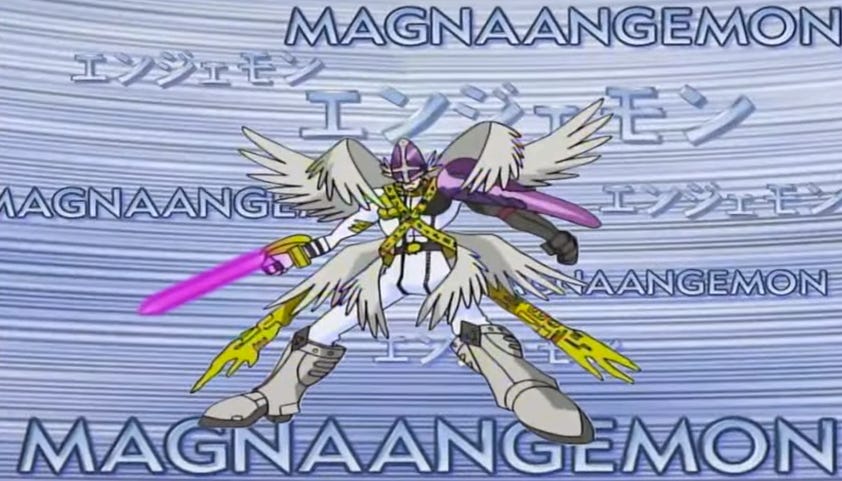
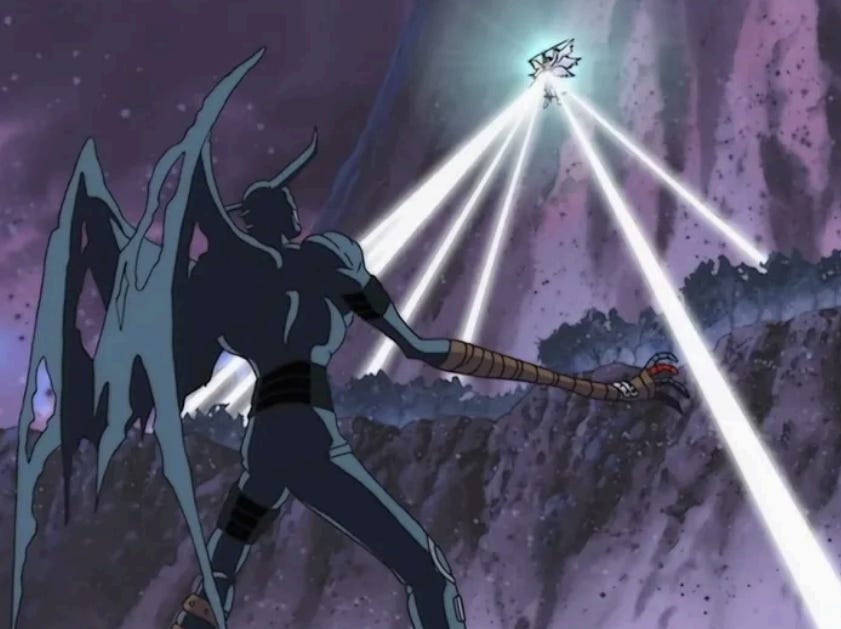
The first arc of the show is structured similarly to C.S. Lewis’s The Lion, The Witch, and the Wardrobe in that the children arrive in a land under the oppressive hand of tyranny. They even meet with a noble lion (Leomon) who informs them of their purpose in the Digital World. What at first seems to be a show about children trying to survive being killed by mindless beasts on an island eventually turns into something far more cosmic when they encounter Devimon, a literal incarnation of evil whose cunning and trickery very nearly lead to the children’s demise. The children eventually prevail, but only due an act of divine intervention (Angemon) and ultimate sacrifice.
One of the most remarkable aspects about the show is how dedicated the writers were at making the children unique characters rather than caricatures. A distinct measure of humanity was distilled into each and every child, making their plight compelling. As early as the third episode, what proceeds is a simple night by the lake in a strange new world and being attacked by a sea monster. However, the episode also includes a brief campfire scene where the children have a scuffle ending in one of them privately confessing that his parents are divorced.
These kinds of developments are not trite either, they are worked into the behaviors of the children with due diligence. The baggage the children carry with them impacts their behavior and their Digimon partners by extension. Even more compelling is the fact that the children don’t always get along with each other leading to bouts of infighting that threaten their cohesion.

Among all the arcs of the show, the first and final are most assuredly bordering on mythological, drawing from classic tropes and merging them with modern aesthetics. The final arc has the children witnessing the Digital World at the brink of destruction as the principalities and powers of the Digital World (the Dark Masters) gather in unison to create a twisted monument of nature, technology, and pure darkness. The children are tested to the point that nearly every one of them is left in a state of utter despair with their only saving grace as divine intervention.
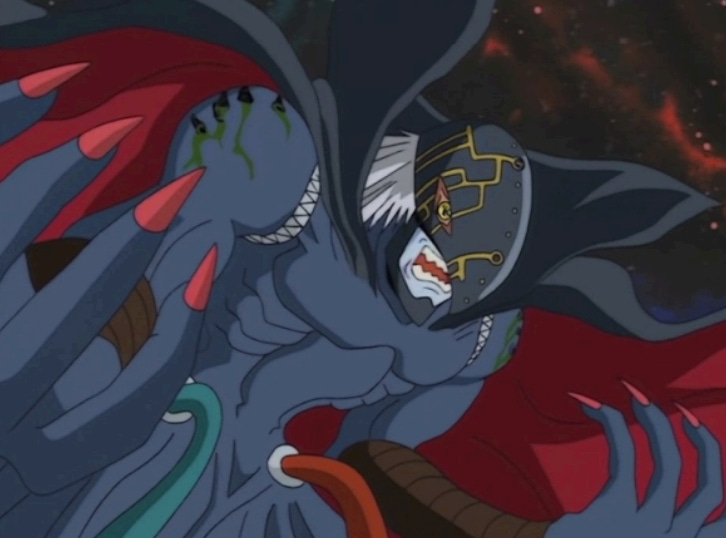
All culminates in a grand battle against the incarnation of Lucifer himself: an amalgamation of a Digimon calling itself legion (he is many), chained within the depths of the abyss, and crying out in vengeance for being cast out of heaven.
Prodigious!
Conclusion
Throughout its history, from season to season, the Digimon TV franchise has repeatedly attempted to reinvent its core premise. Yet, Digimon Adventure is the season that started them all and no other season can compare.
To this day, the show holds up. Much of that must be owed to its mythic good vs evil motif and its chosen children as Christian allegories. The children go on a grand journey that mirrors apostolic missions including trials, revelations, and sacrificial growth. Each child has a crest (Courage, Love, Hope, etc.) that represents a moral virtue akin to fruits of the Spirit. Their Digimon evolve only when the children embody their virtues, reinforcing the concept of spiritual growth as transformative. Moreover, the digital world is a battleground between light and darkness with characters like Devimon and Vamdemon embodying demonic archetypes. The narrative frames evil as seductive, corrupting, and ultimately doomed. All in all, it is a classic Christian moral structure.
The legacy of Digimon Adventure endures not because of monsters or battles. It endures because it speaks quietly and unmistakably in the language of faith, virtue, and redemption.
NEXT: Angel Studios Releases First Trailer For Season 3 Of ‘The Wingfeather Saga’

I only caught a few episodes of Digimon when I was a kid and didn't think much of it. Your article makes me want to go back and investigate it fully.