


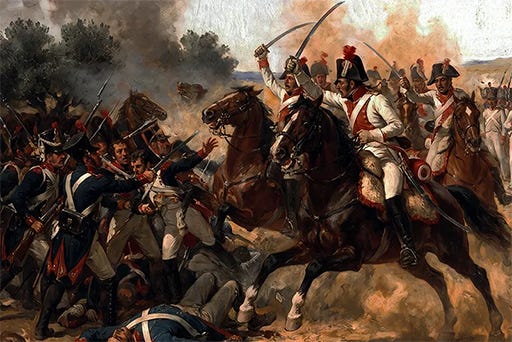
Castalia Library has published Bailén, the fourth volume of Benito Pérez Galdós’s Episodios Nacionales, now available on Kindle, Kindle Unlimited, and audiobook. The pace of publication confirms what Vox Day stated when the series launched: Castalia is translating all forty-six novels in the cycle, and they are moving.
For readers encountering the Episodios Nacionales for the first time: Pérez Galdós is widely regarded as the greatest Spanish novelist since Cervantes. He published forty-six historical novels across four decades beginning in 1873, tracking one fictional narrator, Gabriel Araceli, from the naval disaster of Trafalgar in 1805 through the upheaval of the Napoleonic Wars and the decades of Spanish political catastrophe that followed. Only eight of those forty-six volumes have ever been translated into English before Castalia’s intervention. Thirty-eight novels from one of the supreme achievements of European realism were simply inaccessible to readers who do not read Spanish. Castalia is fixing that.
Bailén is the fourth installment, and it delivers what Pérez Galdós built his reputation on: a battle narrative that is simultaneously a personal story. July 1808. Gabriel is now a young soldier who survived the slaughter of the Dos de Mayo. Napoleon’s armies have crushed Austria, humiliated Prussia, and forced the Tsar to the negotiating table. Twenty thousand French soldiers occupy Andalucía. Fourteen thousand Spanish troops, raw recruits and hard regulars, march south to meet them on the plains before Bailén under a killing Andalusian sun.
But Gabriel is fighting two wars. On the battlefield he faces Dupont’s veteran infantry. In the intercepted letters he carries in his coat, he faces the news that Inés, the woman he loves, is to be married to his commanding officer’s son. The battle of Bailén — the engagement that shattered the myth of Napoleonic invincibility for the first time and changed the course of European history — runs in parallel with Gabriel’s private reckoning.

The excerpt included in the announcement is a masterclass in historical prose. The description of the guerrilleros harassing the French columns around Andújar — “a deadly swarm” that scattered through villages and hamlets, poisoning wells, burning granaries, dismantling mills and burying the stones so no grain could be ground — is nineteenth-century narrative journalism of the highest order. Pérez Galdós tracked down the survivors of these campaigns decades after the events to get the details right. The prose carries that weight without announcing it.
The scope of what Castalia is building only becomes clear when all four volumes are considered together. Volume one, Trafalgar, put Gabriel aboard the Santísima Trinidad as a fourteen-year-old orphan on the day Nelson destroyed the combined Franco-Spanish fleet. Volume two, The Court of Carlos IV, moved him from the deck of a warship into the drawing rooms and backstage corridors of Madrid’s Teatro del Príncipe, navigating the conspiracies of a court in dissolution while barely understanding what he was carrying. Volume three covered the Dos de Mayo. Volume four covers Bailén. Pérez Galdós is building Spain’s Napoleonic catastrophe from the ground up, one episode at a time, through the eyes of a narrator who witnesses everything and understands it only in retrospect.
That retrospective narration is the series’ essential device. Gabriel tells the story as an old man. He knows what every event meant. His younger self did not. The gap between what the boy could see and what the reader understands, guided by the narrator’s ironic distance, is the engine of the whole cycle. It is the technique of Tolstoy and Stendhal applied to a national history that English readers have never had access to.
Forty-two volumes remain. Castalia has confirmed hardcover editions will be available. The paid Castalia Library Substack receives each new ebook on publication day.
Bailén is available on Amazon now. The series begins with Trafalgar.
Are you following the Castalia Episodios Nacionales series? Let us know in the comments.
NEXT: Publishers Are Lamenting the Collapse of LGBTQ Children’s Books Right as Pride Month Begins