


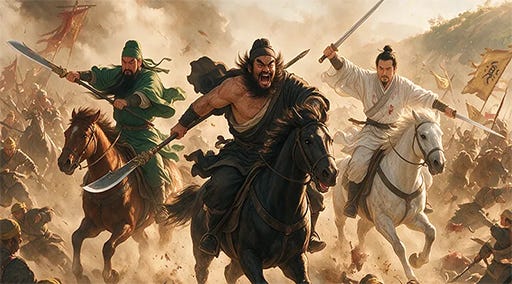
Castalia House has begun releasing the first complete English translation of Eiji Yoshikawa’s Sangokushi, the retelling of the Three Kingdoms saga that has stayed continuously in print in Japan for over eighty years. The publisher will release all ten volumes in daily installments over the next two weeks, giving English readers the full epic in a compressed run instead of the years-long wait that usually separates volumes of a major translation project.
Yoshikawa is the best-selling novelist in Japanese publishing history. His novel Musashi has sold an estimated 120 million copies, and Sangokushi has sold more than 80 million. The story was serialized in the Chūgai Shōgyō Shinpō, predecessor to today’s Nikkei, from August 1939 to September 1943. The video game franchise that introduced most Western audiences to the Three Kingdoms cast, Koei’s Dynasty Warriors series, draws more from Yoshikawa’s version of events than from Luo Guanzhong’s fourteenth-century original.

That original, the Sanguo Yanyi familiar to English readers through the Moss Roberts translation, is a chronicle: eight hundred thousand words of war and statecraft told by an omniscient narrator who introduces characters by their attributes and lets them perform accordingly. Yoshikawa’s afterword to the new translation frames the difference through two epics English readers already know. The gap between Sanguo Yanyi and Sangokushi, he writes, is the same gap that separates The Silmarillion from The Lord of the Rings.
The afterword lays out how Yoshikawa built that gap. The Chinese original opens with the Yellow Turban Rebellion and moves straight to the Peach Garden Oath. Yoshikawa instead opens with Liu Bei walking into the city to sell the family sword and buy medicine for his sick mother, who throws the medicine into the river once she learns what he gave up for it. None of that scene exists in the Chinese source. Neither does the girl Furong, the bandit encounter on the river, or the village school where Liu Bei studies. Yoshikawa invented all of it so readers would know Liu Bei as a person before he swears the oath that starts the war.
The same method reshapes Cao Cao. Chinese tradition casts him largely as the villain who perverts the mandate of Heaven. Yoshikawa’s version gives him interiority: a man whose subordinates follow him for reasons the reader can see, whose ruthlessness sits next to a real poetic sensibility. The afterword states plainly that readers will find themselves preferring his company to the hero’s at points, and that Yoshikawa built the novel expecting that reaction from his audience.
Castalia House paired the Sangokushi release with a second classics project: The Complete Poetry of Genji Monogatari, collecting all 795 waka embedded in Murasaki Shikibu’s Tale of Genji. In Heian court life, poetry carried the weight that conversation carries now. A well-turned verse signaled breeding and intelligence; a clumsy one exposed a courtier as graceless. The new translation renders that hierarchy in English through a five-tier system, one scale for male characters and one for female, so a reader who has never studied waka can still hear the difference between Prince Genji’s verse and a minor courtier’s. Genji’s poems land with the fused ease of a top-tier composer, and Murasaki no Ue answers him at the same level. Lady Rokujō’s poems carry an intensity that borders on danger. The Safflower Princess writes technically correct lines with no ear for rhythm, and the Lady of Ōmi produces verse with the confident gracelessness of someone who never grasped what poetry is for. Each poem is numbered 1 through 795 and indexed for reference, so the volume works as both a companion to the novel and a standalone anthology of Heian-era court poetry.

Both projects put Castalia House in competition with the university presses and legacy publishers that have handled Japanese classics translation for decades, betting that a faster release schedule and full access to source material will pull readers toward the new editions.
How many of the ten Sangokushi volumes do you think the daily-release format will carry through the full two weeks?