


California Attorney General Rob Bonta accused Paramount Skydance CEO David Ellison of trying to blackmail the state Tuesday after reports surfaced that Ellison told senior executives he’s prepared to move Paramount, and eventually Warner Bros. Discovery, out of California entirely if Bonta refuses to negotiate a settlement in the antitrust lawsuit blocking their merger. Bonta responded on X that Paramount was making another attempt to blackmail the state into letting an illegal deal through, adding that the company had “lost the plot” as it continued losing in court.
The threat, first reported by industry newsletter Puck and confirmed by Variety, traces back to a meeting last week where Ellison caught his own leadership team off guard. He told them that while he expects Paramount to win at trial, the Paramount Skydance board has already approved beginning relocation out of California as early as October 1 if settlement talks haven’t started by then. Sources say Georgia, Texas, and Tennessee are all under consideration, and Tennessee’s deputy governor, Stuart McWhorter, has already sent Ellison a letter courting the move. The timing lines up with Larry Ellison’s own company, Oracle, currently relocating its headquarters from Austin to Nashville, giving the Ellison family a second Tennessee relocation in motion at the same time.
October 1 isn’t an arbitrary deadline. That’s also the date Paramount’s $7 million-per-day “ticking fee” to Warner Bros. Discovery shareholders kicks in under the terms of the merger agreement, a penalty triggered by the deal’s continued delay. A federal judge set the underlying antitrust trial for March 2027 in Oakland after twelve state attorneys general, led by Bonta, sued in July to block the $111 billion merger, joined by a separate Writers Guild of America lawsuit. If Paramount ultimately loses that trial, the company owes Warner Bros. Discovery a $7 billion termination fee on top of whatever ticking fees have accumulated by then.
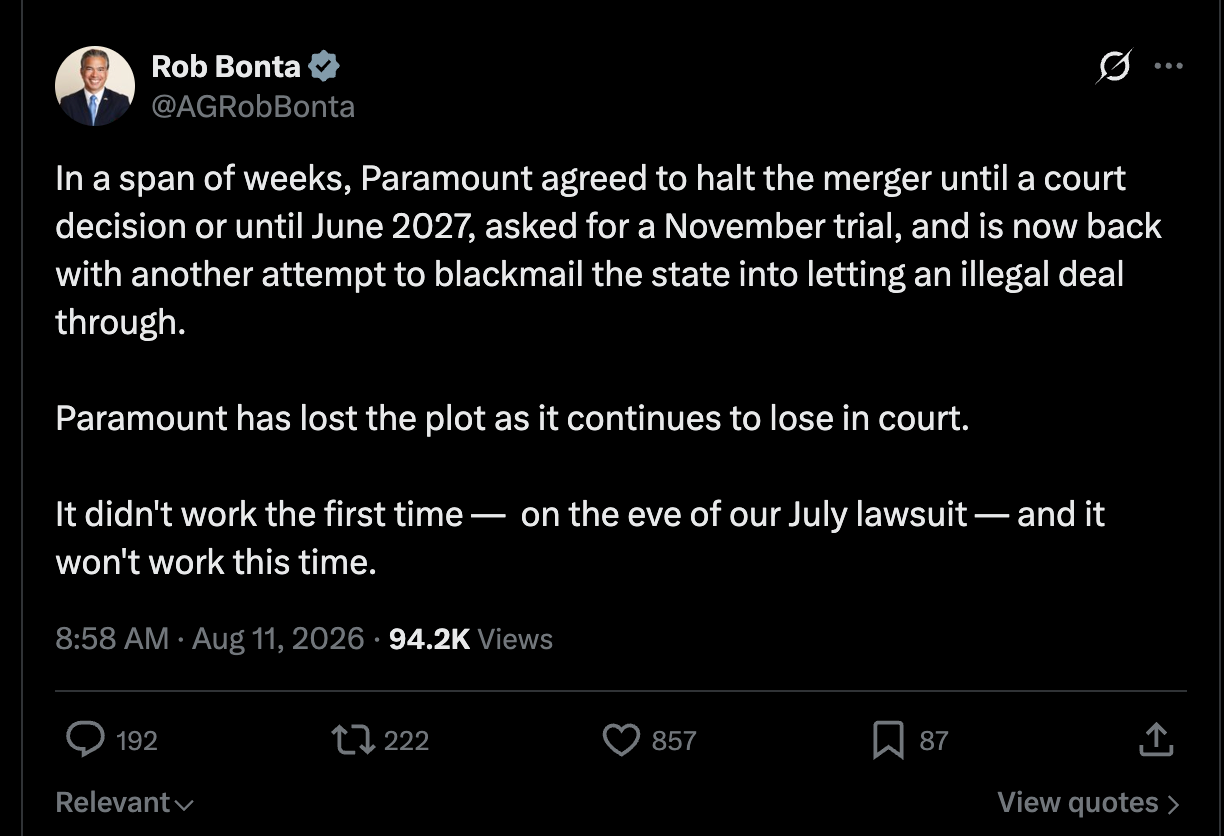
Bonta’s statement traced what he characterized as a pattern of shifting Paramount positions over a short stretch: agreeing to delay the merger until a court ruling or June 2027, whichever comes first, then requesting a faster November trial date, and now threatening to leave the state entirely. He argued the underlying case isn’t political, noting the lawsuit survived an early motion to dismiss, and said the state remains committed to blocking a deal his coalition considers illegal regardless of where Paramount decides to headquarter itself. Paramount has declined to comment on the relocation reports.
This is the second time in a matter of weeks a piece of merger-related leverage has become public. It follows earlier reporting that California itself carries real economic exposure if the deal collapses or Paramount actually leaves the state, and separate industry chatter about what other pressure points, political or financial, Ellison might still have available to save the acquisition. Whether the relocation threat is a genuine plan or a pressure tactic aimed squarely at Sacramento, Paramount now has a hard deadline of its own making, and seven weeks to decide whether it’s bluffing.
Does a company threatening to abandon its home state count as a real business decision or as exactly the kind of coercion Bonta is accusing it of, and does it matter which one it actually is if Paramount follows through either way?
"He argued the underlying case isn’t political"
It's all about CNN. Bonta's arguments don't hold any water since I didn't see him protesting Disney's merger with 20th Century Fox, Netflix when it was buying Warner Bros. or any other major merger.
I think both are true. It is a business move and a way to slap California for their interference.