


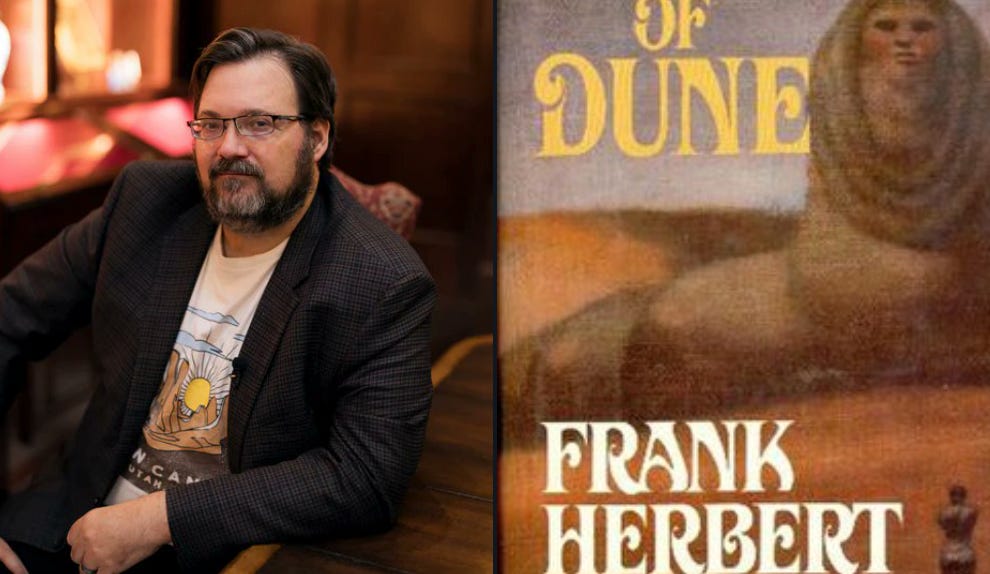
With Dune: Part Three arriving in theaters December 18, 2026, the conversation around adapting Frank Herbert’s complete Dune saga has never been louder. Denis Villeneuve’s adaptation of Dune: Messiah is already generating significant anticipation, with a trailer dropping March 17th and a cast that includes Timothée Chalamet, Zendaya, Florence Pugh, and Anya Taylor-Joy. But as the franchise looks toward its future, one of fantasy and science fiction’s most prominent writers is raising a provocative question: what happens when you get to God Emperor of Dune?
Brandon Sanderson, in a recent episode of the Intentionally Blank podcast, offered a blunt assessment that will resonate with anyone who’s read Herbert’s fourth novel in the series.
“I don’t think it is even possible to make a good movie—a good adaptation—of God Emperor,” Sanderson said. “It’s so fundamentally weird.”
The Context: Dune’s Cinematic Momentum
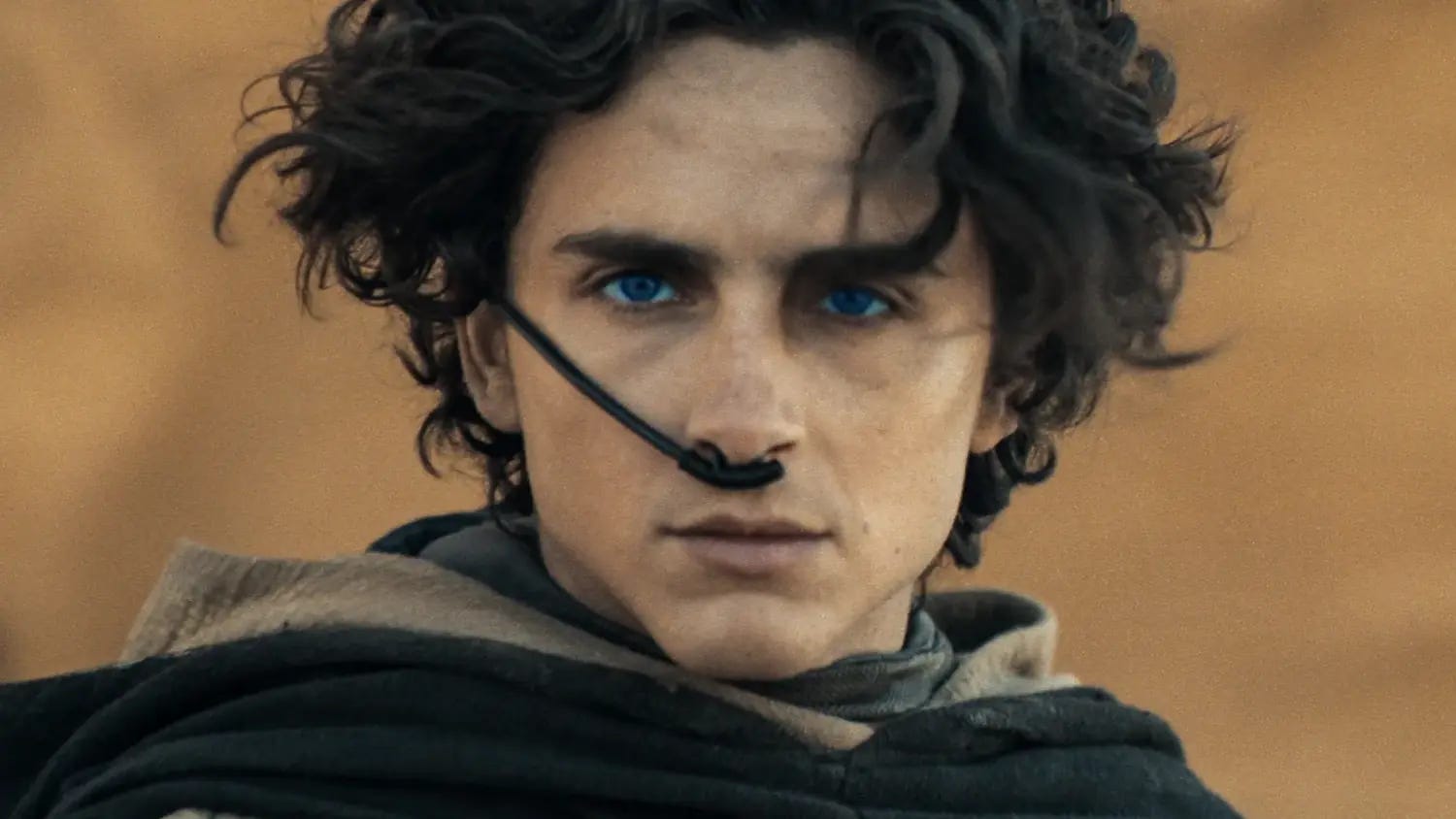
The skepticism is notable precisely because the franchise has earned it. Villeneuve’s first two films represent one of the most successful science fiction adaptations in Hollywood history. Dune: Part One (2021) earned $401 million worldwide and won six Academy Awards. Dune: Part Two (2024) exceeded expectations, grossing over $700 million globally and cementing Villeneuve’s vision as the definitive screen version of Herbert’s world.
Part Three adapts Dune: Messiah—already the saga’s most controversial novel among casual fans. Where Dune is a hero’s journey, Messiah is its systematic deconstruction. Set 12 years after Paul Atreides seized the throne, it follows Paul dealing with the consequences of his rise to power—Fremen disillusionment, Bene Gesserit scheming, and the crushing weight of a jihad fought in his name across the known universe. Timothée Chalamet faces the challenge of playing a character Herbert deliberately designed to fail his own mythology.
Villeneuve has already demonstrated a willingness to deviate from the source material, most notably in his handling of Chani’s arc, which in Herbert’s novel ends very differently than the film version suggested. That creative flexibility will be tested even further in Messiah.
The God Emperor Problem
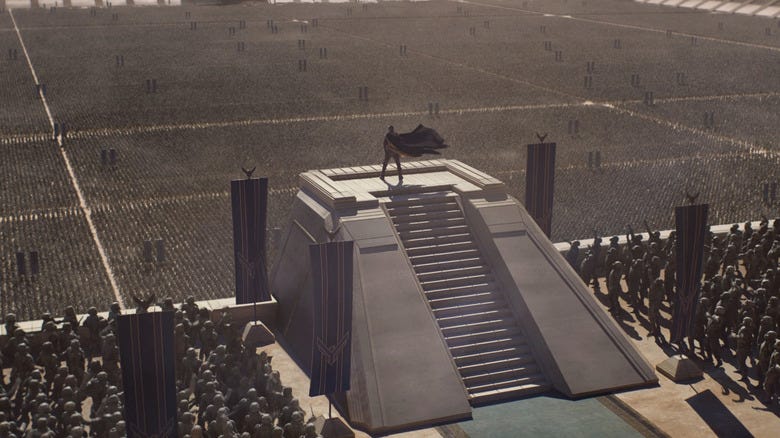
But Messiah is manageable compared to what comes next. God Emperor of Dune—the fourth book, set 3,500 years after the events of the original trilogy—is where Herbert’s saga becomes genuinely alien. Leto II, Paul’s son, has merged with sandworm larva over millennia, transforming into a half-human, half-worm creature who rules the known universe through a tyranny he believes is necessary to save humanity from its own instincts. The novel is primarily a series of philosophical dialogues. The action is minimal. The protagonist is a centuries-old human-sandworm hybrid dispensing wisdom about prescience, power, and the nature of freedom.
On the podcast, Sanderson’s co-host offered a more optimistic take—that God Emperor could work with the right director willing to move away from the source material at the right spots. Sanderson wasn’t having it.
“I disagree,” he said flatly. “It’s so fundamentally weird.”
He contrasted this with the Brian Herbert and Kevin J. Anderson prequel novels, which he sees as significantly more filmable. “If somebody says let’s go back and make some of these Brian and Kevin books, like the Atreides trilogy, like the Butlerian Jihad trilogy, I can absolutely see those working in a way that the original Frank Herbert stuff would not.”
This is a pointed observation from someone who understands narrative structure professionally. The Herbert novels grow progressively less cinematic with each entry. Dune has a hero’s journey, set pieces, and clear antagonists. Messiah has those elements but inverts them. Children of Dune is manageable, as the Sci-Fi Channel miniseries demonstrated. God Emperor is something else entirely—a philosophical novel about the nature of tyranny narrated by a character who is literally part sandworm and has been alive for three and a half millennia.
What Part Three Needs to Accomplish
Villeneuve’s Messiah adaptation faces specific challenges that will determine whether the franchise can sustain itself through the later books. The film needs to honor Herbert’s deliberate dismantling of the messiah myth while remaining emotionally engaging for audiences who fell in love with Paul in the first two films.
The confirmed cast additions suggest Villeneuve is leaning into the novel’s darker elements. The villain Scytale—a Face Dancer shapeshifter serving the Bene Tleilax—is described as ruthless and represents a different kind of threat than anything the franchise has faced on screen. Anya Taylor-Joy returns as Alia, Paul’s sister who was born with full adult consciousness in the womb—a character whose arc in Messiah is deeply unsettling.
Principal photography ran from July to November 2025 in Budapest and Abu Dhabi, with Hans Zimmer returning for the score. The trailer suggests Villeneuve is maintaining the visual grandeur of the first two films while pushing into darker emotional territory.
The Bigger Question
Sanderson’s skepticism about God Emperor points to a genuine problem the franchise will eventually have to confront. Villeneuve has spoken about wanting to adapt the complete saga, but Herbert’s later novels were written specifically to resist the kind of adaptation that made the first book so successful.
Herbert designed God Emperor to be difficult. The lack of action, the philosophical density, the protagonist who is barely human—these aren’t flaws to be corrected by a skilled adaptation. They’re the point. Any film version that makes God Emperor conventionally entertaining necessarily betrays what Herbert was doing.
Sanderson’s suggestion that the Brian Herbert and Kevin Anderson novels are more filmable is probably correct, and Hollywood may eventually follow that logic. The prequel trilogy—covering the Butlerian Jihad, the formation of the great houses, and the early history of the Bene Gesserit and Spacing Guild—offers conventional science fiction storytelling with the Dune brand attached.
Whether that represents a creative capitulation or a pragmatic acknowledgment of the medium’s limitations is a question worth asking.
For now, audiences have Dune: Part Three arriving December 18th, and Villeneuve has earned enough trust to handle Messiah‘s complexities. What comes after remains genuinely uncertain.
What do you think? Is Sanderson right that God Emperor is fundamentally unadaptable, or is there a version of the film that could work with the right creative team?
When genetic engineering nearly doomed the species, humanity made a desperate bargain: let the frontier do what nature intended. In a harsh universe, these cadets have to make impossible decisions. Read Space Fleet Academy today.
I mostly enjoyed the first 2 movies. Then I read the books. I've just finished the first 6 - I bought them together as 2 leatherbound trilogies. The first book was pretty good.. but each book gets progressively more "pervy". Yes the overall story is pretty good, but I can't help but feel put off after reading that series.
What do I think? I think you guys spilled thousands of words telling us why we can't trust Sanderson, and now you're promoting his views for the second time in a week. Care to tell us what's changed? Did he win a PR war against this website, or Mr. del Arroz? Did he apologize behind the scenes? Is some kind of back room deal in the offing?
Mr. Trent acknowledged in the previous article that he shouldn't have written about Sanderson without at least referencing his past trustworthiness issues. Will there be a similar excuse here -- and will it be taken seriously this time -- or will you simply delete this comment?