


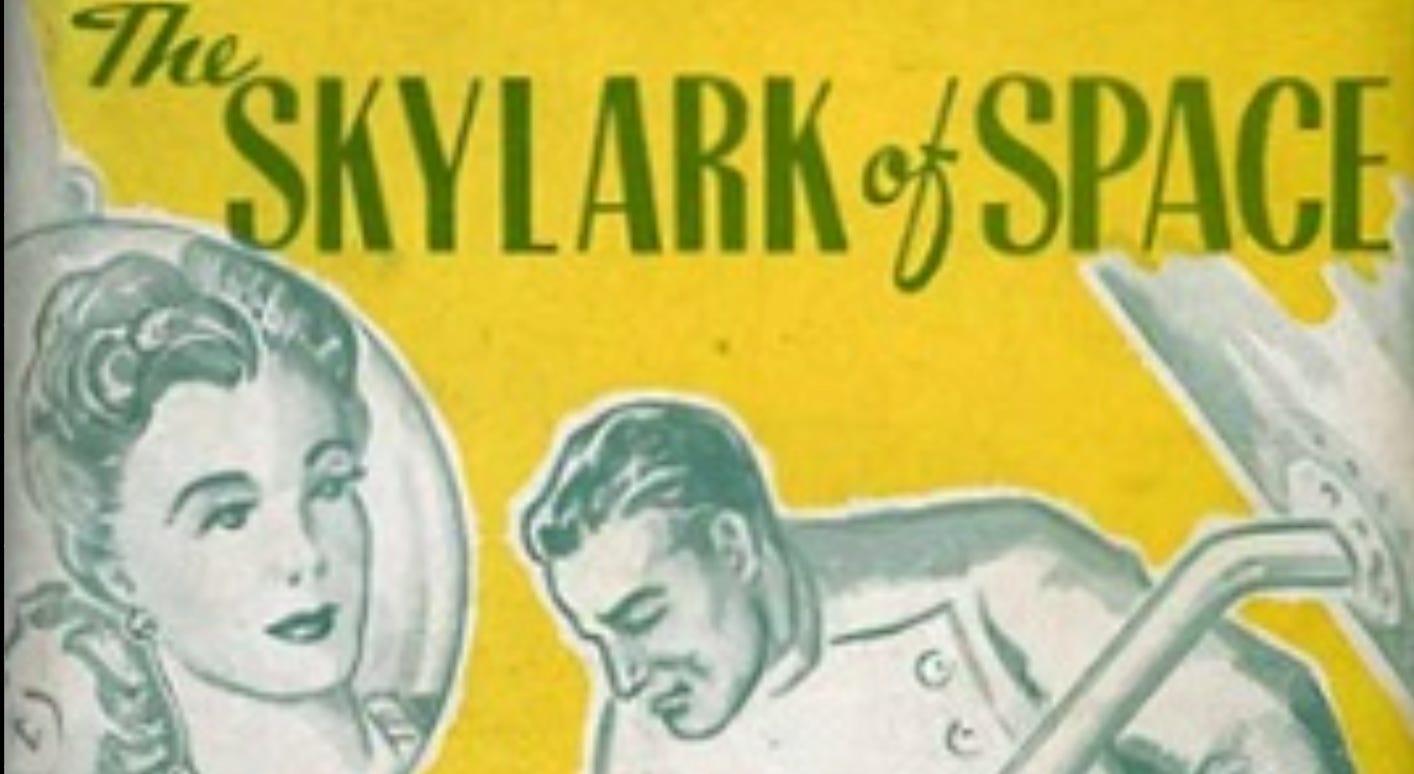
I picked up The Skylark of Space because you cannot understand where science fiction came from without reading it. This is not a book I expected to love as a reading experience, and it’s not one I did love, but it is one every serious fan of the genre owes a debt to, and the history behind it is as interesting as anything between the covers.
Edward Elmer Smith was born in 1890 in Sheboygan, Wisconsin, and spent his professional life as a food engineer specializing in doughnut and pastry mixes. That background matters because the man writing the first true space opera was doing it between shifts as a chemist, not as a professional author with a literary support system. He began the novel in 1915 with his neighbor Lee Hawkins Garby, who contributed the romantic sections Smith felt he could not write himself. He finished the manuscript around 1920, spent years collecting rejection letters, and finally sold it to Amazing Stories in 1928 for $125. The magazine serialized it across three issues and requested a sequel before the second installment had even run.
Hugo Gernsback appended “PhD” to Smith’s name for his contributions to Amazing, which is how he became “Doc” Smith to generations of readers. He went on to write the Lensman series from 1937 to 1948, which many consider his best work. But The Skylark of Space is where it all started, and critics have recognized it as the first example of space opera. Isaac Asimov called it “the first great ‘classic’ of American science fiction” while also admitting “as literature, it was a total flop.” That is about right.
The plot moves from an Earth-bound inventor story into full interstellar adventure. Government chemist Dick Seaton accidentally discovers that combining copper with a mysterious element he calls “X” produces propulsion on a staggering scale. He partners with millionaire Martin Crane to build a spherical spaceship. His ruthless former colleague Marc DuQuesne steals the plans, builds his own vessel, and kidnaps Seaton’s fiancée Dorothy and her friend Peg to force a trade. Seaton and Crane chase them across the galaxy, rescue the women after DuQuesne’s ship runs out of fuel near a dead star, and eventually reach the alien planet Osnome, where two warring civilizations are fighting over copper-rich territory. Seaton and company ally with Prince Dunark of Kondal, help defeat the treacherous Mardonalians, get their ship rebuilt into the more powerful Skylark Two, hold double weddings blessed by the Kondalian monarchy, and fly home loaded with treasure while DuQuesne escapes by parachute.

On paper that sounds like a wild ride. In practice the first two thirds of the book are a slog. The Earth-based sabotage plot, the kidnapping, and the initial chase drag on past the point of usefulness. The prose is rough pulp, the technical descriptions of power bars and object compasses pile up without building tension, and the pacing lurches. Smith was writing this in serial installments between 1915 and 1920, and it reads that way.
Then the crew lands on Osnome and the book comes alive. The alien cultures, the planetary warfare, the copper oceans and jeweled palaces, the sheer scale of discovery: this is what Smith was building toward, and it delivers. You can see directly why it inspired everything that followed. Mike Ashley called it “the seminal space opera,” and Damon Knight praised its “fast, lean plot, an air of excitement, four characters who are comfortingly bigger than life, and the feeling that adventures are waiting everywhere.” Knight was writing about the Osnome half of the book.
I read this for the history, and the history is real. Smith appeared in Amazing Stories in the same August 1928 issue as Philip Nowlan’s “Armageddon 2419 A.D.,” the story that introduced Buck Rogers. That single magazine launched two of the most influential franchises in science fiction. Everything from Star Wars to The Expanse traces a line back to what Smith was doing here, a lone genius inventor taking a handbuilt starship out into a universe full of alien civilizations and coming back changed. That idea was new in 1928. It has never stopped being used since.
The Skylark of Space is not an easy read. The writing is unpolished and the first act tests your patience. But the Osnome sequences alone justify the trip, and the book’s place in the lineage of the genre is impossible to argue with. If you love science fiction and want to understand where it came from, this is required reading. Just be ready to work for it.
What classic science fiction have you read to understand the history of the genre? Let us know in the comments.
Survival of the fittest just became a lot more dangerous. Space Fleet Academy Year Two delivers the hard sci-fi action Paramount refused to give you with Starfleet Academy. That’s why we’re still here while the show is gone. Read it today!

I recommend people to start with "Galactic Patrol" for a reason.
"Last and First Men" and "Star Maker" by Olaf Stapledon. I believe he was the first to come up with what we now call Dyson spheres.
Also, "We" by Yevgeny Zamyatin, which has been described as a precursor to 1984. Interesting, but it becomes a little incoherent at the end.