


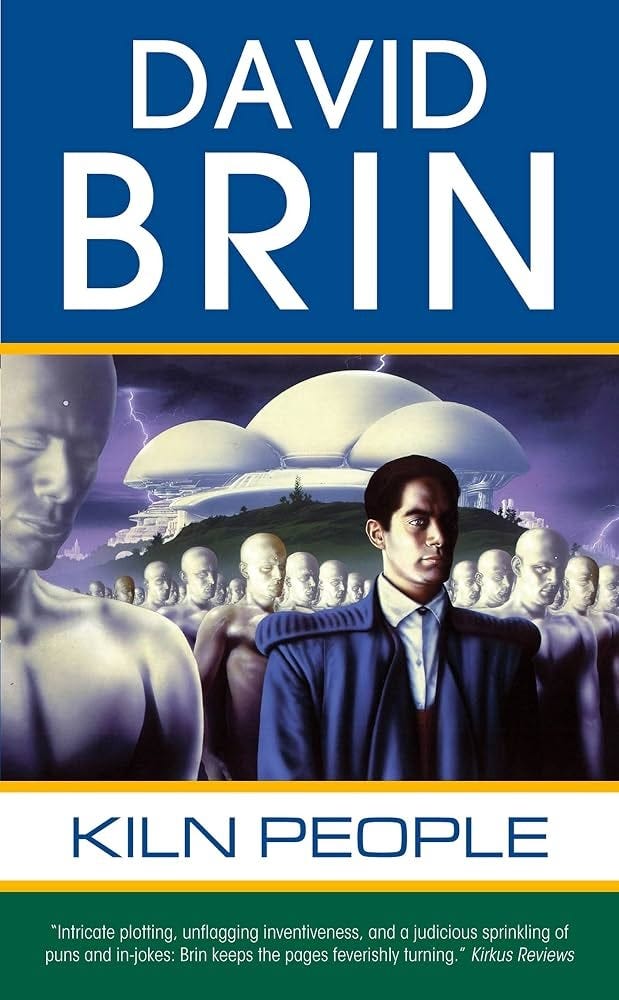
My favorite Sci-fi book of all time is David Brin’s Kiln People. This book was a complete random grab at the grocery store some time in the late 2000s and I was taken in by the premise.
We got Clones!
I confess one of my favorite sci-fi concepts is the idea of clones or copies of one’s self. What makes us who we are? Are we defined by our genetic makeup or our individual experiences? It’s what led me to write my sci-fi short “Valiant Storm” in Anvil Magazine #4, a story of a team of clones of the same individual working together on a high-stakes heist.
Kiln People by David Brin (The Postman, Startide Rising) takes the idea of society having access to quick, cheap clones (called Dittos) and goes balls deep into the concept to showcase some masterful storytelling and worldbuilding. I’ve never read any of David’s other work prior to now, but I’ve heard good things, and with the exception of one bit near the end,I found the entire book to be one of the best concepts I’ve read. Dive in with me.
“Sometimes you’re a grasshopper. Sometimes you’re an ant. The difference now is that you can be both, on the very same day.” –Kiln People
The book stars Al Morris, a private investigator. Al lives in this somewhat near-future version of the modern world where the technology was perfected to copy one’s brainwaves and transfer them to a clone body known as a Ditto. The Dittos have a lifespan of about a day, and then their clay-ish golem bodies start to fall apart and disintegrate. You have the option to transfer that Ditto’s memories back into your brain…or not.
The story begins when a Ditto of Al’s ends up on the receiving end of a rough time and can’t make it back to him, but does make it to his girlfriend’s house during a party. Before it can fully disintegrate, someone puts its brain on ice to preserve its memories. When Al is told of this, he uploads the memories and gets just enough information to kickstart a mystery he intends to solve.
One of the most enjoyable aspects of this book is that it has multiple POVs…but they’re all Al. He sends off a couple to investigate some cases that are on his docket, one to investigate what his ruined Ditto was running from, one to stay home and do paperwork, and one to do the errands. Here we learn about the different kinds of Dittos because not all Dittos are equal.
They’re differentiated by colors. The beige or flesh colored ones are normal 1:1 transfers. Platinums are for high-end, big-thinking jobs. Basically Mentats in clone form and also the most expensive. Greens are the grunts, the cheapest, used for menial tasks and general labor. Being a green means you’re hitting the honey-do list for the day. Worst of all, you’re not jumping back into the body.
The book does not shy away from the realities of transferring your brain to a copy and how that feels to being a disposable body that’s only got a day to live. While many comfortably let their Ditto’s memories come back. In fact, it is an entirely new kind of entertainment to send a Ditto into some Ditto-only spaces to live out entirely different lives and come back with the memories of those next level LARP-sessions with other people’s Dittos without the distance of digital gaming or the uncomfortableness of trying to do it in real life.
But for the working class or laborers, the reality is much more grim. Dittos sent to do a hard day’s work aren’t expected to come back. Their original is paid for the services while the Dittos grimly throw themselves into a giant sludge dumpster and wait for their bodies to disintegrate and become part of the Ditto soup they’re swimming in. In a rather unsettling scene, Al happens upon a Ditto hanging on for dear life to avoid falling into the Ditto soup pit, proof that the brain’s self-preservation instinct is still active. He details that before people are legally allowed to use Dittos, they have to sit through lessons in high school to teach them to let go of their will to stay alive when they’re in a failing Ditto body. The decomposition process can be slightly stalled, but not stopped. The brain still feels as if it’s going to die, even though they know they’re a copy. It’s an existential crisis that is chilling to think about.
And, of course, some Dittos go rogue. This is referred to as becoming a “Frankenstein”. This happens to Al’s green Ditto, who states “No matter how many times it happens I get put in a green, it always feels like I’m being punished.” His green decides he doesn’t feel like fetching the groceries and even leaves a message to his original stating his intention. There are apparently bounty hunter groups who hunt down and eliminate frankies for fun and profit, but Al decides to leave him be. He’s got enough on his plate as is.
As the story progresses and Al makes headway into the multiple cases, some events start to converge and events start to pick up in a way that each individual Ditto and Al are starting to realize they’re missing pieces of a bigger picture and they’re unaware that the others have pieces they potentially need.
We also end up seeing just how divergent and different the Dittos can be. Frankie runs into his best friend who sometimes lives on the other side of the law and uses a weasel-shaped Ditto. Al’s girlfriend is a solider, but in “war”, Dittos have all kinds of animalistic or alien shapes to try and give them tactical advantages. War is treated like a spectator sport because, well, no one can actually die in combat.
I say this book is my favorite sci-fi novel, but it is not exactly a five star read and has some flaws that were impossible to ignore. Towards the end, a lot of meta-physical and philosophical concepts start to come into play. Often not seriously enough to feel like they’re essential aspects of the narrative, but they never truly go away. It did lead to the end of the book having an unintentionally hilarious and not at all menacing moment when the antagonistic character (in a midget Ditto) is sitting on a sci-fi pendulum swinging back and forth in a mad scientist lab with energy sparking everywhere, spouting page after page the most mind-numbing metaphysical technobabble ever put to paper. I don’t know if David Brin meant for this character to be taken seriously or if it was a way to showcase how mad he was, but it was an eyesore to try and read.
Without spoiling the ending, it is a bold and interesting one that I did not see coming and is triumphant, if a little bittersweet. The concept is solid enough to warrant multiple books, but I was fine with the single story we got.
Kiln People is a solid speculative fiction story that brings together multiple storylines in a well-told manner and gives us a peek into a future that was interesting to explore via its concepts and elements–even if the meta-physical and philosophical talk bogs it down.
