

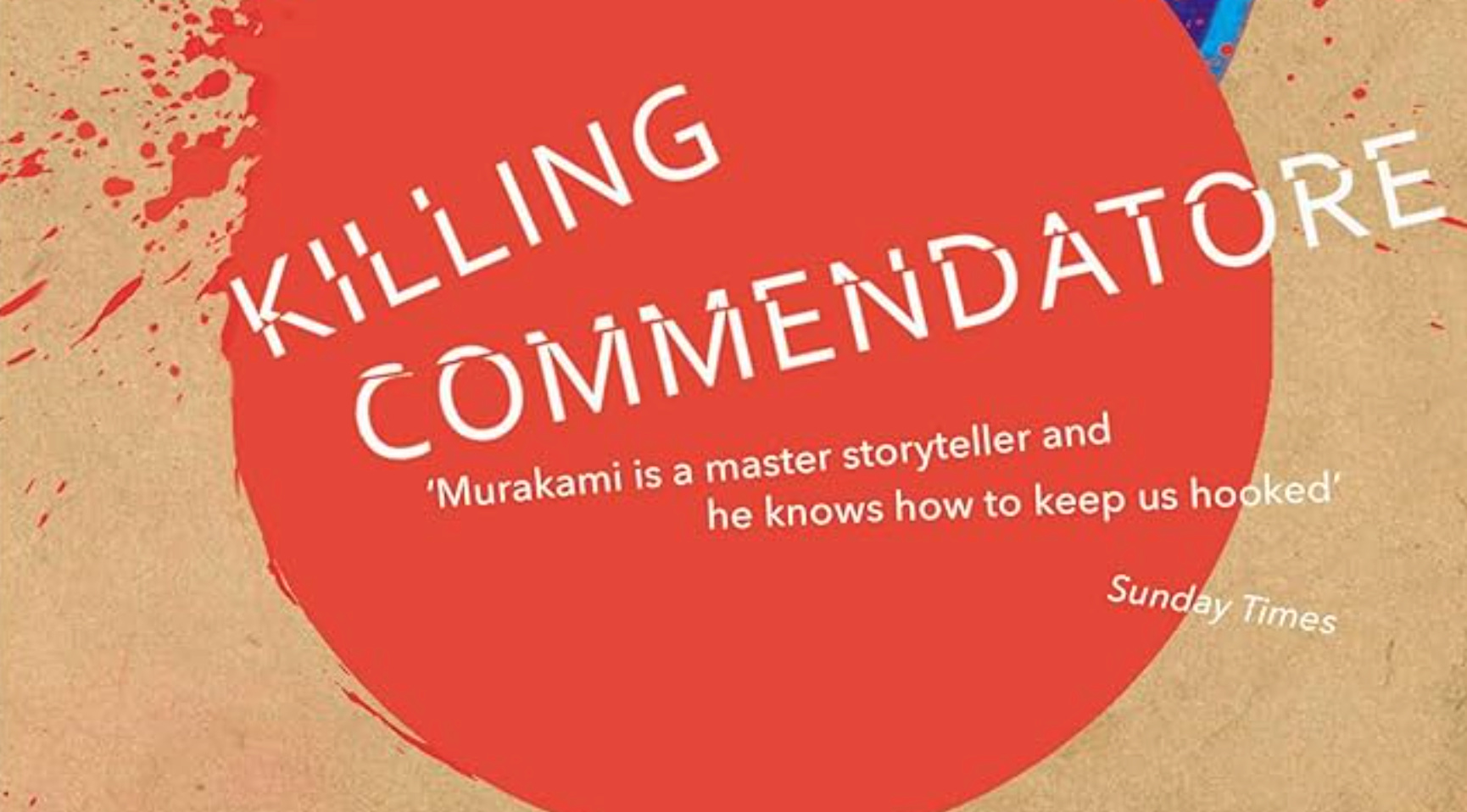
I need to say something about loyalty before I say anything about this book.
I discovered Haruki Murakami at sixteen and have never quite recovered. I have read The Wind-Up Bird Chronicle four times. I carried Norwegian Wood in my bag for an entire summer in Nagano, the summer my parents were separating, and the creased spine of that paperback still sits on a shelf in my mother’s apartment with a coffee stain on the cover that I remember making. I am not a neutral reader of Murakami. I do not know if such a reader even exists. You either hear his frequency or you do not, and I hear it, and I have heard it since I was too young to understand most of what I was hearing.
So when I tell you that Killing Commendatore is a great novel — that it is, after The Wind-Up Bird Chronicle and alongside 1Q84, one of the three peaks of Murakami’s career — I want you to understand the ground I am standing on. I am standing on loyalty to one of my favorite authors of all-time.
The novel was published in Japan on February 24, 2017, in two volumes — Arawareru Idea Hen (The Idea Made Visible) and Utsurou Metafā Hen (The Shifting Metaphor) — by Shinchōsha, with a first print run of 1.3 million copies. Some bookstores opened at midnight. The English translation, by Philip Gabriel and Ted Goossen, appeared as a single 704-page volume from Knopf in October 2018. I read the Japanese in March 2017, in the week after publication, in my dormitory room. I read it again last year. And I also read the English for the first time on a borrowed Kindle, mostly in airports.
Here is the plot, very briefly, because the plot is not the point and also because the plot is magnificent and I do not want to spoil it. A thirty-six-year-old portrait painter, who is unnamed, as Murakami’s narrators so often are, is left by his wife. He drives north for weeks, aimlessly, through Tōhoku and Hokkaidō. His car breaks down. He ends up living in the mountain house of a famous Japanese-style painter named Amada Tomohiko, now ninety-two and vanishing into dementia in a nursing home. In the attic he finds an owl. He also finds a painting that is Amada’s masterpiece, hidden, never exhibited, and titled Killing Commendatore, that depicts a scene from Mozart’s Don Giovanni transposed to seventh-century Japan in the style of the Asuka period. He begins to hear a bell ringing in the night, coming from beneath the earth. A wealthy, white-haired neighbor named Menshiki appears across the valley. A thirteen-year-old girl named Mariye disappears. A two-foot-tall figure steps out of the painting.
That is enough. The novel unfolds from these elements the way a Murakami novel always unfolds — through accumulation, through repetition, through the slow accretion of the strange upon the ordinary until the ordinary has become strange and the strange has become the only thing that makes sense. He cooks. He listens to records. He paints. The Commendatore appears in his kitchen and addresses him as shokun — “gentlemen,” plural, to a single person — and speaks in a courtly, antiquated Japanese that is one of the great comic inventions of Murakami’s career.
What this novel is actually about is painting.
Most of the English-language reviews I have read treat Killing Commendatore as a novel about metaphysics, or about history, or about the boundary between the real and the surreal. It is, to a certain extent, about all of these things. But it is first and most seriously about what happens when a person who has been making competent, professional, soulless work for years — portraits on commission, likenesses that satisfy clients and earn money and mean nothing — suddenly finds himself unable to continue and must discover whether he has anything of his own to paint.
This is a novel about art written by a man who has spent forty years making art, and it shows. The passages in which the narrator describes the act of painting — not the finished painting but the process, the way a portrait begins as a blank canvas and becomes something the painter did not intend — are among the most sustained and convincing descriptions of artistic creation I have read in any language. Murakami has always written well about process. The translator Toru in Wind-Up Bird translating legal documents, Tengo in 1Q84 rewriting Fuka-Eri’s manuscript. But in Killing Commendatore the process is the novel’s spine. Everything that happens — the pit, the bell, the Commendatore, the underground passage, the vanishing girl — happens because the narrator has begun to paint differently, and painting differently has opened a door that was sealed shut, and what comes through the door is the novel.
The Japanese critic Sasaki Atsushi wrote, on first reading, that Killing Commendatore is Murakami’s own “Murakami-ron” — his self-criticism, his attempt to explain to himself why his novels are the way they are. I think this is exactly right, and I think it is why the novel moved me more deeply on the second reading than on the first. On the first reading I was following the plot. On the second I was watching a sixty-seven-year-old writer ask himself what it means to have spent a lifetime making things out of nothing, and whether the things he has made are the things he was meant to make, and what it would mean to start over.
I should say what I think is wrong with it, because I have promised to do that.
The women.
This is not a new complaint about Murakami. It is the oldest complaint about Murakami. It is the complaint that every Murakami reader has either made or decided to set aside, and I have mostly decided to set it aside, but Killing Commendatore makes the setting-aside a little harder than usual. The narrator’s wife, Yuzu, exists primarily as an absence. She leaves on the first page and returns at the end, and what she does in between is have sex with other men and become pregnant. His lover during the separation, an older married woman whose name I have already forgotten, exists to provide sex scenes that are technically accomplished and emotionally vacant. Mariye, the thirteen-year-old girl, is rendered with genuine care and is probably the most fully realized female character in the book, but she is also described through the narrator’s gaze in ways that several English-language reviewers found uncomfortable, and I understand why they found it uncomfortable, even though I think the discomfort is more about the English prose rhythms than about what Murakami actually wrote.
I counted roughly the number of times the narrator notices women’s breasts, because several reviewers had mentioned this and I wanted to see if they were exaggerating. They were not exaggerating. It is a lot. It is a tic. It is the kind of thing a good editor would have flagged and a writer of Murakami’s stature would have ignored, and I wish he had not ignored it, because it gives his detractors an easy target and it diminishes passages that are otherwise doing serious work.
But I think the English-language criticism has been exaggerated. The problem is not that Murakami cannot write women. He can. Kumiko in Wind-Up Bird is a fully achieved character. Aomame in 1Q84 is a fully achieved character. The problem is that in Killing Commendatore he is not interested in writing women, because the novel is about a man alone with his art and the women are peripheral to that solitude. This is a legitimate artistic choice. It is also a limitation, and it is the reason I put this novel alongside 1Q84 rather than above The Wind-Up Bird Chronicle, which has Kumiko and Malta Kano and Creta Kano and the strange, terrifying woman in Room 208, all of whom are more alive on the page than any woman in Killing Commendatore.
The other limitation is length. Seven hundred pages in English, and the Japanese is longer. There are stretches in Part Two where the narrator is cooking pasta and listening to Strauss and thinking about Menshiki and not very much is happening, and these stretches are either the point of the novel — the texture of solitude, the way empty time accumulates around a person who is waiting for something to happen — or they are self-indulgence. I think they are mostly the point. I also think a hundred fewer pages would not have hurt.
Now to the translation, which is where I have the most to say and where I expect to lose the most readers.
Killing Commendatore was translated by two people. Philip Gabriel translated Part One (The Idea Made Visible). Ted Goossen translated Part Two (The Shifting Metaphor). The editor Lexy Bloom at Knopf synchronized the two halves into a single English-language novel. This is, to put it gently, an unusual arrangement, and the novel shows the seams.
I do not think most English-language readers will notice. Gabriel and Goossen are both experienced Murakami translators — Gabriel did Kafka on the Shore and 1Q84 (with Jay Rubin), Goossen did The Strange Library and Men Without Women — and Bloom is by all accounts a careful editor. The surface of the English is consistent. The narrator sounds like the same person on page 400 as on page 100. The rhythm is maintained. The vocabulary is stable.
But.
There is a quality in Murakami’s Japanese — and I realize I am about to describe something that every translator of Murakami has struggled with and that I am not going to solve in a book review — that I would call oku, depth, the sense of a room behind the room you are standing in. His sentences are simple. His vocabulary is deliberately limited. He repeats words and phrases across hundreds of pages in a way that creates a kind of accumulating resonance, the way a bell struck repeatedly in the same spot produces overtones that a single strike does not. The simplicity is the technique. The repetition is the technique. They work together to produce a prose that sounds, in Japanese, like the easiest thing in the world to read and that is, in fact, doing something quite difficult beneath the surface.
Gabriel captures this better than Goossen. I say this knowing it will be contested and knowing that the division of labor means it might be the material rather than the translator — Part One is more grounded, more domestic, more concerned with the narrator’s daily life, and Part Two is more metaphysical, more underground, more surreal, and the qualities I am praising may be easier to sustain in realistic passages than in fantastic ones. But I read both parts in both languages, more than once, and what I heard in the English of Part One was closer to what I heard in the Japanese than what I heard in the English of Part Two.
The specific thing I noticed is rhythm. Murakami’s sentences in Japanese have a particular cadence — a way of arriving at the end of a thought that is neither abrupt nor lingering, that just stops, the way a person stops walking when they have arrived where they are going. Gabriel’s English reproduces this cadence more consistently. His sentences end where Murakami’s sentences end. Goossen’s sentences sometimes continue a beat longer, or add a clarifying phrase, or restructure the clause order in a way that shifts the weight from the end of the sentence to the middle. The effect, cumulatively, is that Part Two feels very slightly more translated than Part One. The window is very slightly less transparent.
I want to praise one specific thing about the translation as a whole, because it has been under-discussed and it is magnificent. The Commendatore’s voice.
The Commendatore in the Japanese speaks in a way that is instantly recognizable and deeply strange. He uses atashi for “I” — a first-person pronoun associated with women and with a certain old-fashioned formality. He addresses the narrator as shokun, “gentlemen,” in the plural. He says de wa aranai instead of the standard de wa nai for negation — an archaic, almost ceremonial form. He is funny. He is imperious. He is two feet tall and he sounds like a retired general who has been shrunk in the wash and is not entirely displeased about it.
This voice is, in principle, untranslatable. There is no English pronoun that does what atashi does. There is no English form of address that does what shokun does. There is no English negation that does what de wa aranai does. And yet Gabriel and Goossen — and I assume Bloom deserves credit here too — found an English for the Commendatore that works. The Commendatore in English is formal without being stiff, archaic without being ridiculous, funny without trying to be funny. He calls the narrator “my friends.” He speaks in complete, slightly ornate sentences. He has dignity. He is the best thing in the translation and I would read seven hundred pages of him alone.
I said at the beginning of this review that Killing Commendatore is one of the three peaks of Murakami’s career. I want to end by saying what I mean by that, because it is the kind of claim that requires defense.
The Wind-Up Bird Chronicle is the peak of Murakami the storyteller — the novel in which his ability to pull a reader into an impossible world and keep them there for six hundred pages reaches its fullest expression. 1Q84 is the peak of Murakami the architect — the novel in which his ability to construct parallel narratives and hold them in tension over a thousand pages is most fully achieved. Killing Commendatore is the peak of Murakami the artist — the novel in which his lifelong preoccupation with what it means to make things, to create something from nothing, to open a door in a wall that has no door, is most directly and most movingly addressed.
It is also the most personal of the three, and the most vulnerable. There is a passage near the end in which the narrator realizes that the painting he has been working on throughout the novel is finished, and that it is good, and that it is the first good thing he has ever made. I read that passage in my dormitory room in 2017 and I cried. I read it again last year in my apartment in Rome and I cried again. I am not a person who cries easily at novels. I am a person who cries at the moment when a character who has been unable to do the thing he was meant to do finally does it, and knows he has done it, and understands that doing it has cost him something he will not get back.
That is what Killing Commendatore is about. The cost of making something real.
The bell rings underground. You can choose not to hear it. You can fill the pit with stones and walk away and paint portraits on commission for the rest of your life and no one will blame you. Or you can move the stones and climb down and follow the passage to wherever it leads, knowing that you will not come back the same person, knowing that the door behind you is closing, knowing that the Commendatore is watching you with his two-foot dignity and his archaic pronouns and his absolute, terrifying faith that you are capable of what he is asking you to do.

I have read this novel three times. I will read it again.
Book: 5/5
Translation: 7/10
— M.M.
The second book of The Secret Scrolls of Naruto shifts the action from the open roads and waterways of the Kamigata to the warren of Tokugawa-era Tokyo, where the conspiracy runs deeper, the villains are closer, and nobody can be trusted. Two killers strike a deal over saké: one will murder the swordsman-monk Gennojō, the other will claim the woman he has been hunting since Osaka. Underground chambers, a great urban fire, a swordfight in total darkness on a plum-scented path, a deathbed confession that transforms a pickpocket, and a midnight ambush at Sensō-ji temple — this is the book where Yoshikawa Eiji earns his reputation as the Alexandre Dumas of Japan.

It's fascinating to read about the untranslatable differences between Japanese and English.
I'm not quite sure how insufficient attention to the female characters, who don't really factor into the story much except to explain why the painter is where he is and has the time to do what he does, is any sort of detriment to a story about the painter's art. But she is correct about it being a very good novel and the observation about the two different translators is excellent.