


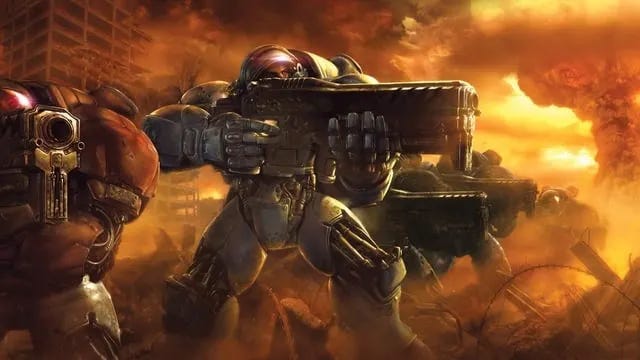
The new StarCraft trailer left a bad taste in my mouth. While many were well aware that some kind of StarCraft shooter was arriving after years of rumors, the sour part is how Blizzard chose to sell it.
The cinematic, titled Dominion dropped at BlizzCon 2026 and follows a Terran recruit named Holt through his training, his suit-up, and first drop. He is shown to be competent and motivated and another point of interest is that the training montage even puts him across from another cadet with a knife. However, after he and the other marines are dropped, Holt’s weapon malfunctions and the Zerg are on him in an instant and the combat knife from the training floor never comes out. So, the cutscene teaches him how to use a weapon and then forgets he learned it? Later, the camera cuts to a hangar where a mechanic hoses the pulp out of his CMC armor, supposedly in preparation for the next unfortunately body.
The trailer’s voiceover (the sons and daughters of the Dominion, their sacrifice bought us another day, carry their strength forward, no matter the cost) is the same speech the Confederacy and the Dominion have been giving cannon fodder since 1998. The difference this time the marketing is reveling in it. In the RTS, while your marines are disposable in the abstract, they were still precious in practice. You walled them into bunkers or parked Medics behind the line to keep them sustained. Then you rage when a Zerg baneling deletes a squad that you spent three minutes assembling. A barracks drop (supposedly what we see in the trailer) is a tactic, but the trailer treats it like a meat grinder.
Lately, I have been playing a lot of Warhammer 40,000: Space Marine 2. That game is boots-on-the-ground science-fiction infantry. You are in the armor and you experience the weight of the bolt rifle as part of the grimdark fantasy. In the story mode, the character Titus is tool of a rotten Imperium and an oppressive God-Emperor. But the fantasy is still an ideal: you are the man inside the ceramite armor, supported by a brotherhood that is bound by honor and duty. Even the Imperial Guard, ordinary human soldiers who are basically treated as expendable cannon fodder, get stories that focus on individual soldiers and their experiences. Even though these troops are thrown into battles where millions can die, the universe still has room to recognize that each soldier is an actual person, not just a disposable body.
The Dominion trailer wants you to detach, and it does so in a way that is almost... Reddit. Holt is introduced so you can watch him get thrown away, and there is nothing heroic he does in the cut. The cinematic almost has the temperature of a post-Vietnam commercial, where the institution eats the infantryman and the camera is in on the joke. I remain unsure whether they know which joke they are telling. Is this nostalgia for the old StarCraft grimness, or a subversive read on Mengsk’s machine? Or is it simply a modern marketing habit of treating the player-character as disposable: Someone you put in the spotlight for the trailer and throw away when it’s over? Again, it feels very Reddit.
The second sour note is worse. Blizzard devs just stood on a stage, showed a cinematic with zero gameplay, and locked a StarCraft shooter to spring 2030, four years out. President Johanna Faries told Bloomberg the early dates exist “to convey confidence in some of our biggest bets.” Dan Hay, the former Far Cry lead now running the project, said the team has been working “for a little bit,” feels good about it, and wanted to share “an inkling.” The official line is that this is a new Blizzard: one that ships, ships big, and ships on time.
Anyone who lived through StarCraft: Ghost heard that and felt a spasm.
What Ghost Was Supposed to Be
On September 20, 2002, at the Tokyo Game Show, Blizzard announced StarCraft: Ghost. It was a third-person tactical action game for the PlayStation 2, Xbox, and GameCube. You would play Nova Terra, a psionic Ghost operative. The game involved cloaking, stealth, and calling down nukes with a laser designator. It was supposed to be the boots-on-the-ground fantasy every
RTS player had already been running in their head every time they selected a Ghost and hit the cloak hotkey.
The developer was Nihilistic Software, a small studio founded by former LucasArts developers who had shipped Vampire: The Masquerade – Redemption. The original target was late 2003, and for a company that had just finished defining PC real-time strategy, a console stealth-action game starring a new face in the Koprulu Sector seemed like a promising new direction.
Instead, Ghost would spend the next several years trapped in development hell.
The Identity Crisis
People who worked on the game later described the train wreck from three sides: Nihilistic, Swingin’ Ape, and Blizzard.
As mentioned before, Ghost started as a stealth game. Started. Chris Millar, who produced it on the Blizzard side for a stretch, put it plainly: It began stealthy, and a large contingent inside Blizzard decided it should be more action-oriented. James Goddard, an action-game veteran brought in as an external producer, said the quiet part: “The game had an identity crisis.” He pushed for a stealth game that stopped short of hardcore stealth. That was a compromise that satisfied nobody.
Feature lists ballooned with whatever was selling that quarter. Splinter Cell shipped in 2002, and suddenly wall-climbing was on the list. Co-op multiplayer, absent from the original design, became a demand. Rob Pardo’s early involvement appears to have provided some of the direction the project needed, but as producers changed and responsibilities shifted, Nihilistic developers felt that Blizzard no longer had a single person clearly steering the project. Chris Millar, whom Huebner later described as the most positive and productive producer they worked with, was eventually replaced, and gaps between feedback sessions became longer. Robert Huebner later described the meetings as a gradual shift away from refining a game they already had and toward constantly experimenting with new ideas. The problem was that the target kept moving. Huebner recalled that each time the Nihilistic team came in with a new build, they would half-jokingly wonder which game Blizzard would want them to imitate next.
Huebner’s complaint was essentially that Ghost was being redesigned faster than it could be finished. The team could produce playable demos, which encouraged Blizzard to keep asking for another variation, another feature, or another interpretation of what a StarCraft shooter should be. However, instead of polishing a settled design, development became an extended process of figuring out what the game actually was.
The contract skipped a hard ship date. By 2004, the game was playable, but it was also largely unfinished. At E3 2004, in a conference room a few feet from a booth full of people playing the demo, Blizzard and Nihilistic effectively ended their relationship. Nihilistic would later go to Electronic Arts and make Marvel Nemesis. And the story Blizzard told the press was that Nihilistic had “completed their work.”
That was the first lie of omission.
Swingin’ Ape, the Buyout, and the Generation That Closed
In July 2004, Blizzard handed Ghost over to Swingin’ Ape Studios, the team behind Metal Arms: Glitch in the System. Unlike Nihilistic, Swingin’ Ape decided to rebuild the game from scratch and put a much greater emphasis on multiplayer. The team looked to Halo for inspiration, treating Bungie’s shooter as the benchmark for what a console action game could be. One former Swingin’ Ape developer, Mike Schweitzer, later recalled that they regularly measured themselves against Halo 2, which he described as the gold standard for console action shooters at the time. He felt they were genuinely competing for that top spot. The result was a multiplayer mode that leaned heavily into the fantasy of playing StarCraft at ground level.
Players could take control of units from all three races, with different character classes translating the RTS factions into a third-person action game. Vehicles and other elements of the RTS series gave the matches a distinctly StarCraft flavor.
And, for a while, it seemed to be working. James Goddard remembered the moment multiplayer was running across multiple consoles, with players jumping onto speeders, as a genuine “holy shit” moment. The multiplayer was becoming the part of Ghost that everyone could finally see working. The problem was what happened to the other half of the game. The single-player experience, the part of Ghost that had originally been sold as Nova’s stealth-action adventure, was still struggling to come together.
Meanwhile, time was ticking away, and the video game industry was moving on without Ghost. The game had originally been designed for the PlayStation 2, Xbox, and GameCube, which were all part of the same generation of consoles. But by 2005, that generation was already being replaced. Microsoft had launched the Xbox 360, while Sony’s PlayStation 3 and Nintendo’s Wii were on the way. The GameCube version was already dead by 2005. Blizzard canceled it because the console did not have a readily available online service, while so much work had gone into the online portion of Ghost that releasing only part of the intended game would have required additional work. It was a small detail that revealed just how important multiplayer had become to the new version of Ghost.
The timing was getting worse. Ghost had started life near the beginning of a console generation, but by the time Swingin’ Ape’s version was taking shape, that generation was nearing its end. Blizzard was now looking at the much more powerful Xbox 360, PlayStation 3, and Wii. The longer Ghost remained unfinished, the harder it became to justify releasing it on hardware that was already on its way out.
On March 24, 2006, Blizzard announced an “indefinite postponement.” The company said it was shifting its console-development efforts toward the next generation and wanted to evaluate how it could use the additional power of the new systems. Official language kept the word “canceled” off the page. At the DICE Summit in 2008, Blizzard executives explained that Ghost was not technically canceled, but it was no longer a focus because the company had a finite amount of development resources. World of Warcraft had become a massive success, while StarCraft II was also in development. Blizzard had to decide where those resources were going.
“We have to choose, we can’t do everything.”
It would not be until 2014, while discussing the cancellation of Titan, that Morhaime finally said the word. Ghost had been canceled. Twelve years after the TGS stage. Eight years after “indefinite.” The vaporware lists had been calling it for a decade. Wired ranked it fifth in its 2005 Vaporware Awards. Morhaime later described canceling Ghost as difficult and said that, like Warcraft Adventures, the cancellation ultimately resulted in better-quality work. Both things can be true, but neither one ships the game you announced.
What Survived
Keith R.A. DeCandido’s novel StarCraft: Ghost: Nova finally came out in November 2006. It had originally been scheduled for April, with the intention of releasing it alongside the game, but the game had already been indefinitely postponed by the time the book reached stores. DeCandido later explained that roughly half of Nova’s backstory came from material he created for the novel, while the rest was built around the character and story Blizzard had already established for Ghost.
The strange thing is that Nova survived even though the game that created her did not. She eventually appeared in StarCraft II, and Blizzard later gave her an entire campaign in Nova Covert Ops. Blizzard’s own announcement described Nova as one of StarCraft’s most memorable characters and brought her back as the star of a new StarCraft II mission pack. Even parts of Ghost itself survived in StarCraft II. Assets from the canceled game, including installation artwork, were later reused in the game. The canceled project had effectively become a source of material for the franchise that continued without it.
Then, in February 2020, something even stranger happened. A playable Xbox development build from Nihilistic’s version of Ghost leaked online. The build contained playable sections of the game, including levels, character and unit models, and other development material. For the first time, people outside Blizzard could actually get their hands on a substantial piece of the game that had been sitting in development limbo for nearly two decades. People weren’t just watching an old trailer anymore. They were playing the game’s corpse.
And that is the part younger players need to keep in mind when they watch today’s trailers: Ghost was a public product. It had trailers, playable E3 builds, a novel, and a character who became part of the wider StarCraft canon. Blizzard had spent years presenting it to the public as a real game that people would eventually be able to buy. Then, after the 2006 “indefinite postponement,” it simply remained in limbo until Blizzard finally acknowledged the cancellation in 2014.
They Tried Again
Yes, they tried again.
Around 2017, Blizzard began work on another StarCraft shooter, this one internally known as Ares. The project was reportedly built as a first-person shooter using the same engine technology as Overwatch. The basic idea was StarCraft from the ground level again, but this time with the scale and battlefield feel of a modern military shooter. Early prototypes reportedly put players in the role of Terran Marines fighting Zerg, with the team also experimenting with the possibility of letting players control Zerg units. Blizzard had apparently spent about two years developing it. By 2019, there were working prototypes and enough development behind the project for employees to have spent years on it.
Then, on June 5, 2019, Blizzard animator David Gibson announced that he was leaving the company. He wrote, “Unfortunately you’ll never see what we made over the past 2 years.” He did not name the project, but the timing quickly became significant. The following day, reports identified the canceled project as a StarCraft shooter called Ares. Blizzard’s response did not deny that the project had existed or that it had been canceled. Instead, the company gave its familiar explanation that Blizzard sometimes decides not to move forward with projects, even after substantial development work has been done.
The cancellation also came with a reshuffling of Blizzard’s development teams. Reports at the time said developers from Ares were being moved onto Diablo IV and Overwatch 2. By October, Blizzard confirmed that Dustin Browder, Eric Dodds, and Jason Chayes had left the company. Browder had previously led StarCraft II and Heroes of the Storm, while Dodds and Chayes were veteran Blizzard developers. Their departures came only months after the StarCraft shooter had been canceled.
In October 2019, Blizzard president J. Allen Brack also acknowledged that the project had existed and that Blizzard was not moving forward with it. Blizzard’s public statement at the time was the house special. They declined to comment on unannounced projects and emphasized that development is an iterative process, where a game can be abandoned even after years of work. The company also said that the work put into canceled projects can still lead to useful ideas and technology elsewhere.
Read that last clause again. That is the company that had just spent years developing another StarCraft shooter, only for the project to disappear before the public ever got to play it. That matters when you look at Blizzard’s latest StarCraft shooter announcement. The history is no longer just one abandoned project from 2002. Ghost was publicly announced, demonstrated, promoted, novelized, and eventually left in limbo. Then Blizzard spent another two years developing a completely different StarCraft shooter, only to cancel that one too.
Two tries. Zero shipped games. Now Blizzard is asking the audience to believe in a third attempt, with a cinematic trailer and a release window that stretches years into the future. The difference this time is that Blizzard is showing us the movie first and asking us to wait for the game.
Third time is the charm, we are told. Only this time, the charm is a four-year runway and a trailer is about hosing a kid out of a combat suit.
The Pattern Under the Pattern
While Ghost is the game most people remember, it shares the graveyard. Warcraft Adventures: Lord of the Clans was shown, delayed, and killed in 1998 because quality fell short. Titan burned seven years and became Overwatch. Nomad died so World of Warcraft could live. A Civilization-style StarCraft 4X flickered and went out. The house culture has always been “done when it’s done,” which is admirable when the thing that ships is StarCraft or Diablo II, but corrosive when it’s a magazine-cover project that drops from the vine.
Faries’ line, “we ship, we ship big, we ship on time,” is a repudiation of that old Blizzard culture, sold as confidence. Maybe it is. The important thing is that Blizzard is explicitly asking the audience to believe that this is a different company, one that can put a date on a game years in advance and actually deliver it.
Dan Hay’s pitch for the game is, at least on paper, encouraging. Hay comes from the Far Cry school of big, self-contained action games rather than Blizzard’s traditional seasonal model, and he has described this StarCraft as a “box product.” You create a character, give them a name, and follow their story. He specifically said that, at least in its current form, it is not a seasonal game. That is probably the most encouraging part of the entire reveal and fits Hay’s background. He spent years working on Far Cry, a series built around standalone, story-driven releases, and the structure he describes for StarCraft sounds much closer to that model than to World of Warcraft or a seasonal Diablo loop.
Even so, all we have is a cinematic. While the trailer establishes the kind of story Blizzard wants you to imagine, it does not demonstrate the actual gameplay systems, combat, exploration, progression, or even the perspective you will use to play the game.
And finally, there is the release date: Spring 2030. Four years.
In video game development, four years is an enormous amount of time to put between a public reveal and a finished game. A four-year runway means Blizzard is asking the audience to wait through an entire console generation’s worth of technological change, several holiday shopping seasons, and enough development time for a game to change engines, directors, mechanics, scope, or even its entire identity.
For a studio with StarCraft: Ghost and Ares already sitting in its history, four years is a very long time to ask the audience to take the promise on faith.
Why the Marine Thing Sticks
Go back to Holt. Then go back to Titus.
Space Marine 2 understands the contract of a boots-on-the-ground game. You inhabit the role. The Imperium can be ugly and grotesque at times, but you fight to keep the brother next to you standing. That is true of the Astartes fantasy and, in a different register, of the best Imperial Guard fiction. Expendability is a condition those stories put on a person. There is no punchline involved.
StarCraft Marines were never Space Marines. In truth, they’re closer to the Guard. The old StarCraft games never leaned into their expendability. You were incentivized to keep them alive as long as you could, holding the line against Zerg and Protoss alike. The cruelty of the Dominion was diegetic. Mengsk threw men into the grinder, and the campaign made you feel the lies of the Dominion. But Raynor’s whole arc is what happens when you stop believing those lies. The player’s hands, down in the RTS, were the opposite of Mengsk’s speeches: bunkers, medics, defensive lines, and the desperate effort to keep your forces alive. You were complicit in the machine, but you were also the only person on the battlefield trying to stop the machine from eating your squads.
The new trailer recites the speech with a straight face and frames the recycled armor as the whole atmosphere. That move fails to honor the lore. This new Blizzard is lifting the aesthetics the story was about and using them as brand tone. Are we really expected to enlist at StarCraft.com after watching the last guy get poured down a drain?
As I said before, the register is post-Vietnam, and it is oddly late. That mode, irony as the “adult” way to look at infantry, had its run. That’s why it feels so Reddit. Helldivers 2 still runs a version of it, but Helldivers lets you be in on the satire while you dive. Dominion detaches you from the marine you are about to play, revels in the texture of his death, and asks you to come back in 2030.
So, does Blizzard finally have something to prove with this StarCraft shooter? Or has the history of Ghost and Ares already made the promise impossible to believe?
