


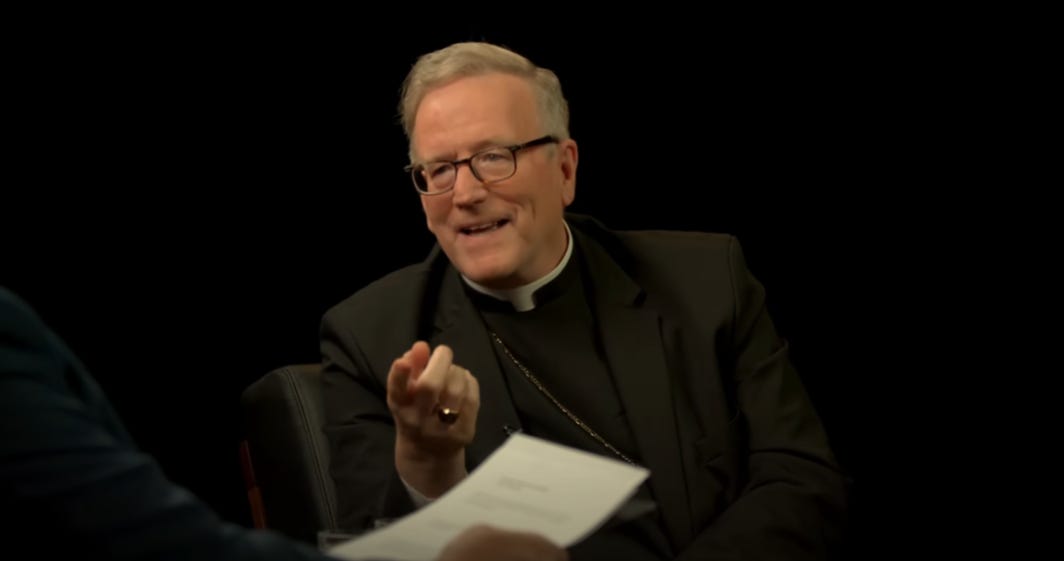
Bishop Robert Barron recently did a discussion with Word on Fire Managing Editor Dr. Tod Worner where he not only defines what beauty is, but reveals how it is objective.
At the very beginning of the conversation, Barron defines beauty saying, “I’ve always followed Thomas Aquinas. And I like the objectivity and the rationality of his definitions. And Thomas says the beautiful occurs at the intersection of three things in his Latin: integritas, consonantia, and claritas. You might render them as wholeness, harmony, and radiance. When those three things come together we say, ‘Ah, that’s beautiful!’”
He then went on to break down each of the components, “Integritas, it exists as one thing. It’s all the parts contribute to a unity. Consonantia, the parts in harmonic relationship to each other. Claritas is always the most elusive, but the most interesting. It means literally like light, or shine, or splendor. And in some texts Aquinas will even say like bright color. We tend to say, ‘Ah! That’s beautiful!’ The trouble with that, of course, you say what about a Rembrandt painting. There’s not much bright color. So what he typically means though by claritas is the claritas forme or the clarity of form. It’s when the form of something shines forth.”
While he notes there are these objective markers of beauty, he also recognizes there is a subjective element to it as well. He explains, “Aquinas following Aristotle will say whatever is received is received according to the mode of the recipient. That famous adage. That’s a very important point. So something can be very beautiful, but I’m not attuned to it, right? I haven’t been instructed yet. I don’t know the intricacies of it. No one’s explained the pattern to me yet. I’m not going to see it. Or I’m not kind of given naturally to that. That’s not my thing. That’s the mode of the recipient able to take it in what it can.”
“Or you might be able to appreciate the beautiful in a preliminary way then in time more and more dimensions of it open up to you as you become more refined,” he added.
After discussing why beauty is a transcendental and using James Joyce’s A Portrait of the Artist as a Young Man as an example, Bishop Barron explains how beauty points toward God, “That’s the move that goes back to Plato, comes out through Dante, it’s basic in our tradition. That the particular beautiful opens you to the source of beauty.”
Later on in the discussion when he was asked again about the idea of beauty being in the eye of the beholder, he reiterated that idea that certain people will have certain tastes, but that does not render something not beautiful that is. Additionally, he advised, “Don’t surrender to this lordship of autonomy. It’s all about your subjectivity. No, train subjectivity. Take subjectivity and introduce it to the world of objective value and teach someone what to to love.”
“The trouble now we’re stuck at baby consciousness like, ‘Whatever you want. Whatever you want.’ And that’s bad for babies, by the way,” he added. “Any parent, ‘Whatever you want?’ Give me a break. No, you want to direct love in the right way. So bring the subjective, which is kind of this tabula rasa, bring it into line with objective value.”
NEXT: The Sydney Sweeney Jeans Debate Is The Epitome Of The Devil Sending Two Errors
The subjective idea that "anything is art" is the error forced on us by Luciferians. It is meant to be destructive.
Never admit something ugly is art. Be public about it. The truth will stand on its own, but we need to proclaim it.