


When readers think of J.R.R. Tolkien, they think of hobbits, rings, and the vast mythology of Middle-earth. What they don’t realize is that Tolkien produced an enormous body of work outside that legendarium—children’s stories, academic essays, poetry, translations of medieval literature, and even satirical fiction about the commercialization of Oxford.
Most of this material remains unknown to casual fans. Some of it was published during Tolkien’s lifetime in obscure journals. Some sat in archives for decades before Christopher Tolkien or other editors brought it to print. And some of it—like his aborted student edition of Chaucer—was thought lost entirely before being rediscovered years after his death.
For readers who’ve exhausted The Lord of the Rings, The Silmarillion, and Unfinished Tales, this is the next frontier: the shorter works, the academic writings, the translations, and the art that reveal different facets of Tolkien’s creative genius.
Children’s Stories and Whimsical Tales
Tolkien wrote several children’s books that have nothing to do with Middle-earth. These are lighter, more playful works that showcase his sense of humor and his skill as an illustrator.
Mr. Bliss is a picture book about a man with a motor car, some cantankerous bears, and a creature called a girabbit. Tolkien illustrated it himself with colorful drawings. It’s charming and absurd in equal measure.
Roverandom tells the story of a toy dog’s adventures. Written before The Hobbit, it was inspired by a toy Tolkien’s son Michael lost on a beach. The story involves wizards, a trip to the moon, and an underwater kingdom. It’s inventive and strange, with the kind of imaginative world-building Tolkien would later apply to Middle-earth.

The Father Christmas Letters (also published as Letters from Father Christmas) are exactly what they sound like: letters Tolkien wrote to his children from “Father Christmas,” profusely illustrated with drawings of the North Pole, polar bears, and various mishaps. They’re delightful, and they reveal Tolkien as a devoted father who went to extraordinary lengths to maintain the magic of childhood for his kids.
Farmer Giles of Ham features a very fine dragon and a reluctant hero. Originally published in 1949 as a stopgap between The Hobbit and the still-in-progress Lord of the Rings, it’s a comic medieval tale with Tolkien’s characteristic attention to language and detail. An expanded 50th anniversary edition includes a map, the original story outline, and Tolkien’s notes for a possible sequel that was never written.
Smith of Wootton Major was the last story Tolkien completed. It’s about a blacksmith who eats a magical star and gains the ability to visit Faërie. The story is deceptively simple, but it’s deeply allegorical—a meditation on art, mortality, and the relationship between the mundane world and the realm of imagination. An expanded edition edited by Verlyn Flieger includes the first draft, an essay by Tolkien, and notes on an alternate ending.
The Allegorical and the Satirical
Leaf by Niggle is one of Tolkien’s most personal works. It’s a short story about a painter named Niggle who’s obsessed with a single painting he can never seem to complete. The allegory is transparent: Niggle is Tolkien, the painting is his mythology, and the story explores the tension between artistic ambition and the demands of everyday life. It’s also deeply Catholic, dealing with themes of purgatory, redemption, and the ultimate value of creative work.

The Bovadium Fragments is Tolkien’s satirical fantasy about the commercialization of Oxford. Written in the 1960s but not published until 2025, it’s described by those who read it as an early commentary on how institutions sell out their values for profit. The delay in publication is fitting—the editor commissioned to write an introductory essay didn’t deliver it until five years after Christopher Tolkien’s death, a delay that would have amused J.R.R. Tolkien given his own propensity for missing deadlines.
Poetry
Tolkien published poetry throughout his life in various magazines and journals. Much of it was later collected in The Adventures of Tom Bombadil, a volume of poems supposedly “from the Red Book” that connects them loosely to Middle-earth. An expanded 2014 edition includes additional poems and notes.

Bilbo’s Last Song is a short poem supposedly written by Bilbo as he traveled to the Grey Havens. It was originally released as a poster—an odd format choice—before being published as a small book.

The definitive collection is The Collected Poems of J.R.R. Tolkien, a three-volume boxed set edited by Christina Scull and Wayne G. Hammond. It contains more than 200 poems, many with variations and extensive commentary. About a third of the poems had never been published before. The collection doesn’t include poems that appear in his novels or his longer standalone poetic works, but it’s the most comprehensive gathering of his verse available.
Academic and Scholarly Works
Tolkien was a professional philologist and medieval scholar. His academic work is less accessible than his fiction, but it’s foundational to understanding how he thought about language, mythology, and storytelling.
On Fairy Stories is essential reading for anyone interested in Tolkien’s creative philosophy. Originally delivered as a lecture, it describes what fairy stories are, what they accomplish, and why they matter. It’s where Tolkien introduces the concept of “eucatastrophe”—the sudden happy turn in a story that reflects the Christian belief in redemption. A 2008 edition edited by Verlyn Flieger and Douglas A. Anderson includes the essay, drafts, and related material.
Beowulf: The Monsters and the Critics is one of the most influential academic articles ever written about Beowulf. Before Tolkien, scholars treated the poem primarily as a historical document. Tolkien argued it should be read as literature, with the monsters central to its meaning rather than distractions from the “real” historical content. The essay transformed Beowulf scholarship. Michael D.C. Drout’s book Beowulf and the Critics contains the original lectures this essay was derived from, along with commentary.

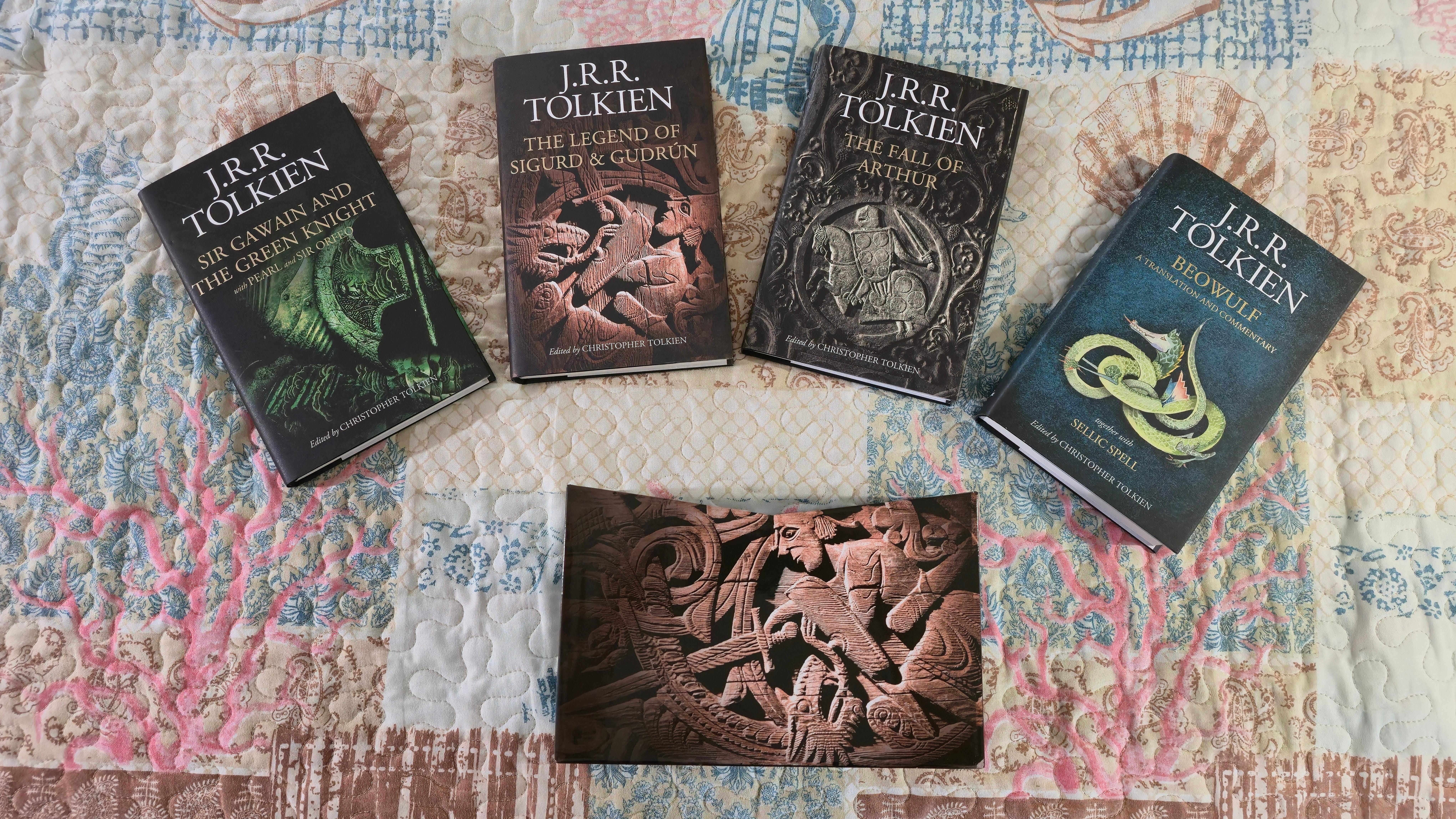
Tolkien also produced a prose translation of Beowulf with extensive notes and commentary. He never completed a full alliterative verse translation, though he translated some lines into that form. The published edition includes “Sellic Spell,” a short tale reflecting Tolkien’s thoughts about the poem’s origins.

The Homecoming of Beorhtnoth, Beorhtelm’s Son is a verse-drama based on the Old English poem “The Battle of Maldon,” accompanied by an essay on the poem. It’s an odd hybrid of creative writing and scholarship, dramatizing the aftermath of a historical battle while exploring themes of heroism and foolish pride.
Translations and Retellings
Tolkien translated several medieval works into modern English, making them accessible to readers without specialized training.

Sir Gawain and the Green Knight; Pearl; Sir Orfeo contains his translations of three Middle English poems. This was the first posthumous publication of Tolkien’s work, released in 1975 and edited by Christopher Tolkien. The translations are excellent—faithful to the originals while readable in modern English.

The Legend of Sigurd and Gudrún is Tolkien’s verse retelling of a Norse legend. Published by Christopher Tolkien, it demonstrates J.R.R. Tolkien’s deep engagement with northern mythology and his skill with alliterative verse.

The Story of Kullervo is a prose retelling of a tale from the Finnish epic Kalevala. The influence of this story on The Children of Húrin is obvious, both deal with cursed heroes, doomed love, and tragic fate. First published in the journal Tolkien Studies with commentary by Verlyn Flieger, it was later released by HarperCollins in 2015.

The Fall of Arthur is an unfinished alliterative verse poem based on Arthurian legend. Published with essays by Christopher Tolkien on the poem’s context and composition, it shows Tolkien grappling with the same material Stephen R. Lawhead would later explore in The Pendragon Cycle.

The Lay of Aotrou and Itroun is a poem in the style of a Breton Lay, originally published in The Welsh Journal. A 2016 edition with notes by Verlyn Flieger makes it more accessible.
The Lost Chaucer
One of the most fascinating stories in Tolkien scholarship involves a student edition of Chaucer’s works that Tolkien worked on early in his career. The edition never appeared, and the manuscripts were thought lost.

Tolkien’s Lost Chaucer, edited by John M. Bowers, tells the story of how the manuscripts were rediscovered. It includes images of manuscript pages, details of the drafting process, and analysis of why the volume never appeared. Sadly, it doesn’t contain the actual manuscripts themselves.
Tolkien on Chaucer: 1913-1959 features many of Tolkien’s writings on Chaucer with extensive commentary. It reprints academic papers that are otherwise difficult to find and includes previously unpublished notes from the aborted edition.
Language and Invention
A Secret Vice is an essay about the art of creating artificial languages like Tolkien’s Elvish tongues. An extended 2016 edition edited by Dimitra Fimi and Andrew Higgins provides context and analysis. For readers fascinated by Tolkien’s linguistic inventions, this is essential.
The Road Goes Ever On is a song cycle with musical settings by Donald Swann. It contains an essay by Tolkien on the poem “Namárië” and the Quenya language. The most recent edition includes a CD of Swann performing the music with vocalist William Elvin.
Art and Illustration
Tolkien was an accomplished amateur artist. He illustrated many of his own works and produced sketches and paintings throughout his life. Several collections showcase his visual art:
Pictures by J.R.R. Tolkien is a collection selected by Christopher Tolkien. The most recent edition features high-definition scans.
J.R.R. Tolkien: Artist & Illustrator is a comprehensive collection with text by Wayne G. Hammond and Christina Scull.
The Art of the Hobbit and The Art of The Lord of the Rings focus specifically on Tolkien’s illustrations for those works, with text by Hammond and Scull.
Tolkien: Maker of Middle-earth is a spectacular book assembled for the 2018 exhibition at the Bodleian Library at Oxford. Edited by Catherine McIlwaine, curator of the Tolkien papers at the Bodleian, it’s one of the most beautiful Tolkien books ever produced.
HarperCollins has also released editions of The Hobbit, The Lord of the Rings, and The Silmarillion illustrated with Tolkien’s own art, allowing readers to experience the stories with the author’s visual interpretations.
Collections and Anthologies
Many of these shorter works have been anthologized in various collections, making them easier to access:

Tales from the Perilous Realm contains Roverandom, Farmer Giles of Ham, Leaf by Niggle, The Adventures of Tom Bombadil, Smith of Wootton Major, and “On Fairy-Stories.”
The Monsters and the Critics and Other Essays includes “Beowulf: The Monsters and the Critics,” “On Translating Beowulf,” “On Fairy-Stories,” essays on Sir Gawain and on English and Welsh, and Tolkien’s valedictory address on retiring from Oxford.
The Tolkien Reader contains Farmer Giles of Ham, Leaf by Niggle, The Adventures of Tom Bombadil, “On Fairy-Stories,” and “The Homecoming of Beorhtnoth.”

HarperCollins released a boxed set titled Myths and Legends containing The Legend of Sigurd and Gudrún, the translations of Sir Gawain and the Green Knight; Pearl; Sir Orfeo, Beowulf: A Translation and Commentary, and The Fall of Arthur.
Why This Matters
These works reveal dimensions of Tolkien that Middle-earth alone doesn’t show. The children’s stories demonstrate his playfulness and his devotion as a father. The academic essays reveal the depth of his scholarship and how it informed his fiction. The translations show his mastery of medieval literature and his ability to make it accessible. The poetry displays his skill with verse forms and his lifelong engagement with language as music.
For readers who love The Lord of the Rings and want to understand the mind that created it, these shorter works are invaluable. They show Tolkien as a complete artist.
Most of this material is still in print and readily available, despite many knowning these books don’t exist. This is the hidden Tolkien, the work that doesn’t get adapted into films or turned into merchandise. It’s quieter, more scholarly, sometimes more personal. And for readers willing to explore beyond Middle-earth, it’s a treasure waiting to be discovered.
What do you think? Which of Tolkien’s non-Middle-earth works are you most interested in exploring?
If you’re interested in a fun fantasy world, read The Adventures of Baron von Monocle six-book series and support Fandom Pulse!
NEXT: The Lost Final Chapter: What Anne McCaffrey’s Unpublished After the Fall Is Over Might Have Been