


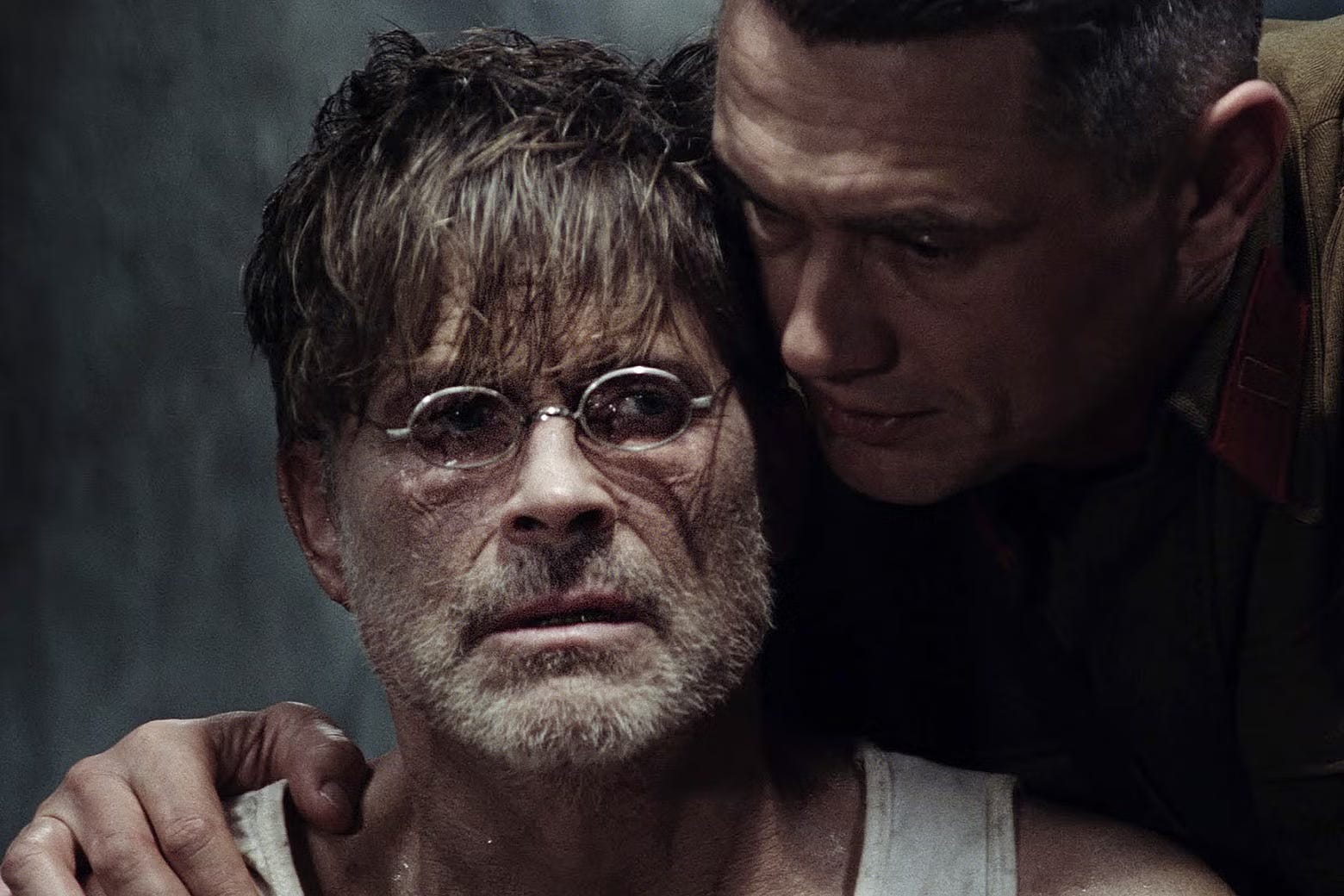
Ben Shapiro spent the run-up to Confession telling audiences he wrote the script in four days, then landed Rob Lowe, James Franco and a cast stacked with Oscar nominees to perform it. The Daily Wire put the film in 100 theaters for one night on Veterans Day and on its streaming platform the same day. After sitting through all 2 hours and 10 minutes, I came away convinced Shapiro was trying too hard to prove how smart and literary he is. The writing is doing the showing off, and the movie got left behind.
That hurts to say, because I wanted to like it. I agree with the message 100 percent. Communism is bad, and communism runs on obscuring the truth, and I do appreciate that The Daily Wire is attempting to do dramatized films and generally try to support them. A film that drives that home deserves an audience, and Confession is too rough to earn one.
A Strong Premise, Then Nothing
The setup is a great concept. Moscow, 1938. Alexei (Lowe), a literature professor, is hauled into Lubyanka Prison and told nothing about why he’s there, for a long time. They shove him into a tiny, pitch-dark cell where he can barely sit, which shows how bad this place is. Then the pressure begins: give up an Orthodox priest who has been passing out counter-revolutionary pamphlets. Alexei refuses.
His interrogator is Vladimir (Franco), a lieutenant who knows him from the past. Vladimir knows enough about Alexei that when the professor claims he has no idea who the priest is, he can tell it’s a lie.
From there the movie lives in two rooms. The cell and the interrogation chamber, start to finish, with zero establishing shots. The look is gray and drab, and the rooms are so small the camera has nothing to do. That makes it extremely low budget, and you can see every inch of it.
The Viewer Gets Tortured Instead
The claustrophobic cell is high stakes for about a minute. After that, it’s talking heads going back and forth for the entire runtime. Vladimir presses, Alexei denies, and they circle back to Crime and Punishment, Russian philosophy and the Leninist takeover. Then they do it again. And again. And again. At 2 hours and 10 minutes, you feel every one of those minutes dragging on.
The stakes barely climb. They bring in the family, eventually they physically torture him, but each step plays at the same pitch as the last. The result is a problem a prison drama cannot afford. The viewer ends up more tortured than the man in the chair.
Now this setup can work. An example is that 12 Angry Men is fantastic, and it spends most of its time in one room with people talking. But it had a dozen people in conflict, a man’s life on the line, and huge emotional stakes. We don’t seem to even know what the results of the prison will be until far into it which doesn’t help. No one really threatened Alexi’s life early on, and perhaps they should have. So by contrast, this has two heads trading lines.
Film is a visual medium, and there was nothing to attach to visually. I caught myself fast-forwarding just to find out how it ended, because I couldn’t sit through it.
Everything Ties Back to Alexei
Shapiro connects the literature, the philosophy and the Soviet takeover back to Alexei personally. Vladimir knows him well. They bring in his ex-wife. They bring in other prisoners to show how absurd the system is. The dialogue hammers the point: the truth doesn’t matter, the state needs what the state needs, just give us what we want. It’s very over the top. Nobody talks like that. It reads like Shapiro beating the audience over the head the thesis, in case anyone missed the subtext.
And the details are murky. Alexei keeps saying he doesn’t know anything about the priest, and it’s clear he does. They bring up specifics that show he knows him well, and the film never sorts out what’s going on. He holds to his story through all of it, torture included.
Why Should I Care About These People?
Alexei’s first scene has him waking up drunk on the floor, licking vodka off the boards. I get it. Soviet Russia is miserable. Am I supposed to like this guy? Presumably the idea is that I root for him because he stays strong and won’t confess. Then it turns out he isn’t innocent.
The family angle doesn’t help. His ex-wife left him because she wanted higher social status, so when the guards threaten her, how am I supposed to care? She seems like a terrible person. Then the son shows up and lectures Alexei on being a worthless drunk. So the threat to “the family” doesn’t register either. Nobody in the room is someone I’m asked to care about, and the movie never settles on whom I should.
Accents Break the Spell
Many of the actors use plain American accents and don’t even try for Russian. Lowe seems to attempt one at points, but a lot of the cast sounds like they walked in from Los Angeles. It’s hard to believe you’re in Stalin’s Moscow when they don’t sound like it.
The Twist Undercuts the Message
Here’s where I sat up and said, wait a minute. At the end of the film. Vladimir gets pulled off the case. The priest is convicted anyway, and the state is about to apologize to Alexi. At that point, Alexi confesses that he wrote all the counter-revolutionary pamphlets himself. He recites every word by heart, and it’s his philosophy.
So the whole film, which looked like it was about a state that goes after innocent men and a good man who won’t turn in another innocent man, turns out to be about two counter-revolutionaries. The state was kind of right and they were subversive agents. That undercuts the message of the entire movie. Alexei then sacrifices himself, apparently hoping to plant a seed in the lieutenant’s mind. Like I said, my reaction was: huh? Maybe the point is that nobody is innocent, but that makes it a mess. It would have been far stronger with a truly innocent man destroyed and that going through.
The Verdict
This could have been a short film, and a much more powerful one, if it had been direct. Dragging it out hurts the emotion. It needed a hard edit, a clearer sense of its emotional stakes, and a resolution that satisfied instead of an ambiguous moral where everybody’s a little guilty. I like the premise, and it’s sad to see it play out like this.
Unfortunately, I can’t recommend it. I appreciate that the Daily Wire keeps trying, and I loved The Pendragon Cycle and Run, Hide, Fight: Infidels. You can’t make everything work every single time.
Where would you have cut it: shorten the runtime, make Alexei and the priest truly innocent, or give the camera somewhere else to go?
For quality storytelling, check out Ayla Rin: Gateway to Doom Crowdfund, as a return to classic and great science fiction comics with a cover by legendary Green Lantern artist, Ethan Van Sciver:
