



James Cameron’s Avatar: Fire and Ash, the third and final installment in the franchise, arrived in theaters this weekend with a runtime exceeding three hours. The film follows the same formula as The Way of Water where Jake Sully and his family flee from danger, face overwhelming odds, and ultimately triumph through a combination of Na’vi spirituality and environmental intervention. It’s bigger, louder, and more action-packed than its predecessors, but it’s also derivative, politically heavy-handed, and structurally repetitive.
The result is a visually stunning spectacle that works best on the biggest screen possible, but struggles under the weight of its own ambitions, Cameron’s ideological preoccupations, and shallow writing.
Plot Summary
Fire and Ash picks up with Jake Sully (Sam Worthington) and his family still on the run following the events of The Way of Water. They’re hiding among a water-dwelling Na’vi clan when Spider (Jack Champion), the human boy raised among the Na’vi, experiences a critical failure with his breathing apparatus. The family must escort him back to the human encampment for repairs, exposing themselves to danger.
During the journey, they’re attacked by the Ash People, a militant Na’vi clan led by Varang (Oona Chaplin), a shaman priestess who values conquest and domination over the spiritual harmony practiced by other Na’vi tribes. Varang forms an alliance with Colonel Miles Quaritch (Stephen Lang), who has been resurrected in a Na’vi avatar body for the third time, to hunt down Jake and his family in exchange for human weapons and technology.
The conflict escalates as the Resources Development Administration (RDA) expands its whaling operations, harvesting sentient space whales for a valuable substance. Jake’s family must defend the whale colonies while navigating the threat posed by both the Ash People and Quaritch’s forces. The climax involves a massive battle where Kiri (Sigourney Weaver), Jake’s adopted daughter born through unexplained virgin conception, channels Eywa, the Na’vi deity, to turn the planet’s wildlife against the human invaders.
Spider develops the ability to breathe Pandora’s atmosphere without a mask, making him valuable to the RDA for colonization research. Jake contemplates killing Spider to prevent this knowledge from spreading, but ultimately cannot go through with it. Quaritch, offered redemption at the film’s conclusion, chooses death over reconciliation, plummeting to his demise for the third time in the franchise.
What Works: Pacing and the Ash People
Fire and Ash is the best of the three Avatar films, primarily because it maintains momentum after a slow 20-30 minute opening. Once the Ash People attack, the film shifts into action-heavy mode and rarely lets up. The pacing is significantly improved over The Way of Water, which spent excessive time showcasing underwater scenery and whale bonding. Fire and Ash moves from set piece to set piece with efficiency, keeping the audience engaged even across a three-hour runtime.
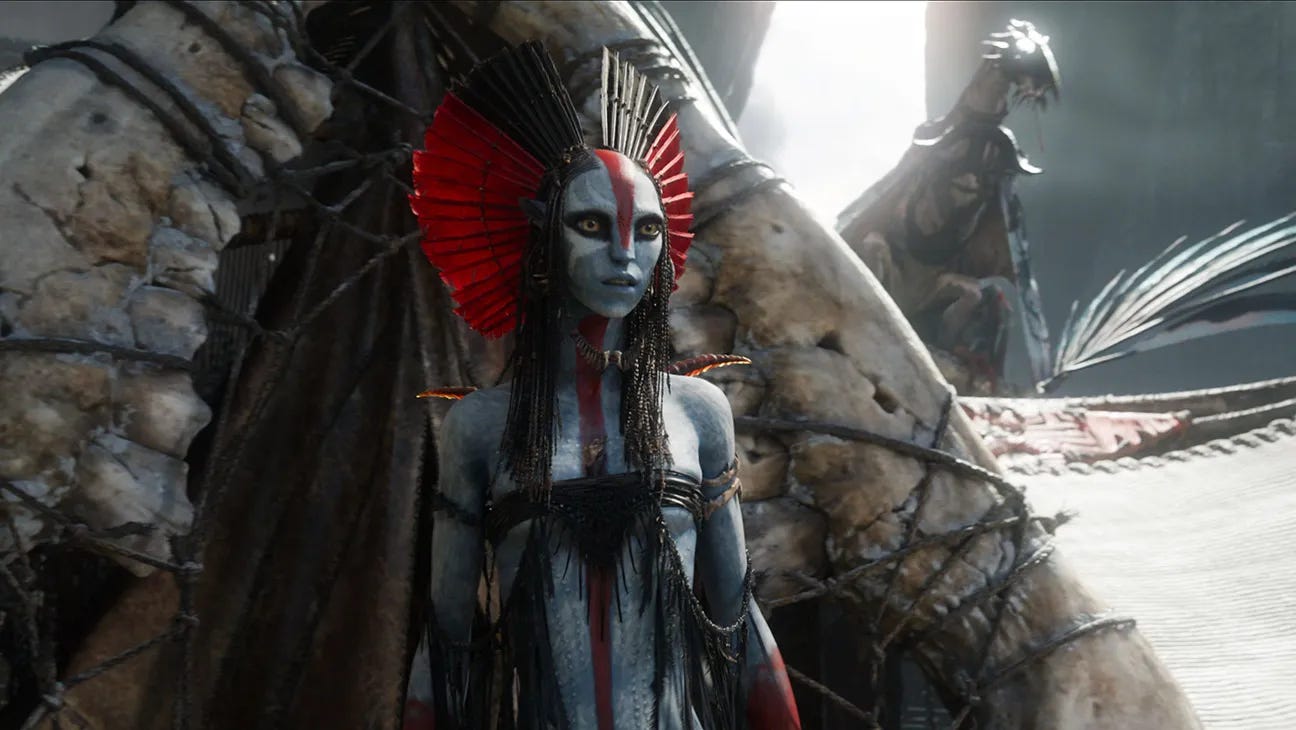
The Ash People are the film’s strongest addition. Varang is a compelling antagonist as a Na’vi leader who values power and conquest over spiritual harmony. She performs dark shamanic rituals, uses her neural queue to mind-control enemies, and pursues domination with ruthless efficiency. Oona Chaplin steals every scene she’s in, bringing intensity and menace that the protagonists lack. Varang is more interesting than Jake, more dynamic than Neytiri, and more compelling than Quaritch’s one-note revenge obsession.
The inclusion of a villainous Na’vi faction adds moral complexity the franchise desperately needed. The first two films presented the Na’vi as a uniformly noble, spiritual, and harmonious indigenous people in space who commune with nature and reject violence except in self-defense. The Ash People reveal that Na’vi culture is diverse, that some clans are warlike and expansionist, and that the conflict isn’t simply “noble natives versus evil colonizers.” This nuance makes the political messaging less heavy-handed and the world more believable, which should have been a part of the franchise from the beginning.
The action sequences are spectacular. Cameron knows how to stage large-scale battles, and Fire and Ash delivers multiple set pieces involving aerial combat, naval warfare, and ground assaults. The visuals are stunning in a theatre setting as well. Pandora’s bioluminescent forests, the volcanic landscapes of the Ash People’s territory, and the massive space whales are rendered with meticulous detail. This is a film designed for theatrical exhibition, and it shows. The 3D presentation enhances the immersion, and the scale of the battles demands the biggest screen possible.
What Doesn’t Work: Repetition and Ideological Baggage

Fire and Ash suffers from the same structural problems as The Way of Water. It’s essentially a remake of the first film with higher stakes and more CGI. Jake and his family are on the run. They’re hunted by Quaritch, who has been resurrected from what they thought was his death again because he was saved by Spider this time. They ally with a new Na’vi clan. They face overwhelming human military force. They triumph through a combination of individual heroism and Eywa’s intervention. The formula is identical, just bigger.
Quaritch’s being back as villain with no development is particularly egregious. He died in the first film, was brought back as a Na’vi avatar in the second, and now he’s back again for the third. The franchise refuses to let go of Stephen Lang’s character despite having climaxes where he’s killed in 2 movies. We still don’t know why he was cloned to begin with, beyond his having a “mission” to stop “Jake,” but it doesn’t really make sense that some offworld people would conceive of such a specific plan for a distant colony to deal with one person. What makes him so valuable? The answer is that Cameron needs a recurring antagonist, so Quaritch keeps coming back and never changes or grows as a character for the sake of the plot. This particularly hurts the film at the end, which we’ll get to later.
The combat sequences, while visually impressive, suffer from inconsistent internal logic. The Na’vi’s bows and arrows consistently outperform human firearms. Hundreds of bullets miss Jake and his family while single arrows find their targets with perfect accuracy. The space whales shrug off machine gun fire but can destroy armored ships by ramming them. The RDA’s forces are simultaneously technologically superior and incompetent, depending on what the plot requires. It’s the Stormtrooper problem on steroids, with villains who can’t hit anything because the heroes need to survive, and the inconsistency becomes distracting.
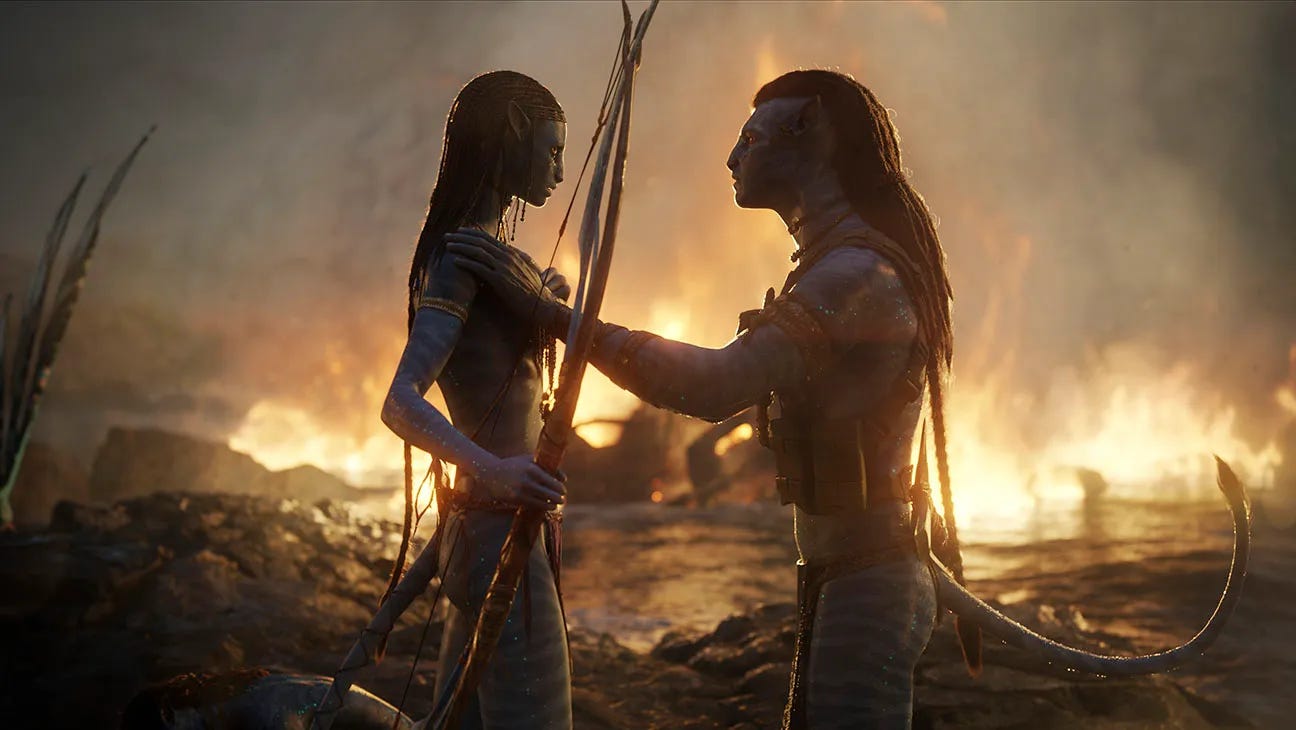
The film’s political messaging is less subtle than Cameron seems to think. The RDA is staffed entirely by white people. This is a deliberate casting choice in an era when every other blockbuster features diverse ensembles. The white humans pollute, destroy, and exploit. The Na’vi live in harmony with nature. The message is clear: industrial civilization is evil, indigenous cultures are noble, and environmentalism is the only moral position. It’s a simplistic worldview that ignores the complexities of development, resource management, and cultural exchange.
The religious allegory is equally heavy-handed. Kiri is born through virgin conception, making her a Na’vi Jesus figure. She channels Eywa to save her people, replacing God the Father with a feminine planetary deity. The film explicitly positions environmentalism as a replacement for traditional religion, with Eywa as the divine force that punishes human arrogance and rewards Na’vi spirituality. Jake’s near-sacrifice of Spider mirrors the Abraham and Isaac story, but the film doesn’t explore the theological implications—it just uses the imagery for dramatic effect.
The climactic battle evokes Star Wars Episode I: The Phantom Menace in uncomfortable ways. The Ash People’s army facing off against human forces resembles the Gungans versus the droid army. The musical score during the battle echoes “Duel of the Fates” in tone and structure. The virgin birth concept mirrors Anakin Skywalker’s origin. The parallels are distracting, and they highlight how much Fire and Ash borrows from other franchises without adding anything new.
Quaritch’s final scene is particularly frustrating. After three films of relentless pursuit, he’s offered redemption and friendship. Instead of accepting or rejecting it through character-driven choice, he simply falls to his death. It’s an anticlimactic end for a character who’s been the franchise’s primary antagonist, and it raises the question: will Cameron resurrect him again for a fourth film?
The Jesus Allegory and Feminist Theology

Kiri’s role as a virgin-born savior who channels a feminine deity is the film’s most overt ideological statement. Cameron replaces traditional Christian theology with eco-feminist spirituality. Eywa as an allegory for Mother Earth, Kiri as the divine feminine, and salvation through environmental harmony rather than personal redemption. It’s not subtle, and it’s not particularly deep. The film treats this theology as self-evidently superior to human religion without exploring the implications or acknowledging the contradictions.
If Eywa is all-powerful and benevolent, why does she allow the RDA to devastate Pandora for decades before intervening? If Kiri can channel Eywa’s power, why doesn’t she do so earlier to prevent suffering? The film doesn’t address these questions because of the shallow writing elements trying to appear deep but again has logical problems that are built on a flawed world from the first two films.
Final Verdict
Avatar: Fire and Ash is the best of the three Avatar films, which is faint praise given the competition. The improved pacing, the addition of the Ash People, and the spectacular action sequences make it more engaging than The Way of Water or the original. But it’s still a derivative, ideologically heavy-handed film that repeats the same formula for the third time.
The film earns a seven out of ten. It’s entertaining enough to justify a theatrical viewing, and the visuals are impressive enough to make the experience worthwhile. But it’s not a film that will be remembered for its storytelling, its characters, or its themes. It’s a technical showcase that demonstrates what modern CGI can achieve while reminding us that spectacle alone isn’t enough.
If you’re a fan of the franchise, Fire and Ash provides a satisfying conclusion. If you’re skeptical of Cameron’s environmental preaching and repetitive plotting, this won’t change your mind. It’s a competent blockbuster that does what it sets out to do, deliver three hours of visually stunning action, and nothing more.
Rating: 7/10
Improved pacing and the compelling Ash People elevate Fire and Ash above its predecessors, but repetitive plotting, inconsistent combat logic, and heavy-handed ideology keep it from greatness. Worth seeing in theaters for the spectacle, but don’t expect narrative depth.
What do you think? Does Fire and Ash successfully conclude the trilogy, or is it just more of the same?
These movies look sooooo boring.
I respect your review but first one was mid and the rest trash.