



It’s incredible how many controversies Worldcon and the Hugo Awards manage to embroil themselves in. After a disastrous 2023 where even the woke mob who’s been running the award for the past decade decrying the Hugos as meaningless, in 2024, the problems were one-upped once again as Publisher’s Weekly exposes that sci-fi fandom’s once most prestigious honor has a voting fraud problem.
Last year, Worldcon held its science fiction fandom event in Chengdu, China, and with it came a list of demands from the Chinese government to remove certain works from Hugo Award eligibility based on the Communist Party's sensitivities. This was done behind the scenes in a non-transparent fashion, which unsettled many science fiction authors who had their works discarded for nebulous reasons.
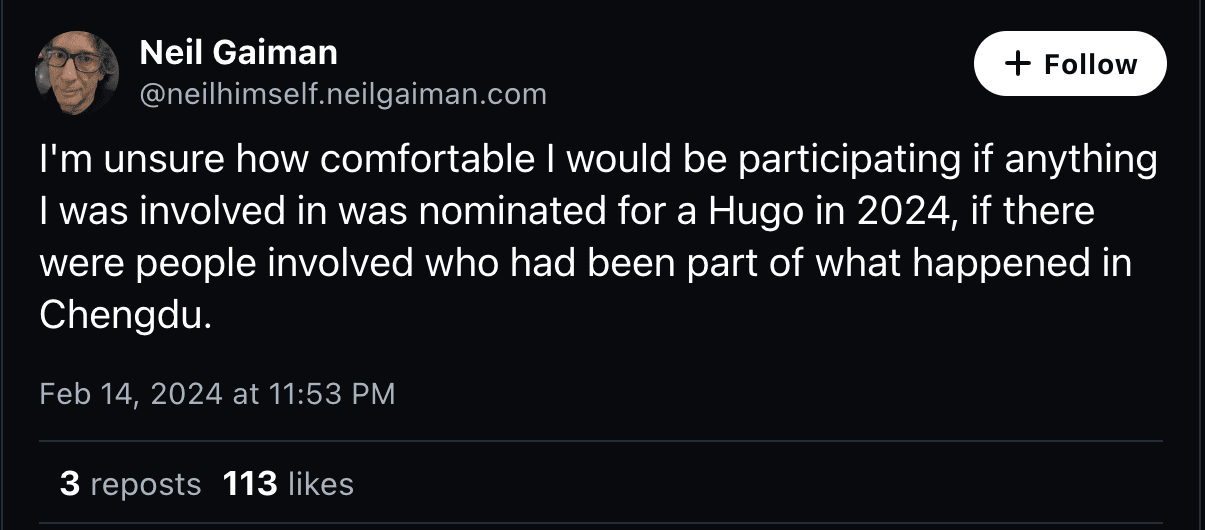
Alleged sex predator Neil Gaiman threw a particular fit about the situation. He took to the woke safe space BlueSky to post at the time, “I’m unsure how comfortable I would be participating if anything I was involved in was nominated for a Hugo in 2024 if there were people involved who had been part of what happened in Chengdu.”
Many would be uncomfortable with Neil Gaiman participating in anything at this juncture, ironically.
Others directed their ire at Hugo Awards administrator Dave McCarty, who eventually was accused of sexual misconduct himself, which led to him being banned from Glasgow 2024’s Worldcon, even though he volunteered and ran the Hugo Awards last year.
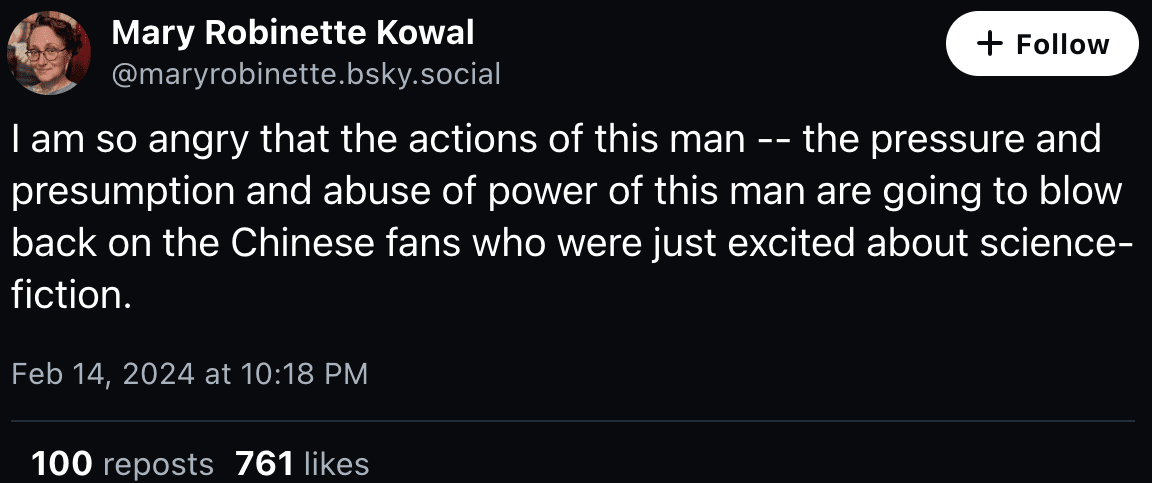
Former SFWA president Mary Robinette Kowal said of him at the time, “I am so angry that the actions of this man — the pressure and presumption and abuse of power of this man are going to blow back on the Chinese fans who were just excited about science-fiction.”
This year, however, the Hugo Awards might have had a worse problem than eligibility concerns: There was confirmed ballot fraud during the voting. The Hugo Awards administrators noticed unusual activity and saw that at least 377 ballots had been fraudulently placed.
It is unknown how a ballot could be fraudulently cast when one is required to get a Worldcon membership and login to vote. With the few members Worldcon has (around 8,000 between online and in-person), it should be easy to sift through the ballots of people casting said votes and determine one person gets one vote.
Apparently, several of these ballots cast were not made by actual people. It seems there might have been fake Worldcon memberships bought as duplicates in order to influence the award.
Only 3,813 final ballots were cast, and they determined that at least 377 were cast fraudulently and, therefore, disqualified those. How they determined these ballots were fraudulent was not mentioned.
It does seem odd, however, that the end result for the one category people pay attention to in science fiction fandom went to an LGBTQ debut novel with a protagonist who looks suspiciously like a self-insert. Some Desperate Glory by Emily Tesh left many in fandom wondering who the author was when the award results were announced. The book was published by Tor, a publisher who’s been known to manipulate the Hugo Awards, even going so far as to have the rules changed for how votes are tallied to maintain its winnings.

Publisher’s Weekly ran interference for Worldcon, writing a glowing review of the convention and the Hugo Awards in a piece titled, “In Glasgow, Worldcon Worked to Put Hugos Controversy Behind It.”
A reader had to go deep into the article to even see what the Hugo Awards scandal was, where they wrote: “The controversy surrounding the fraudulent votes cast for this year's Hugo Awards was unfortunate and it's upsetting for the SF community that someone would try to interfere with the voting system in this way,” said Jackson. “I commend the Hugo organisers for being transparent around this matter.” Liza Trombi, editor in chief at Locus magazine, concurred, saying, “The current team has done an excellent job of managing problems when they appear, in a transparent way that is rebuilding confidence within the larger SFF community.”
The attempt to bury 10% of Hugo Award ballots being shown as fraudulent is suspect to say the least. One only can wonder what will happen at next year’s Worldcon in Seattle to make matters worse for the convention.
What do you think of the Hugo Awards getting rocked by a voter fraud scandal? Is Worldcon complicit or inept? Leave a comment and let us know.
If you enjoy Fandom Pulse and want to support our creative efforts with science fiction that does honor to the classics, get the new science fiction audiobook for Colony Launch on Amazon now!

"Voter fraud? Say it ain't so, Josephine! Say it ain't so!"
Slowly then all at once.