


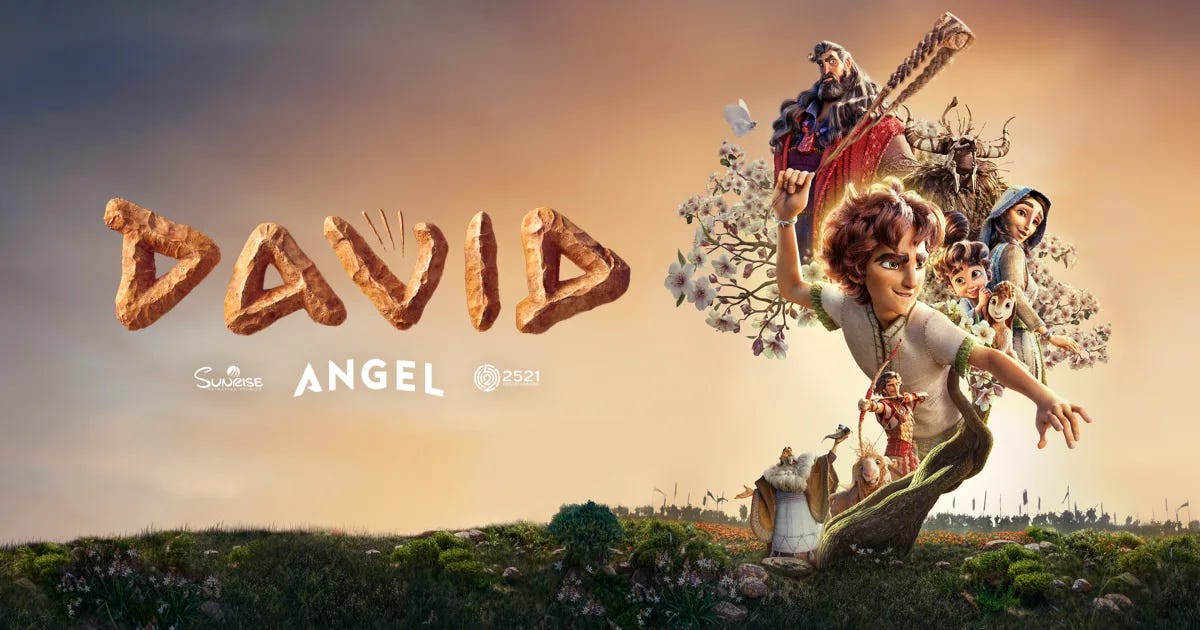
Angel Studios releases David on December 19, 2025, and it’s the biblical animated musical families have been waiting for. The nearly two-hour film follows the shepherd boy’s journey from anointing to giant-slayer to fugitive king, delivering a story that’s faithful to Scripture while embracing the Disney musical format. This is quality family entertainment that treats the Bible seriously.
The animation is exceptional. My twelve-year-old son, an anime fan, commented unprompted that the animation quality impressed him throughout. The character designs are expressive, the backgrounds are detailed, and the directorial choices show real craft. There’s a Middle Eastern aesthetic that gives the film an Aladdin vibe and the visual storytelling keeps the nearly two-hour runtime from dragging.
The film opens with David as a shepherd, singing songs while tending his flock. The musical numbers are competent but not particularly memorable. After a few days of reflection, I can recall the general melodies but not specific lyrics. The standout is “Tapestry,” sung by David’s mother, a character expanded significantly for the film who was not named in the Bible. The songs blend into the background score, which works in one sense (they don’t jar you out of the story) but also means they lack the punch of Disney’s best musical moments.
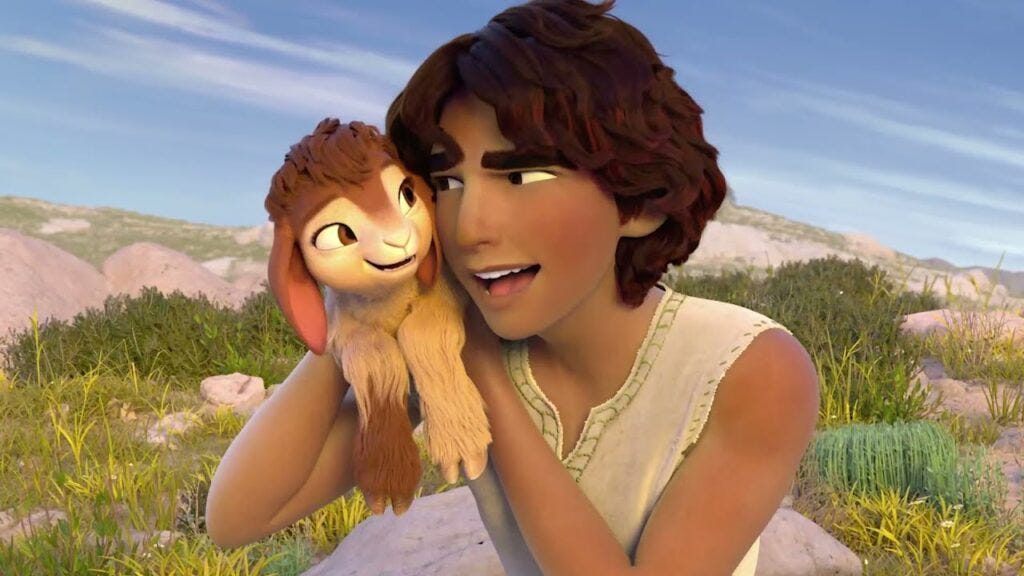
The biblical narrative unfolds faithfully. Samuel arrives to anoint David, causing panic in the household because Saul has been hunting potential rivals. But David is summoned to the palace as a musician, not a threat. This tracks with Scripture, where David served Saul for a time, playing music to soothe the king’s troubled spirit. The film establishes their relationship before the conflict begins.
The Philistine challenge comes next. Goliath is cartoonishly huge, but this is a stylistic choice that works for animation. The giant’s size emphasizes the impossibility of David’s task. The film shows the standoff taking place over several days, which initially bothered me since Scripture specifies forty days. But David’s arrival and the confrontation happen quickly enough that it doesn’t undermine the story’s tension.
The sling-and-stone sequence delivers. David fells Goliath with a rock to the head, and the giant topples. It’s the most famous moment in David’s story, and the film handles it with appropriate weight. This climax hits around the halfway mark, and the tone shifts dramatically afterward.

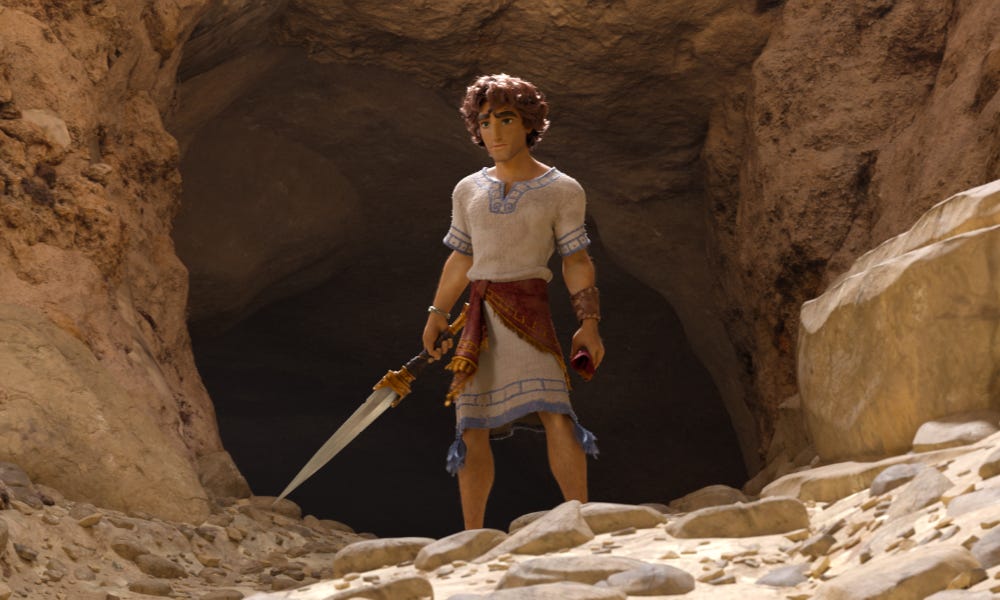
The second half uses time jumps and montage to age David up and show Saul’s descent into jealous madness. The king hunts David through the wilderness, and the film takes a darker turn. David has the opportunity to kill Saul in a cave and cuts his cloak instead, demonstrating he won’t harm the Lord’s anointed. Saul temporarily relents but resumes the hunt. The cat-and-mouse dynamic drives the rest of the film.
The Amalekites serve as the final antagonists. They’re designed as monstrous figures wearing ram skulls and horns, looking like something from Game of Thrones. The film establishes them early as a threat, then brings them back in the climax for narrative symmetry. In Scripture, the Amalekites capture David’s wives and children. The film changes this to David’s mother and his entire village, a necessary adaptation for a children’s movie that doesn’t address David’s multiple marriages.
The rescue sequence is where the film diverges most from Scripture. In the Bible, David attacks the Amalekites and slaughters them, recovering everything they took. The film softens this considerably. David is captured and hung from a tree by the Amalekites in a clear Christ parallel, and he uses his inner strength to sing a song that inspires his people to rebel. The Amalekites flee rather than fight. It’s a tonal choice that keeps the film family-friendly while sacrificing some of the story’s edge.
More Christ parallels are woven throughout. David enters the city on a donkey after defeating Goliath, mirroring Jesus’s entry into Jerusalem. He’s celebrated with palms. The crucifixion imagery at the climax is unmistakable. These connections are theologically sound, and the film handles them with reverence rather than heavy-handedness.
The biblical accuracy is impressive overall. Saul’s madness is portrayed seriously. David’s time as a fugitive is genuinely tense. The violence is toned down for younger audiences, but the stakes remain clear. This is a story about faith, obedience, and God’s sovereignty, and the film doesn’t shy away from those themes.
The voice acting is solid across the board. David’s character arc from shepherd boy to warrior to hunted fugitive is handled with emotional depth. Saul’s descent into paranoia is tragic rather than cartoonish. The supporting cast all serve their roles effectively.
The runtime is the film’s biggest weakness for a children’s film. At nearly two hours, it pushes the attention span of younger viewers. Most children’s films run around 90 minutes for good reason. My family stayed engaged throughout, but I noticed restlessness during some of the wilderness sequences in the second half. Tightening the middle section by 15-20 minutes would have improved pacing without losing essential story beats.
David’s mother is expanded into a significant character, presumably to add female representation and give her musical moments. She sings “Tapestry” and appears throughout the film as David’s emotional anchor. It feels slightly shoehorned, but it’s not intrusive. The character works within the story, even if her prominence is clearly a creative choice rather than a scriptural one.
The film could have used a montage early on to show David serving Saul for an extended period before the Philistine conflict. The relationship between David and Saul needed more development to make Saul’s later jealousy hit harder. The film establishes that David played music for the king, but we don’t see enough of their bond to fully understand what’s lost when Saul turns against him. A brief montage showing David’s growing favor in the court would have added emotional depth.
These are minor complaints. David succeeds at what it sets out to do: tell a biblical story with craft, reverence, and entertainment value. Angel Studios has carved out a niche producing faith-based content that doesn’t feel cheap or preachy. Sound of Freedom, His Only Son, and Cabrini all demonstrated the studio’s commitment to quality. David continues that trend.
The film works for families with children of all ages. Younger kids will enjoy the music and adventure. Older children and teens will appreciate the darker second half and the thematic depth. Adults will recognize the care taken to honor Scripture while making the story accessible. This is the kind of film churches will show, homeschool families will own, and Christian parents will feel good about their kids watching repeatedly.
The film releases December 19, 2025, in theaters. Angel Studios typically uses a “pay it forward” model where viewers can buy tickets for others who can’t afford them. It’s a distribution strategy that’s worked well for their previous releases, building word-of-mouth and community engagement.
David is a win for Christian filmmaking and a solid animated musical by any standard. The animation is excellent, the voice acting is strong, the story is faithful to Scripture, and the themes are handled with maturity.
Rating: 9/10
Minor pacing issues and forgettable songs keep it from perfection, but the animation is exceptional, the biblical faithfulness is commendable, and the storytelling is solid. Highly recommended for families looking for quality faith-based entertainment.
What do you think? Are you planning to see David when it releases on December 19?
NEXT: Gene Roddenberry’s Genesis II: The Post-Apocalyptic Pilot That Almost Made It
Excellent review. We’ve been watching the Young David series on Angel for months now and can’t wait to see the film. Rhythm of Your Grace (episode 5) is a popular song in our house. Very happy to hear the movie pays off so well.
It's not biblically accurate if they are changing the story. If kids can read it in the bible , it should be in the movie. Parents can explain what was different way in the past. That's their job. Some of these kids will wonder why the movie lied about what was in the bible.