


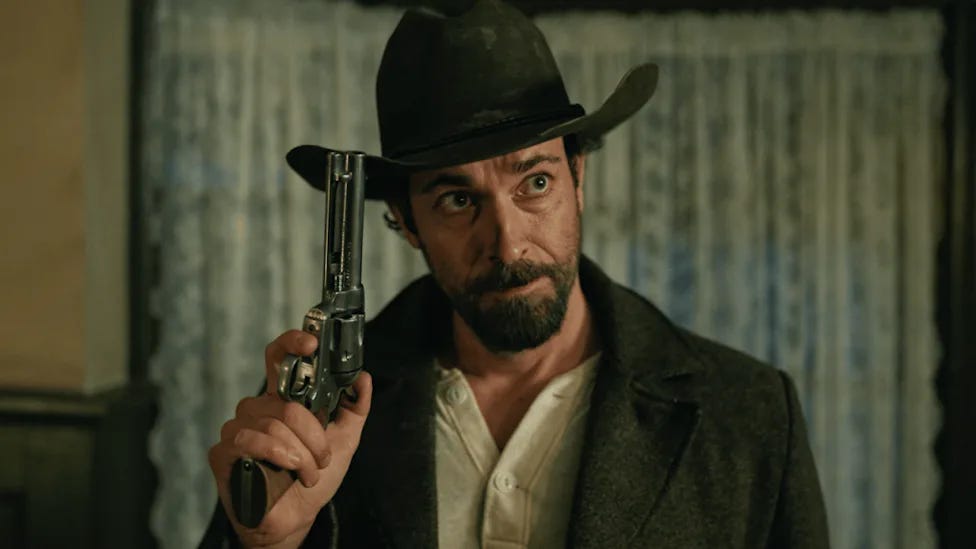
Angel and the Badman, Angel Studios’ remake of the 1947 John Wayne Western, reached theaters October 9 with Zachary Levi stepping into the role of gunman Quirt Evans. Julio Quintana directs. Neal McDonough plays the villain Laredo Stevens, Tommy Lee Jones plays the lawman on Quirt’s trail, and Meg Fraser plays Penny, the young woman whose family takes in the wounded outlaw. The film runs 105 minutes and is rated PG-13.
The original came from Republic Pictures. James Edward Grant wrote and directed it, and it was the first picture Wayne produced himself. Gail Russell played Penelope Worth, Harry Carey played the marshal, and Bruce Cabot played Laredo. Audiences have seen the story once since then, in a 2009 Hallmark Channel remake with Lou Diamond Phillips, Luke Perry and Deborah Kara Unger. That version followed the Wayne film very closely, and this new one does too.
Viewers who know the 1947 picture should expect a familiar ride. The remake is very, very similar to the original, and several scenes play almost beat for beat. A wounded Quirt lands in the care of a decent family, and the household slowly domesticates him. He learns that the Christian values around him are worth having. His old nature then pulls him back into trouble, Laredo’s people come for the family because of it, and the lawman shoots the villain dead at the finish so everyone can live in peace. Anyone who has seen the Wayne film will recognize that skeleton. The changes sit on top of it.
The first change comes at the start. Quirt takes a bad wound in a gunfight that runs tighter and more intense than the opening of the 1947 version, then wanders until he collapses at the door of Penny’s farm. The film gets the audience into the danger faster than the original did.
The second change is the plot that drives the villains. In the Wayne film, Quirt’s feud with Laredo grew out of cattle and a land claim, and the details were hard to follow. The remake swaps that for gold. Quirt has robbed Laredo’s gang, buried the loot and made himself the most wanted man in the territory. A mix-up then sends the gang after the family. The lawman has taken the gold, Laredo’s men decide Quirt is lying about where it is, and they start harassing the people who sheltered him. The motives are clear from the first act, and the story is easier to follow for it.
The film also makes Quirt a worse man at the start. The 1947 version hinted at a criminal past without dwelling on it. This one commits, presenting Quirt as a dangerous man with plenty to answer for. That gives the redemption arc more distance to cover, and the arc covers it. Redemption stories work when the sinner has real sins, and the remake gives its lead a bigger load to put down.
Penny is the best character upgrade. The character is now a horse woman trying to break a stallion into a plow horse. The film is working the same problem on Quirt, a wild thing being taught to pull a load, and the parallel keeps the theme in front of the audience without a speech. The stallion returns later when Quirt is stuck in jail while the marshals are away, and the horse helps him break out. The escape is contrived, but it fits the film’s idea and it works.
The performances carry the picture. Levi does a great job as Quirt. Jones is a pleasure, and McDonough makes Laredo a threat the family has reason to fear. The film turns the gang member Hondo into a Hispanic character, with Spanish dialogue and accents played broadly, and that choice is a bit much. It is a small stumble in an otherwise well-cast film.
The film also lets its men be masculine and its women be feminine. It makes no attempt to subvert either, which is hard to find in a modern release. The Christian content is overt. The characters pray, endure trials in faith and treat “do unto others” as the rule of the house. That is heavy-handed at times, and it fits a story about a sinner changing his life. Penny’s patience and goodness are what convince Quirt to leave his violent ways behind, and the message comes through clearly.
Parents should know the film pushes into adult territory while trying to stay a family picture. A saloon scene includes prostitutes, and the villain calls them whores outright. Laredo’s gang makes rape threats against Penny. Both are less subtle than anything in the 1947 version.
Spoilers for the ending follow. The finale is where the film stumbles because of its trying to ride the line on tone. Laredo, who is dying of an illness the film never explains and whose face shows it, demands that Penny put on her wedding dress and takes her upstairs. The scene hints that he means to rape her. Because the film is careful not to push a family picture too far, it never makes his intent clear. Laredo turns his back, and Penny drives a heavy metal object into him. The moment is confusing, and it does not make the point the filmmakers seem to want. The Wayne version took a different route at this stage. A gunfight broke out in town, Quirt refused to fight because he was trying to become like the people who took him in, and the lawman shot Laredo. The remake keeps the lawman’s final shot but gives up the moral clarity of Quirt’s refusal.
The remake is a good Western. It tells a clear redemption story, gives the villains a plot that is easier to follow than the original’s, and has a lead who does the work. The muddled ending is the film’s one real problem. It is worth seeing in a theater and worth supporting for what it is trying to do.
In the 1947 film, Quirt put down his gun because he wanted to be like the family that saved him. Did the remake’s new climax make that choice clearer, or did it cost the story something?