


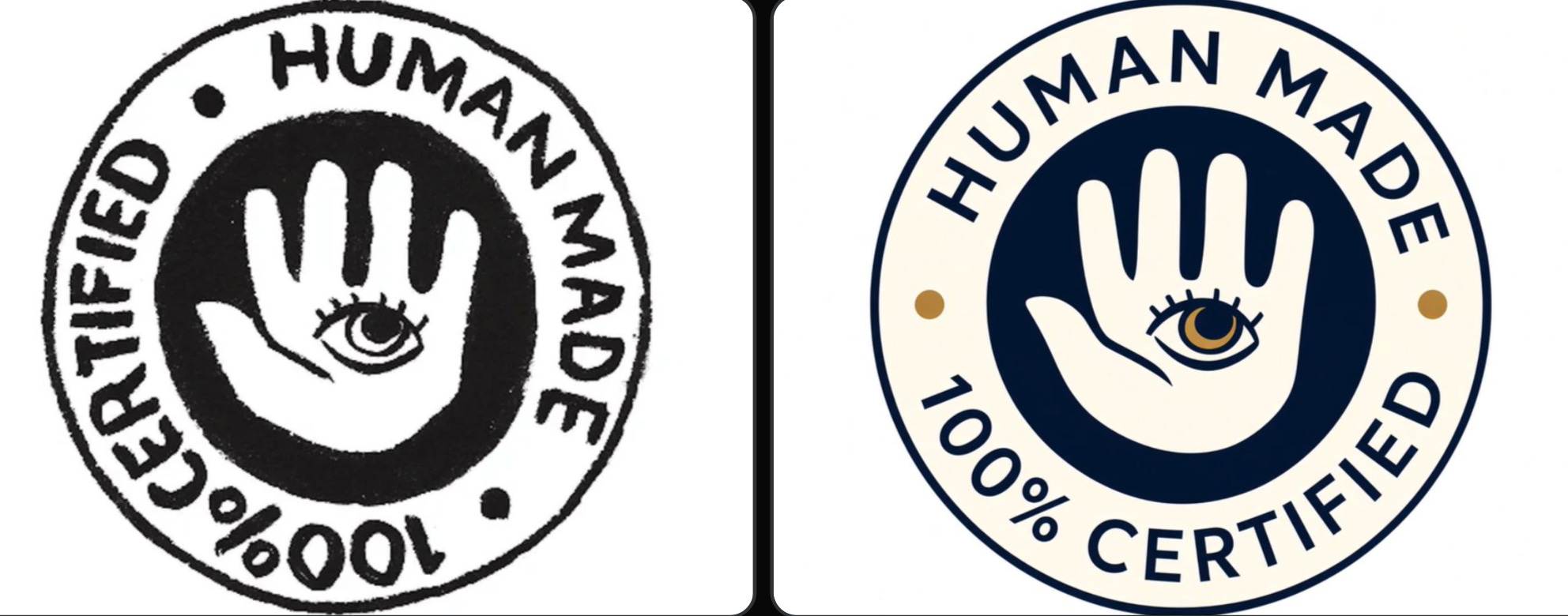
Matt Kindt designed an open-source emblem for one purpose: let creators tell readers, at a glance, that a comic came from a human hand and nothing else. Ahoy Comics just became the first publisher to commit its entire line to wearing that emblem, starting with Mark Russell and Russ Braun’s The Forgotten Divine. And now that the logo is actually circulating in the wild, plenty of people are looking at it and asking the same question: why does the symbol meant to reassure you about authenticity look like it belongs on a dollar bill next to a floating eye?
Ahoy Comics Editor-in-Chief Tom Peyer then put the company’s position in writing without softening it: “AI is rightly loathed throughout the world of legitimate comics, and we want to make it clear to our readers that Ahoy is 100% powered by the very human blood, sweat and tears of our uber-talented creators.” Every future Ahoy title carries Kindt’s certification now, a public, permanent, on-cover promise that nothing inside was touched by a generative tool. It, of course, does not certify anything regarding people using digital 3D assets, Photoshop rendering, or using robots to print and staple books, however.
The certification itself is open-source, released under a Creative Commons license so any publisher or independent creator can use it for free, provided the work was made entirely by human hands from concept through finished page. Kindt debuted it on his own Mind MGMT: New & Improved #1 under his Flux House imprint at Oni Press before Ahoy picked it up wholesale. There’s no third-party auditor checking anyone’s process. The whole system runs on a publisher’s word.
That trust-based system is landing in an industry that has gotten ugly over this exact question. San Diego Comic-Con spent years quietly allowing labeled, non-for-sale AI art in its art show, until artists like Karla Ortiz, who’s worked on Marvel films and is a plaintiff in an ongoing AI lawsuit, and Sarah Myer publicly called the policy “tone deaf.” The convention reversed the rule within 24 hours and banned AI art from the show outright, with no public announcement, just a quiet edit to the fine print.
That reversal didn’t happen in a vacuum. A month earlier at Dragon Con, a vendor’s booth, registered to Oriana Gertz Art, got surrounded by fans and organizers over accusations of selling AI-generated prints. When the vendor couldn’t produce convincing proof the work was human-made, Atlanta police physically removed them from the show floor. Someone left a sign on the empty table reading “Vendor removed for selling AI,” and it became a rallying point for the rest of the weekend. Within weeks, GalaxyCon, which runs a portfolio of mid-sized comic and pop-culture conventions across North America, announced a sweeping AI ban of its own, citing the Dragon Con incident directly. DC Comics president Jim Lee put his own line in the sand publicly around the same period, vowing the company would never lean on AI for its published work: “Not now, not ever.”
The suspicion cuts the other way too, and that’s where it gets uglier. A Japanese fan artist doing Demon Slayer work got hit with false AI accusations from a single caller-out and deleted their entire account rather than fight it, the cultural pressure around “causing offense to the community” too intense to weather. An artist named Ben Moran posted commissioned work, over 100 hours of labor, to a major art subreddit and got banned anyway; moderators told him even after seeing his process files that the piece “looks so much like AI we don’t care.” In China, an illustrator who goes by Snow Fish discovered his own work had been fed into a platform’s AI generator without his consent, and even after the company privately admitted it, boycott hashtags accusing him of secretly using AI himself racked up more than 20 million views before the record got corrected. One artist helping moderate an AI ban in a children’s-book illustrators group watched legitimate artists get harassed off the platform, then got falsely accused herself. Reports have documented posts telling AI users to kill themselves, and pro-AI commenters receiving actual death threats over hobbyist image generation, threats platforms have in some cases determined don’t even violate their own terms of service.
That’s the environment Ahoy is stepping into with a permanent, unverifiable, cover-mounted pledge. It’s either a genuinely smart trust play in a market where readers are primed to demand exactly this kind of proof, or it’s painting a target on every future release for anyone looking to make an accusation stick, given that the certification has no auditing process behind it at all.
Set the politics aside for a second and just look at the triangle with a single centered eye. They inadvertently (or perhaps intentionally?) created the exact visual grammar that’s been shorthand for the Illuminati and secret-society iconography for decades, on everything from album covers to conspiracy forums. Maybe nobody at Ahoy or in Kindt’s design process intended that reading. It doesn’t matter. A symbol whose entire job is inspiring trust probably shouldn’t require a footnote explaining it’s not what it looks like.
I’ll be running a side-by-side below: Kindt’s original certification next to a cleaned-up version I put together using AI as the thumbnail here. Tell me which one you’d actually want to see on a comic book cover.
Sign up for the Ayla Rin: Gateway to Doom Crowdfund, coming soon for great cosmic comic books with a cover by legendary Green Lantern artist, Ethan Van Sciver:

NEXT: Grant Morrison Watches “Lanterns,” Delivers Mixed Verdict After Slamming Damon Lindelof