


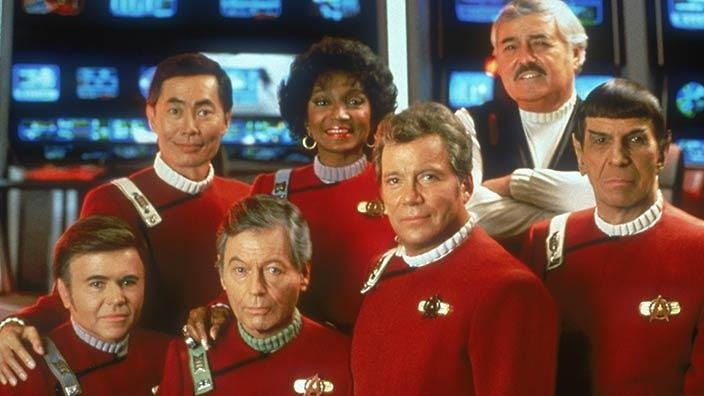
Star Trek VI: The Undiscovered Country gave the original crew the sendoff they deserved. The Khitomer Accords signed, the Enterprise flying into the sunset, signatures scrawled across the stars. Gene Roddenberry died three days before it opened. It felt genuinely final.
But “final” has never sat well with publishers, or fans. Over the next three decades, a handful of novels, comics, and autobiographies tried to fill the gap between that last great adventure and Kirk’s death on the Enterprise-B in Generations. Some of them tell new stories. Others are content to look backward from the vantage of age. Here’s a list of all of the above so you can see the true final adventures of the USS Enterprise.
The Retrospective Shelf: Looking Back More Than Forward
Several entries in the post-Undiscovered Country era use the period as a framing device rather than as a stage for new action. They’re not without value — they just aren’t really “what happens next” stories.

Best Destiny (1992, Diane Carey) sets Kirk answering a distress call near Faramond post-ST VI, but that’s scaffolding for a long flashback to a 16-year-old Jimmy Kirk running away from home, resenting his father George, and getting dragged on a milk run aboard Captain Robert April’s Enterprise that turns dangerous when pirates attack. George Kirk loses an arm and a leg. Jimmy gets the lesson he needed. It’s solidly written Carey, but readers wanting post-Undiscovered Country momentum will feel the pivot.

Klingons: Blood Will Tell (2007, IDW, Scott & David Tipton) is a five-issue comic miniseries with a genuinely clever premise. It retells classic TOS episodes “Errand of Mercy,” “The Trouble with Tribbles,” “A Private Little War,” and “Day of the Dove” from the Klingon perspective, framed by a post-ST VI story where High Council member Kahnrah debates whether to back Gorkon’s peace proposal with the Federation. The flashbacks carry the weight; the frame is the point. For Klingon fans, it’s essential. For those wanting pure post-ST VI narrative, it’s more meditation than adventure.

The Captain’s Table: War Dragons (1998, L.A. Graf) drops Kirk and Sulu into a bar near Utopia Planitia after ST VI, where retired captains trade war stories. The bulk of it is those stories are flashbacks to early-TOS-era run-ins with reptilian space pirates called the Nykkus and Anjiri. Sulu gets the better present-day adventure aboard the Excelsior. The Captain’s Table framing device is a fun conceit, but War Dragons functions more as a collection of tall tales than a forward-moving story.
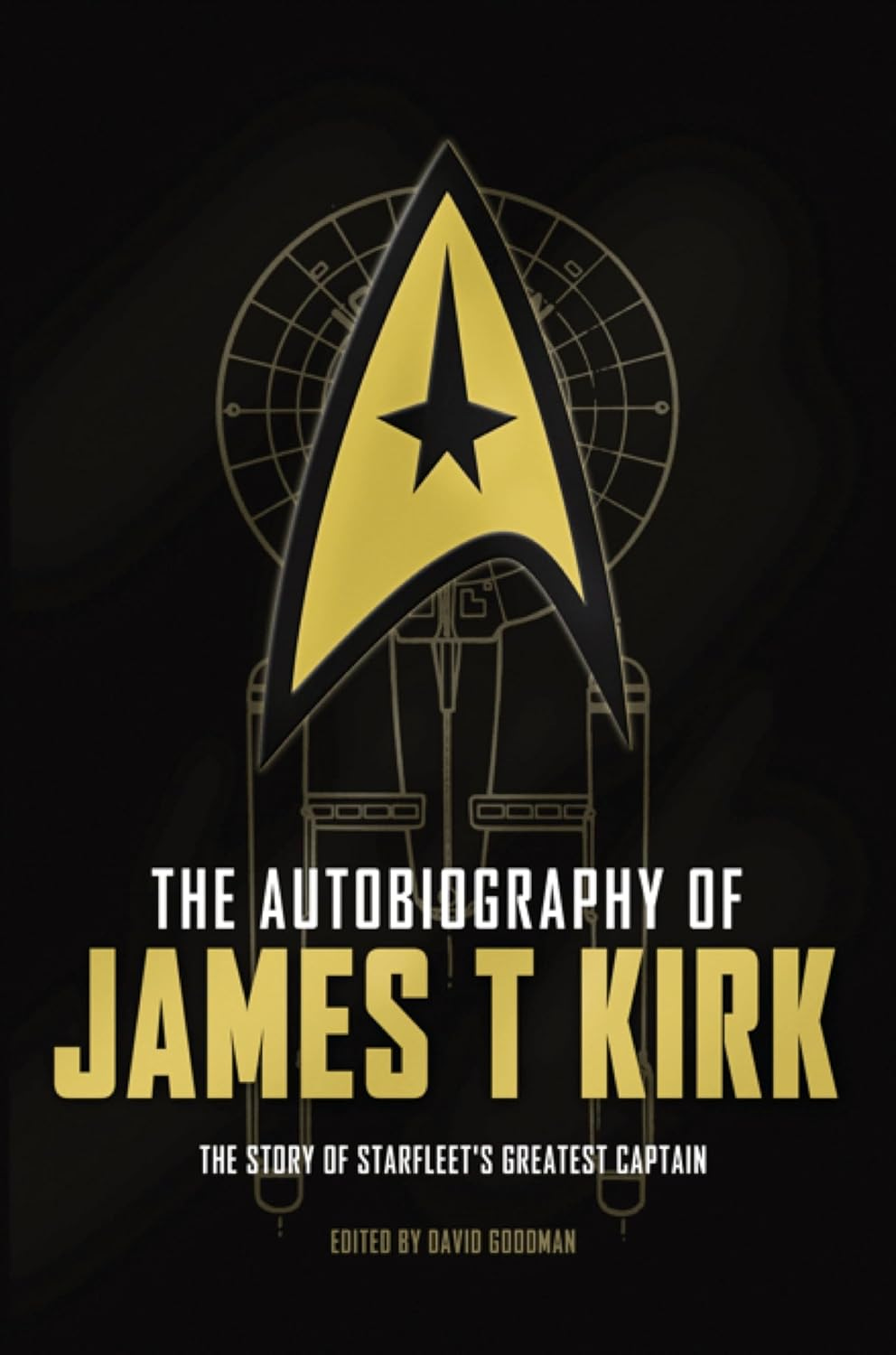
The Autobiography of James T. Kirk (2015, David A. Goodman) covers Kirk’s entire life in memoir format, ending at the Enterprise-B launch. It hits the expected beats — Tarsus IV, Kobayashi Maru, Carol Marcus, Edith Keeler — with confidence and affection. The post-ST VI section is brief, serving more as an emotional landing strip toward Generations than as a story in its own right. Worth reading as a companion piece, not as a standalone adventure.

The Autobiography of Mr. Spock (2021, Una McCormack) addresses itself to Jean-Luc Picard and spans from Vulcan childhood through Michael Burnham, Pike, Kirk, post-ST VI diplomacy, “Unification,” and Spock’s final mission to save Romulus. McCormack handles Spock’s hybrid identity and emotional growth better than almost any other prose author working with the character. The post-ST VI section, covering his Romulan-Vulcan reunification work and his evolving relationship with Saavik and Valeris, is the most substantive of the retrospective entries on this list.

The Lights in the Sky brings Shahna, the drill thrall from “The Gamesters of Triskelion,” the woman who once asked to join Kirk and was told to stay and help her people, back as Triskelion’s ambassador to Earth, hoping to reconnect with Kirk after all those years. It’s a gentle, fan-pleasing concept built on one of TOS’s more quietly sad supporting characters. This is contained within the short story anthology “Strange New Worlds.”
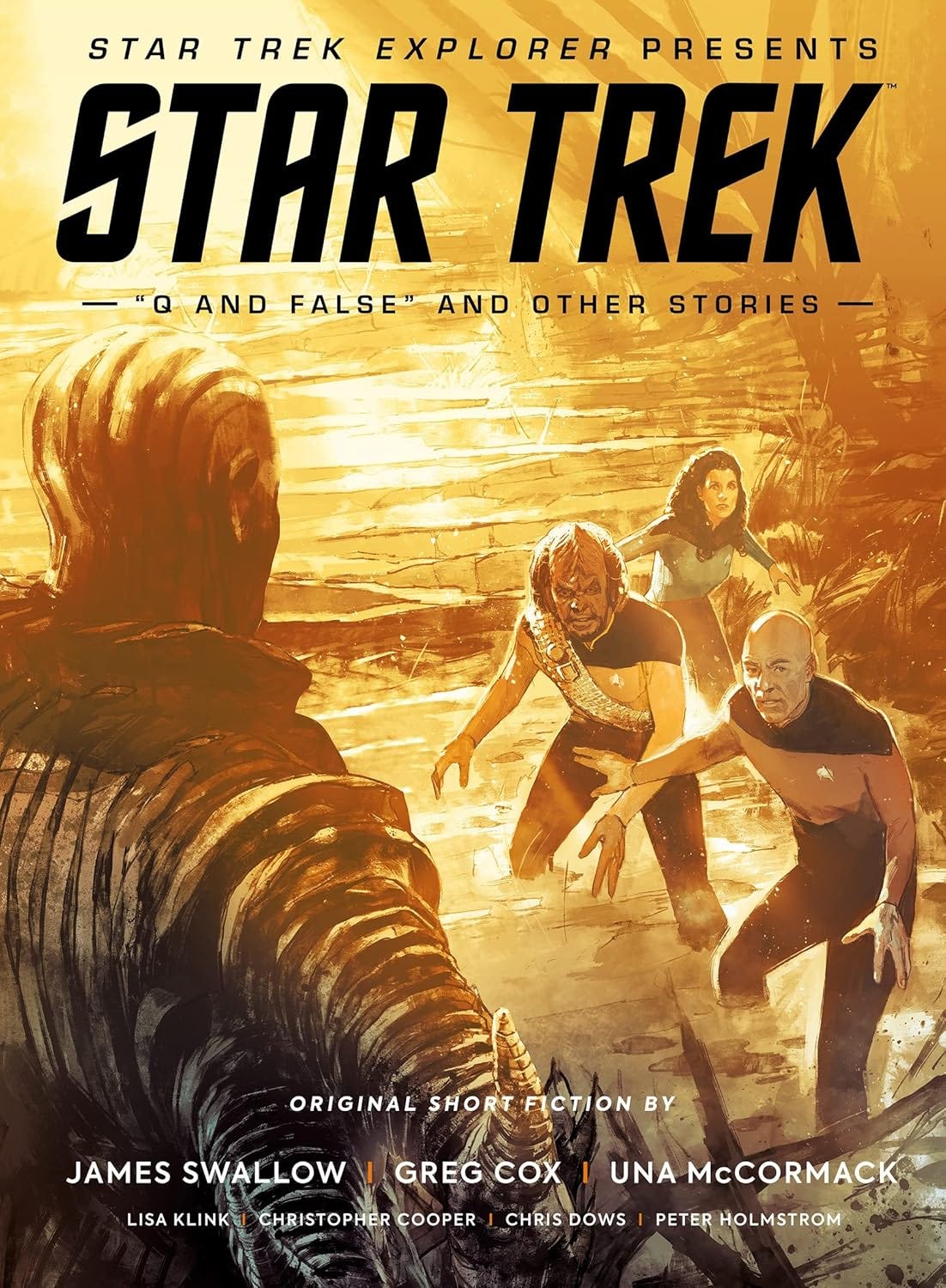
All That Most Maddens and Torments (Christopher Cooper, published in Star Trek: Explorer, 2021) is a short story set during Kirk’s first moments inside the Nexus, filling in the gap between his disappearance aboard the Enterprise-B and Picard finding him decades later. More of an emotional coda than a narrative, it gives Kirk’s experience in the Nexus interiority the film never had time to provide. It’s contained in the Star Trek Explorer short colleciton, “Q And False.”
The Real Post-Undiscovered Country Stories
These books actually pick up after the credits roll and try to answer the question everyone had: now what?
Shadows on the Sun (1994) — Michael Jan Friedman

McCoy has always been the most emotionally complex of the three leads and the least served by the tie-in novels. Friedman gave him a real book. Set post-ST VI, Shadows on the Sun sends McCoy on an assignment alongside his ex-wife — the woman he divorced, the marriage whose collapse haunted his entire life. Friedman splits the narrative: one thread is the present-day mission, where McCoy has to function professionally with a woman he loved and failed; the other is a flashback to his earliest Starfleet posting, where a decision to save an assassin’s life set off consequences that echo into the main story.
It’s the most character-driven of the post-Undiscovered Country novels. It doesn’t need a universe-ending threat to justify its existence. McCoy’s regret is the threat. The flashback structure works because it earns the present-day emotional weight. If you care about who McCoy is rather than what he does, this one holds up.
Mind Meld (1997) — John Vornholt

Spock, post-Undiscovered Country, is escorting his young Vulcan niece Teska back to Vulcan for her betrothal ceremony — teaching her what it means to be Vulcan, helping her manage emerging telepathic abilities she doesn’t yet understand. An unplanned mind meld reveals she’s connected to a deadly assassin, and suddenly both of them are targets. Beneath the action, Teska’s destiny is tied to the eventual reunification of the Vulcan and Romulan peoples — which gives the book a resonance with the long arc of Spock’s life that pays off if you’re reading it in sequence with his appearances in TNG.
Vornholt keeps the pace brisk. It’s not a demanding novel, but it uses Spock well and doesn’t manufacture conflict by having him behave out of character. The stakes feel proportional.
Sarek (1994) — A.C. Crispin

The most ambitious of the post-Undiscovered Country novels and the one that does the most to bridge the TOS and TNG eras. Crispin built something genuinely layered. The premise: Sarek is working to expose a Romulan conspiracy using Freelans — telepathic agents who are, in fact, enslaved descendants of captured Vulcans, bred for mind control — to stoke xenophobia and blow up the Khitomer Accords before the peace takes hold.
Running parallel: Amanda Grayson is dying on Vulcan. Her journal entries structure the emotional core of the book and illuminate the Sarek and Spock relationship in ways the films only gestured at. Kirk’s nephew Peter also gets drawn in through a xenophobic organization called the Keep Earth Human League, which the Freelans have been amplifying. The conspiracy is functional. The family story is what makes it. Crispin understood that the real subject of Sarek was grief — the grief of a Vulcan who has loved humans and is watching them die.
The Ashes of Eden (1995) — William Shatner with Judith & Garfield Reeves-Stevens

The Ashes of Eden is Shatner’s novel, written with the Reeves-Stevens, who are responsible for most of it, and it is very much a Shatner production. Kirk is 62, the Enterprise-A is being decommissioned, and his nemesis Admiral Androvar Drake has taken command of Starfleet. Disillusioned and aging, Kirk meets Teilani, a half-Klingon, half-Romulan woman who asks him to defend her homeworld, Chal, a planet whose inhabitants do not age.
Kirk steals a decommissioned Enterprise and goes. What he finds is that Drake has orchestrated the whole thing — a conspiracy involving dissident Klingons and a rumored doomsday weapon, aimed at reigniting Federation-Klingon hostilities before the peace can set. The plot mechanics are there. The wish fulfillment is nakedly apparent: Kirk gets rejuvenated, gets a beautiful alien woman, gets to fly the Enterprise again. It’s a better ending than Generations gave Kirk for sure. But the Reeves-Stevens know how to structure a thriller, and the book moves. As the entry point to Shatner’s multi-novel continuation of Kirk’s life, it does what it needs to do: it makes the death in Generations feel premature rather than inevitable.
The Last Roundup (2002) — Christie Golden

The most straightforward post-ST VI adventure novel on this list, set between Undiscovered Country and Generations. Kirk is retired and restless, teaching at Starfleet Academy, when his nephews invite him to join a colonization mission on an uninhabited planet called Sanctuary. He recruits Scotty and Chekov and goes. What they find is an alien outpost with a threat that turns out to be very much the Federation’s problem. Stranded without a ship, Kirk investigates while, one by one, loyalty draws the rest of the crew into the fight.
This is a proper Trek novel in the Pocket Books tradition: a solid threat, the crew functioning as a unit, Kirk doing what he does best without the benefit of a starship under his feet. The emphasis on his restlessness in retirement is well-handled. He’s not a man built for lecture halls, and the novel knows it. The Last Roundup is the cleanest “one last adventure” story this era produced.
The Alternate Timeline
The Crucible Trilogy (2006-2007) — David R. George III
George’s three-novel sequence is the most ambitious literary project the TOS line ever attempted, and though it isn’t exactly a “what happens after Star Trek VI,” it does show the end of the lives of Kirk, Spock, and McCoy in alternate timelines. It’s the most demanding read on this list. Each volume takes one member of the triumvirate and traces the lifelong consequences of “The City on the Edge of Forever,” the episode where McCoy accidentally travels back to 1930s New York and saves Edith Keeler, and Kirk has to let her die to preserve history. These

Provenance of Shadows (McCoy) runs the alternate timeline in full. McCoy saves Edith Keeler. The result is a world at prolonged war. He lives out decades in Georgia, watching history unspool wrongly because of him, weaving in and out of canonical TOS moments in a structure that is more literary novel than genre adventure. It’s the most heartbreaking of the three.

The Fire and the Rose (Spock) recontextualizes his path from the early Kirk years through ST VI and into TNG‘s “Unification,” with his logical decisions, including his role in the Keeler crisis, examined as sources of guilt he could never fully process. It’s the densest volume.

The Star to Every Wandering (Kirk) is the most directly post-ST VI of the three. Kirk’s time-displacement haunts him into and through the Generations era, forcing him to race through timelines to resolve a collapse of causality rooted in that same pivotal moment in 1930. Picard eventually finds him. It bridges the original crew’s era to TNG more deliberately than any other novel attempted.
The trilogy asks more of the reader than most Trek novels do. George writes long. The alternate-timeline sections in Provenance particularly require patience. But the payoff is unlike anything else in the tie-in library.
The Undiscovered Country was a proper ending. These novels are for the readers who needed to know what the crew did with the morning after. Some of them more than justified the question.
Which post-Undiscovered Country novel hit hardest for you? Drop a comment below.
When genetic engineering nearly doomed the species, humanity made a desperate bargain: let the frontier do what nature intended. In a harsh universe, these cadets have to make impossible decisions. Read Space Fleet Academy today.
NEXT: RUMOR: Star Trek: United Has Been Greenlit at Paramount/Skydance
I'm sorry, but the Next Generation movies were trash--just utter rubbish.
After the 3.5 really good, 1.5 good, and 1 OK TOS movies, the NG ones missed the plot entirely. They tried to be big, dumb, crowd-pleasing sci-fi action movies, which might have been forgivable it they were at least passable to that end.
They weren't.
ANYTHING trying to "bridge the gap" between Kirk and crew triumphant and Kirk dies like a chump for no reason in some weird, pointless "passing the torch, but he accidentally set himself on fire" moment is, by definition, pointless, for chumps, and has no reason to exist.
A respectful continuation of Kirk's story? OK, that's fine.
A bus stop on the route to Generations killing Kirk off because audiences are too stupid to understand Star Trek can exist without Kirk/Spock? No thank you.
Whenever I see Sulu now, I just imagine him licking some dude's butt. Oh my.