


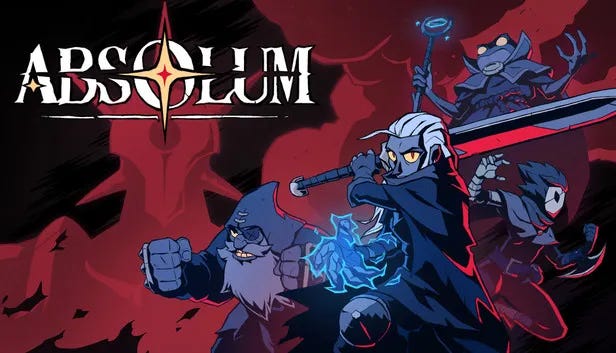
Absolum presents itself as a high fantasy of rebellion and restoration. It borrows the outer garments of the old stories: a ruined kingdom, remnants of dying races, an oppressive tyrant, and a small band of outcasts who rise against him. Yet the game systematically un-names the very relations that alone make societal restoration possible. It speaks the language of an epic while refusing the grammatical call of the bod and of sex.
Galandra the elf was once a maiden of Yeldrim. A catastrophe came and the role of warrior was forced upon her. However, the game does not treat this as a tragic necessity under which a woman still carries the memory of the form she was meant to fill. Instead the story has her declare that the male role feels natural to her and so the maidenhood that once oriented her toward the continuance of her people is discarded. In a land whose kingdom has been destroyed, she chooses the sword as her final speech. Her body no longer heeds the call of her ancestors; instead, she answers herself to do as she feels.
Karl the dwarf appears, at first, a more solid character. He fights with his fists and with a gun. Like classic dwarves, he enjoys filling his belly. But then the subplot reveals the truth of dwarven generation: they are not born of man and woman. They are forged. Minerals and gems are gathered and cast into the furnace of the All-Maker. Karl himself must perform this act to create a child. And so, the living speech between male and female is replaced by the mute work of a forge. Continuance becomes a technical problem solved by materials rather than a vow spoken between persons.
Brome the frog wizard carries a similar refusal. His people, the Mowlai, change sex under pressure. He was once female and he laid eggs. Then, after his people were attacked by the tyrant Azra, he became male in order to give those eggs purpose. The game presents this as an adaptive necessity and even as natural wisdom. Alex Jones’s old reference about making the frogs gay is made literal and solemn. What was once a fixed polarity that produced the next generation is treated as a costume to be exchanged when the situation demands it. The species survives by dissolving the very distinction upon which actual survival rests.
Cider completes the pattern. A woman by voice, she has had her body replaced, piece by piece, with the parts of puppets. The trauma erased the memory of what she was. Therefore she settles into the claim of being neither male nor female. The game offers this as some kind of coherent identity when that coherence was only made possible due to her loss. Trauma is allowed to rewrite the indicative of the body. The person is no longer called by the form into which she was born; she is called only by the absence that remains after the form has been broken.
Around these four figures the larger story turns the same inversion. The wizards of Talamh meddled with powers beyond their comprehension and brought chaos upon the world. Azra rose and imposed an empire that contained the chaos. The game names this empire tyranny. Order itself is the villain. The greater threat, the interdimensional creature named Absolum, was the very thing the empire sought to hold in check. And when the rebels dismantle the structure, the chaos is not truly overcome. In feminist fashion, the evil is negotiated with (via lullaby) and told to return from whence it came.
The heroes themselves are kept alive by the Ritual of Rebirth. Each return from death is purchased by the sacrifice of others who remain nameless. Only the graveyard itself is known. And the heroes just accept it. They do not speak against the exchange at all. Their immortality is bought by the quiet consumption of persons who have no identities of their own.
At the center stands Uchawi, the Root Mother who revives the party. By the end of the game, you discover she is the wife of Azra and she carries his miscegenated child. After Azra’s empire falls Uchawi remains the single mother of that child. The speech of the story ends not with the restoration of a people under a shared law, but with the solitary figure of the mother after the father has been eliminated.
The final confrontation makes the refusal complete. Absolum, the force that threatens to unmake the world, is revealed as something like an otherworldly child sealed within the outer casing of some womb. The heroes beat the casing of that womb until it cracks, essentially performing a cosmic C-section. Then Uchawi sings. She sings a lullaby. The song soothes the child and it ceases its work of destruction and departs for the stars.
Evil is not named as that which must be judged and driven out by a higher speech. It is treated as a restless infant that can be reasoned with, negotiated with, and finally convinced to retreat. The imperative that once called men to stand against the chaos is replaced by a maternal song that asks the chaos to be quiet.
A people continues only when the body is addressed by a call that precedes the self: the call of the race that must be continued, the call of the sex that must answer the other sex, and the call of the order that can hold chaos at bay. Absolum gathers the outer signs of that call and then systematically un-speaks them. The maiden becomes the warrior who feels no need of the old role. The dwarf forges children from rocks. The frog changes sex. The broken body claims its brokenness is its truth. A mechanism for the sacrifice of nameless people is accepted as a means to overthrow an empire of order. A mixed child is left to be raised with a single mother.
And the final evil is sung to sleep as if it were a child that only needed understanding.
Fantasy once served as the speech by which a culture remembered that it must answer for its future. When that speech is emptied of the relations that make answering possible, the story can only gesture at restoration while dissolving its conditions. The heroes of Talamh may fight well, but the game itself remains speechless before the one question every people must answer: how shall the living continue? It answers by un-making every traditional form of continuance.
NEXT: Deus Ex Creator Warren Spector Announces Retirement After 44 Years In Game Development
It sounds like Just Another Stupid Game.