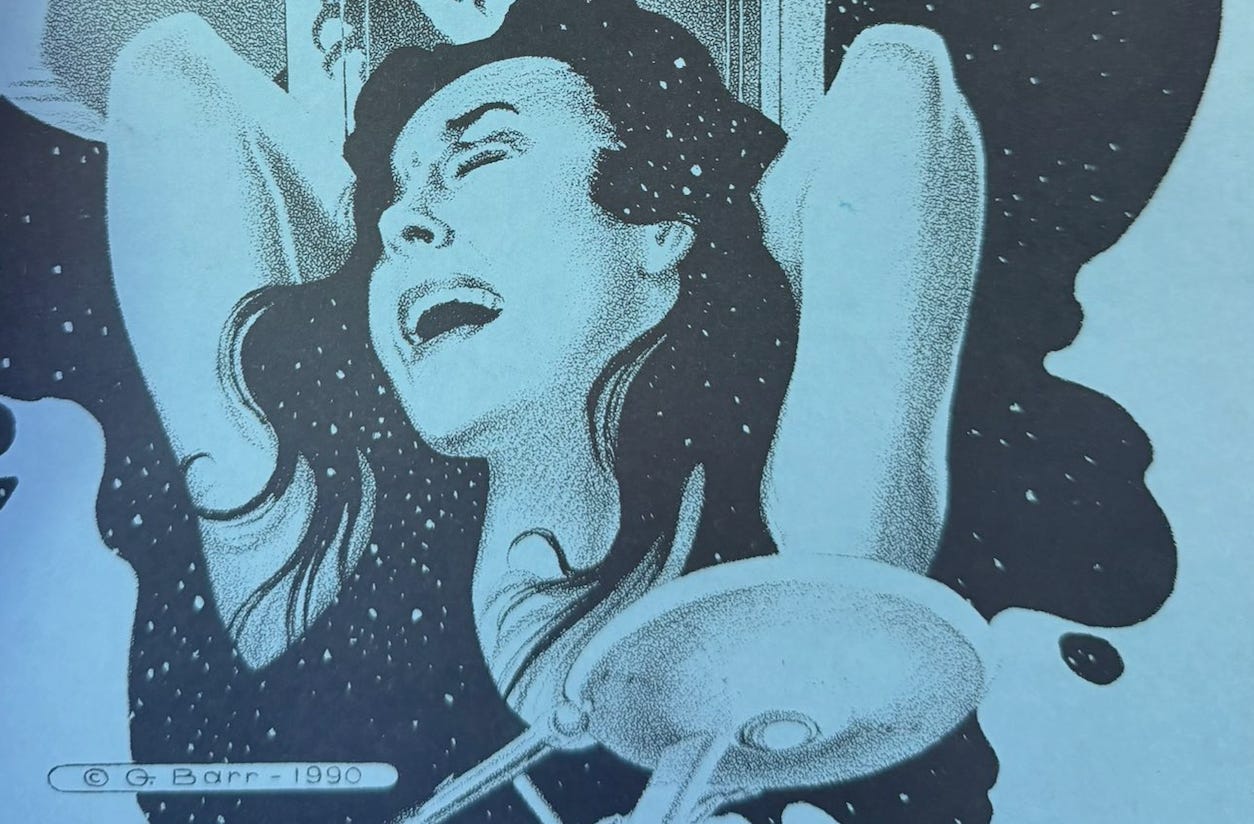
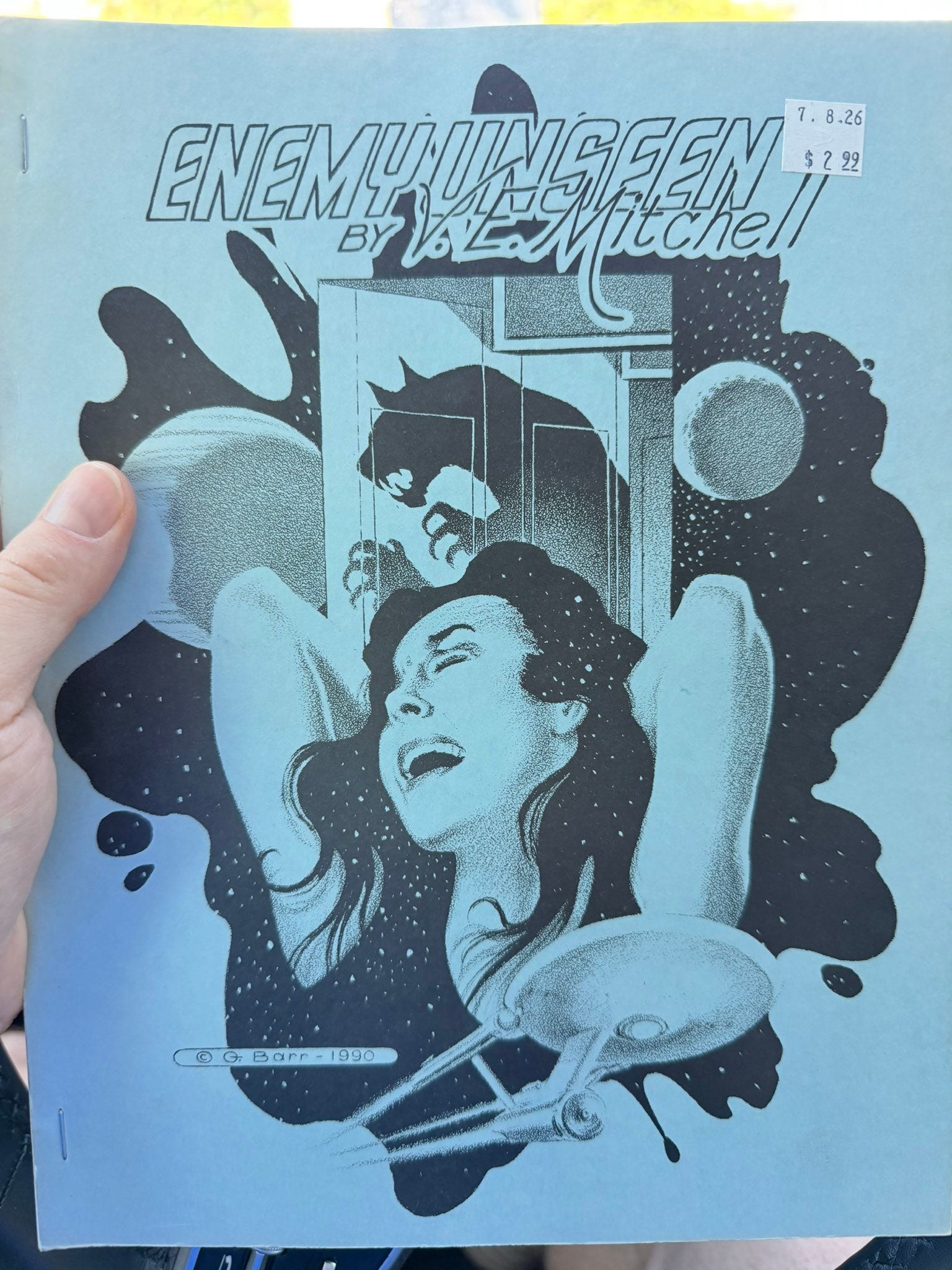
A rare self-published fanzine by Star Trek novelist V.E. Mitchell has surfaced, and it lays out in granular detail how Paramount and Pocket Books reshaped her 1990 TOS novel “Enemy Unseen” before it ever reached a shelf.
Mitchell, born Victoria Estelle Mitchell Gustafson, wrote “Enemy Unseen” as TOS novel #51. She died on April 13, 2017, at age 62, at her home in the Pacific Northwest. Beyond Star Trek, where she also wrote TOS #65 “Windows on a Lost World” and TNG #22 “Imbalance,” Mitchell worked with the Idaho Geological Survey and won convention awards as a costumer.
The origin story alone runs longer than most authors admit to. In early 1983, Mitchell’s husband was helping run a convention department in Moscow, Idaho, and mentioned to Pocket Books editor David Hartwell that his wife thought she could write a better Star Trek novel than the one currently on shelves. Hartwell gave the standard editorial answer: show me. Mitchell wrote the first draft on a borrowed TRS-80 that overheated above 85 degrees, then replaced it that August with an Osborne 1, a purchase she credited to advice from fellow Star Trek author Vonda McIntyre. She taught herself the WordStar word processor from the manual alone.
The manuscript’s path to publication took years and survived a near-death experience along the way. Mitchell submitted it to an editor who left Pocket Books before responding, and the manuscript sat with his successor for close to two years before coming back unread and unbought. The editor who eventually would have decided its fate died without ever answering Mitchell’s letters. It was a chance conversation at MosCon in 1986 with another writer, who passed the manuscript to his own agent, that got it back in front of Pocket Books. That agent read it and called Mitchell within a week to say he could sell it as written.
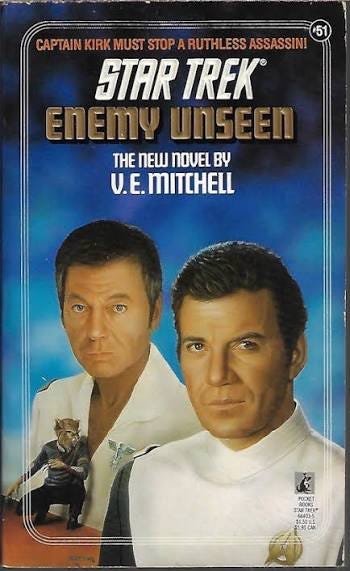
Editor David Stern bought the book, but only after Paramount approved an outline, and that approval process alone took three drafts and eighteen months. Along the way, Mitchell had to make structural concessions tied directly to franchise continuity. Her manuscript had originally used a race of aliens she’d invented to replace the Vulcans, created for a separate 120,000-word novel she didn’t want to give away to Paramount for a one-off sale. She also had to shift the entire story’s timeline earlier, from a “fourth season” setting to the years before Spock combined the science officer and first officer roles, in order to line up with Vonda McIntyre’s established continuity in “Enterprise: The First Voyage” and to accommodate a Gary Mitchell appearance as first officer.
That timeline shift became a bigger problem than Mitchell expected. Paramount had already approved cover art and print proofs when the studio informed her, through her editor, that Gene Roddenberry’s account of series canon held no aliens existed in Starfleet during the period she’d originally chosen. Mitchell’s own reaction to that note survives in the fanzine: “No aliens in Starfleet in the early years?” The correction forced a new cover, new uniforms in the artwork, and a rewrite completed in one month with no extensions and no further changes allowed after submission.
Smaller notes stacked on top of the larger ones. Paramount objected to the word “telepathy” describing a character’s psychic abilities and required alternate phrasing. The studio insisted every uniform and piece of equipment match what appeared on screen exactly. A subplot involving a clone was cut at Paramount’s request over Mitchell’s own objections that the reasoning behind the cut misread her material. Later correspondence with an associate editor even flagged jokes about Kirk that had to stay in, on the reasoning that they helped make Kirk read as more of a hero to an inattentive reader.
Mitchell dedicated the fanzine to a reader named Jon Gustafson, thanked for editorial help on the novel, and to cover artist George Barr. The item now in circulation ties Mitchell’s manuscript account directly to Barr’s cover art and carries her signature.
How many other Star Trek tie-in authors from that era went through changes this extensive, and how many of them ever got the chance to document the process themselves the way Mitchell did?
First contact with the Oridians was supposed to be humanity’s proudest moment. Instead, their chief engineer is dead, their ship is sabotaged, and an ancient alien technology is stealing souls. Book one of the Valiant Frontiers series delivers exploration, mystery, and the kind of crew you’ll want to follow across the galaxy. Read The Soul Catcher on Amazon and start the adventure.