


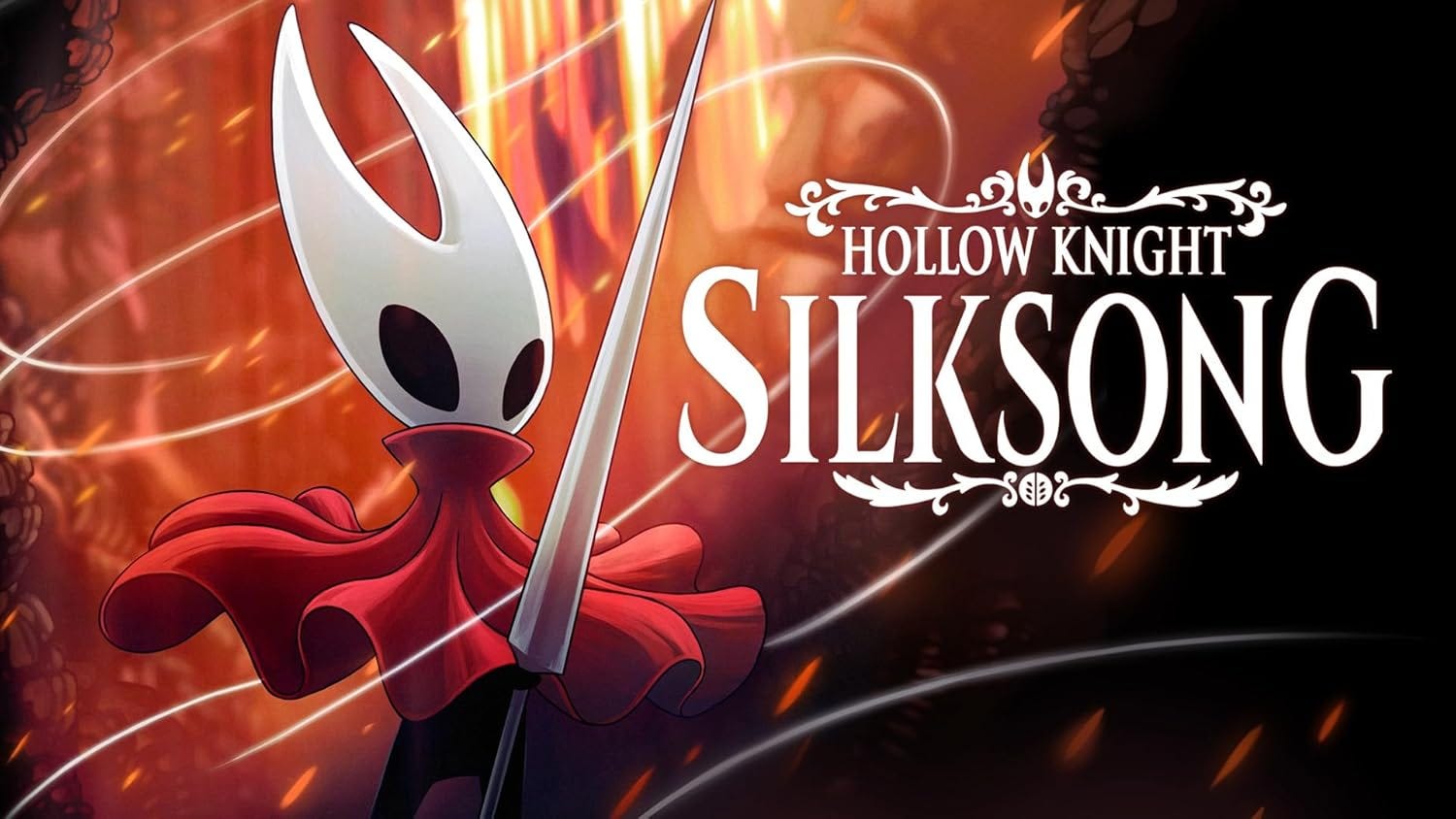
I entered Hollow Knight: Silksong without ever having played the original Hollow Knight. I should grant, I likely would have steered clear given the hype surrounding the first game and a desire not to be associated with the kinds of people who thrive on hype. However, a close circle of gaming compatriots had expressed interest in it and the $20 price tag could not be beat.
I finished my first play through a few days ago, scoring 100% in about 68 hours of playtime.
Gameplay: Platforming and Navigation
When I think of any 2D platformer, my point of comparison begins with Donkey Kong Country 2. Therein, the core mechanic to any 2D platformer is hazard avoidance. Combat might also seem intuitive, but it is always is and ought to be secondary given there will always necessarily be more hazards to avoid than to eliminate. Even if you’re jumping from one ledge onto another, that’s platforming: basic hazard avoidance what you are going to be doing 80% of the game. This is even where “platformer” gets its name from since a fall between any two points you want to cross is the most basic example of a hazard.
So, let’s talk about platforming, starting with a basic premise and moving on from there:
In Donkey Kong Country 2 you are given at least three different methods of platforming, you have jumping, sprint-jumping, and floating (with Dixie Kong). One of the reasons I love talking about DKC2 is that it does everything it does very simply but effectively and its variations are actually level-dependent and not particular to what the game gives the player by default. For instance, if you’re playing one of the beehive levels, there would honey on the wall which gives you the ability to cling to walls.
This is what fundamentally distinguishes a level-by-level game like DKC2 from a metroidvania. In a metroidvania, you would basically find a wall-cling ability as an item and carry that as your solution into the world. Moreover, the mark of a good metroidvania would be in putting the tool into your hands and laying the world out in such a way as to let you figure out how to navigate.
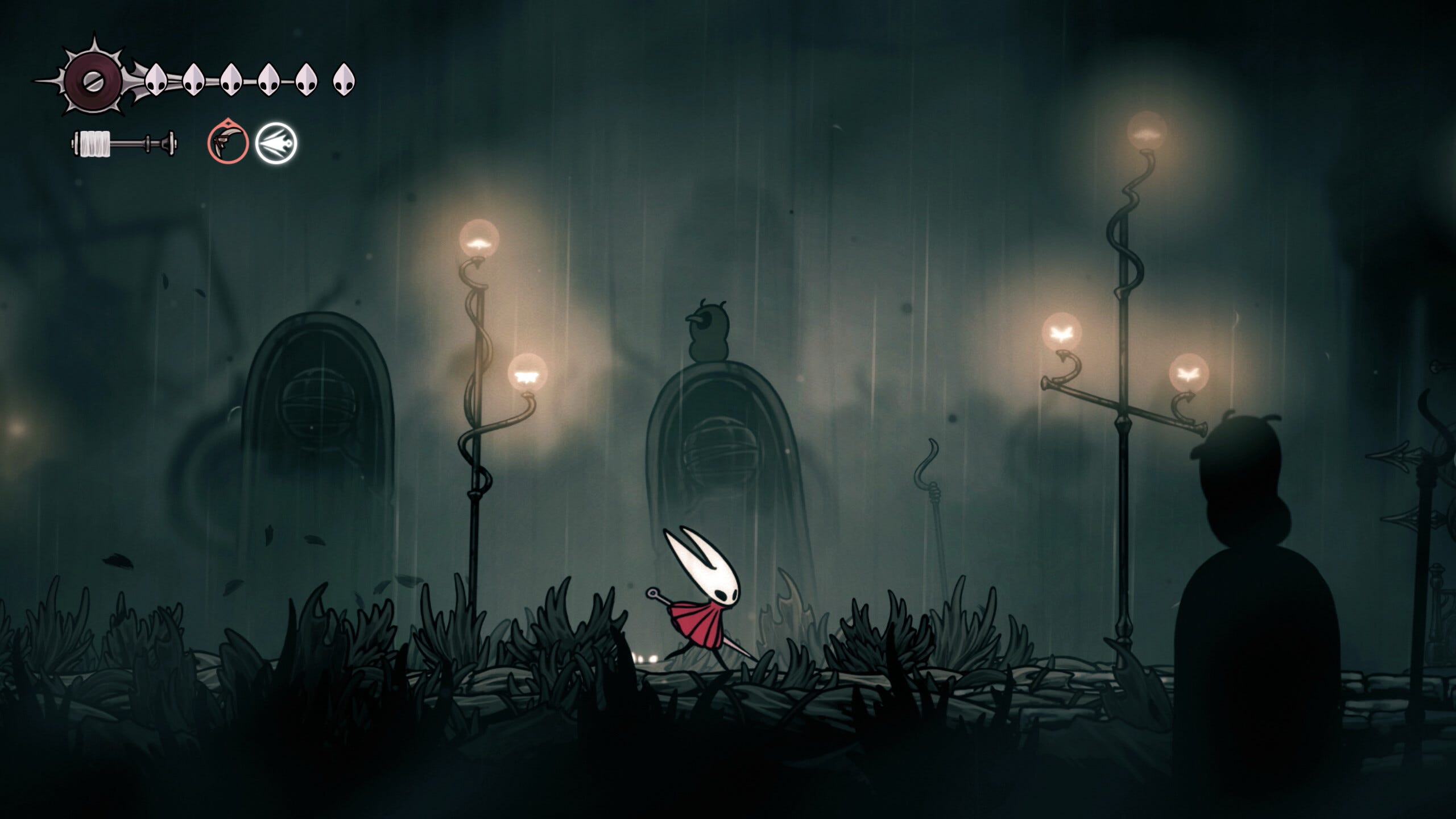
Silksong starts your platforming experience with a standard jump ability. Team Cherry keeps things so gradual, they don’t even give you your sprint ability from the get-go. Eventually your platforming capabilities will evolve into not three, but seven different methods of platforming: regular jumping, sprint-jumping, double-jumping, floating, pogo-jumping, wall-hanging, and wallharpooning. While I wouldn’t say this is necessarily better or worse than your standard platformer, what marks a metroidvania as being in any way worthwhile is all the the planning that goes into it.
In any metroidvania whenever you come to a new area any new area, in the back of your mind you know you will likely revisit that area again with new abilities and access areas you couldn’t before. However, what’s even more important than known you will revisit an area is that the game gives you a good reason to. This is something that Silksong does extremely well as it manages to condense up to 60 hours of gameplay and over 200 enemies into almost 30 distinct locations.
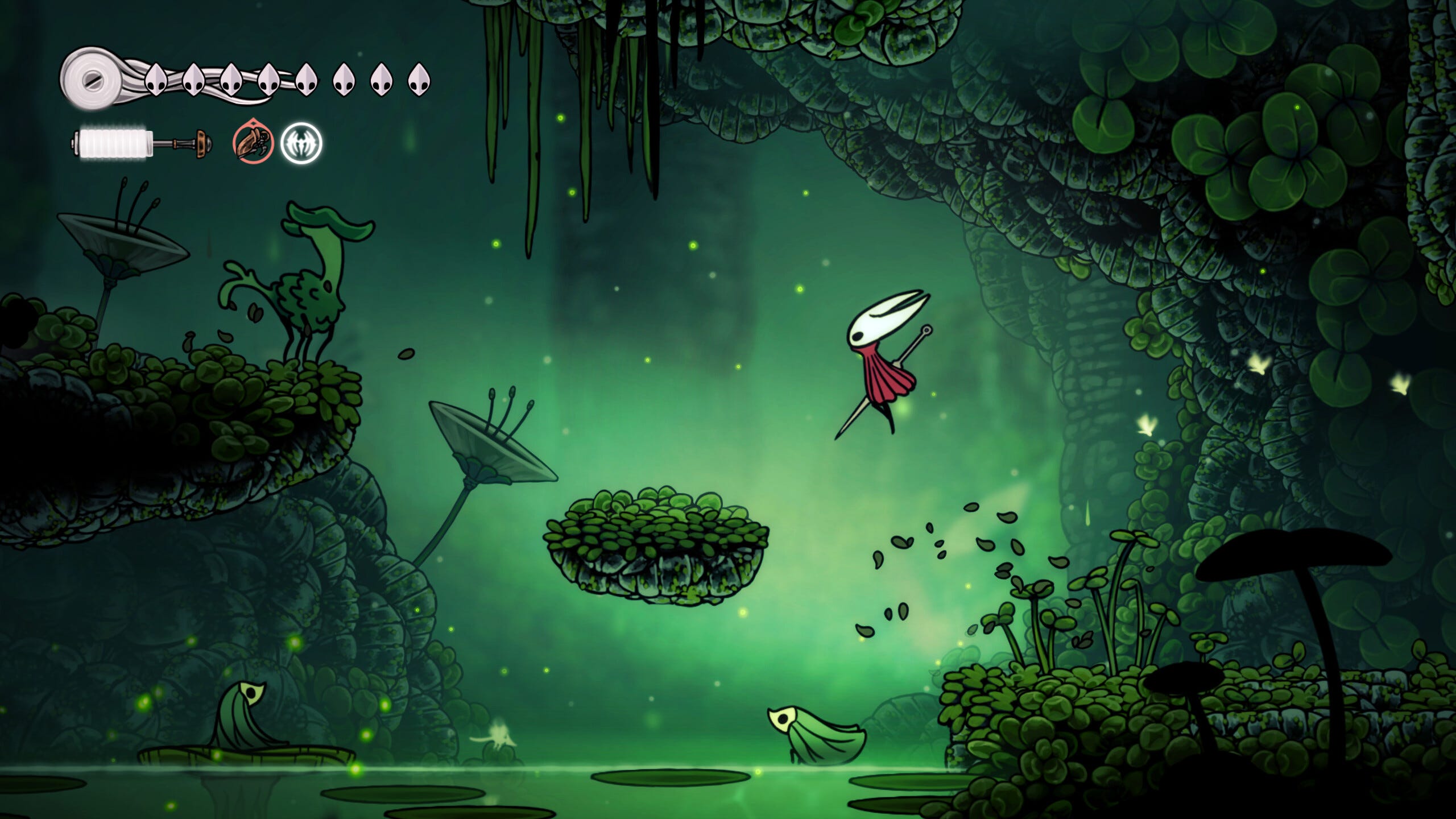
By the beginning of the game, you look at your map and wonder, “I wonder how big this world is.” Then, when you have almost everything filled out, you notice how small and boxed in everything is and wonder, “Wow, how did they fit so much into it?”
That’s how you know it is a metroidvania done well.
Note that even if you’re not a fan of the combat (which I wasn’t) the platforming and subsequent exploration and collect-a-thon was enough to keep me engaged.
Gameplay: Combat
Throughout the game, Hornet is armed with a needle, a collection of tools, and an energy bar called “silk” which can be used to heal or perform special attacks. Silk expenditure is also tied to a few other platforming abilities as well which means, on top of managing several types of jumping mechanics, the game also gives you an entire combat kit to work with, tailoring it as best suits your style.
Combat move-sets are also governed by several distinct stances or “crests” which change the way you thrust. slash, or pogo with your needle. Some Crests also open up entirely new ways of playing the game, such as the Architect Crest which gives you the ability to recharge your tools on the go. I’ve seen some people on YouTube defeat bosses using nothing but booby traps and poisoned throwing knives. One guy even defeated the Act 3 final boss with nothing but the Rosary Cannon.
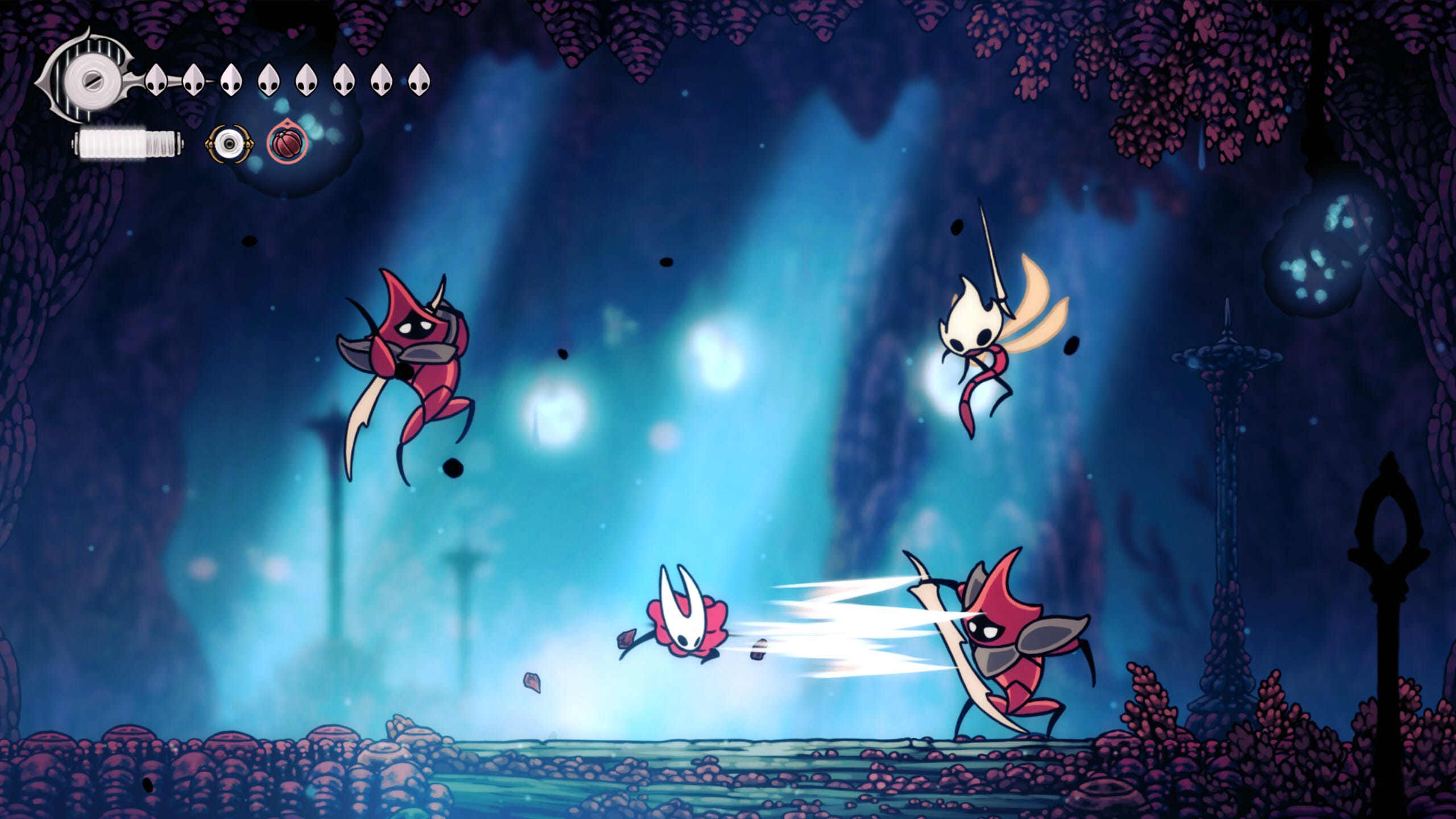
While the variations are welcome, the combat itself is one of the most taxing parts of the entire game. When you’re fighting any enemy, something you’ll have to adapt to is the fact that many of them are almost or completely resistant to being moved by your attacks. This ensures you remain as far outside the enemy hitbox as you can while staying close enough in melee range with your needle strikes. However, this can become even more difficult when you fight enemies who are also wielding pins or other weapons and are trained to keep a healthy distance away from you as they stab you.
What this inevitably trains you to do is maintain as safe distance as you can from every enemy while also trying to get close enough to attack in melee. This becomes quite the chore when fighting many of the flying enemies in the game with erratic movements like the flying Crawbugs in the Greymoor area (the ones that look like crows).
Further frustrating, however, are any moments where your strike hits, but your body was too close and you got hit even though you would naturally think you wouldn’t because your weapon was between you and the enemy. Gradually, I had to learn to adapt to these tactics if only because it is so counterintuitive to how you would expect it to work.
Here’s what I mean: on several occasions, I would use a pogo attack on an enemy and take damage even though my attack connected. This is because the game registered Hornet’s hitbox collided with the enemy’s hitbox. The fact that Hornet’s needle ought to be between her and the enemy implies this shouldn’t be possible, but it can happen and it happened to me a lot.
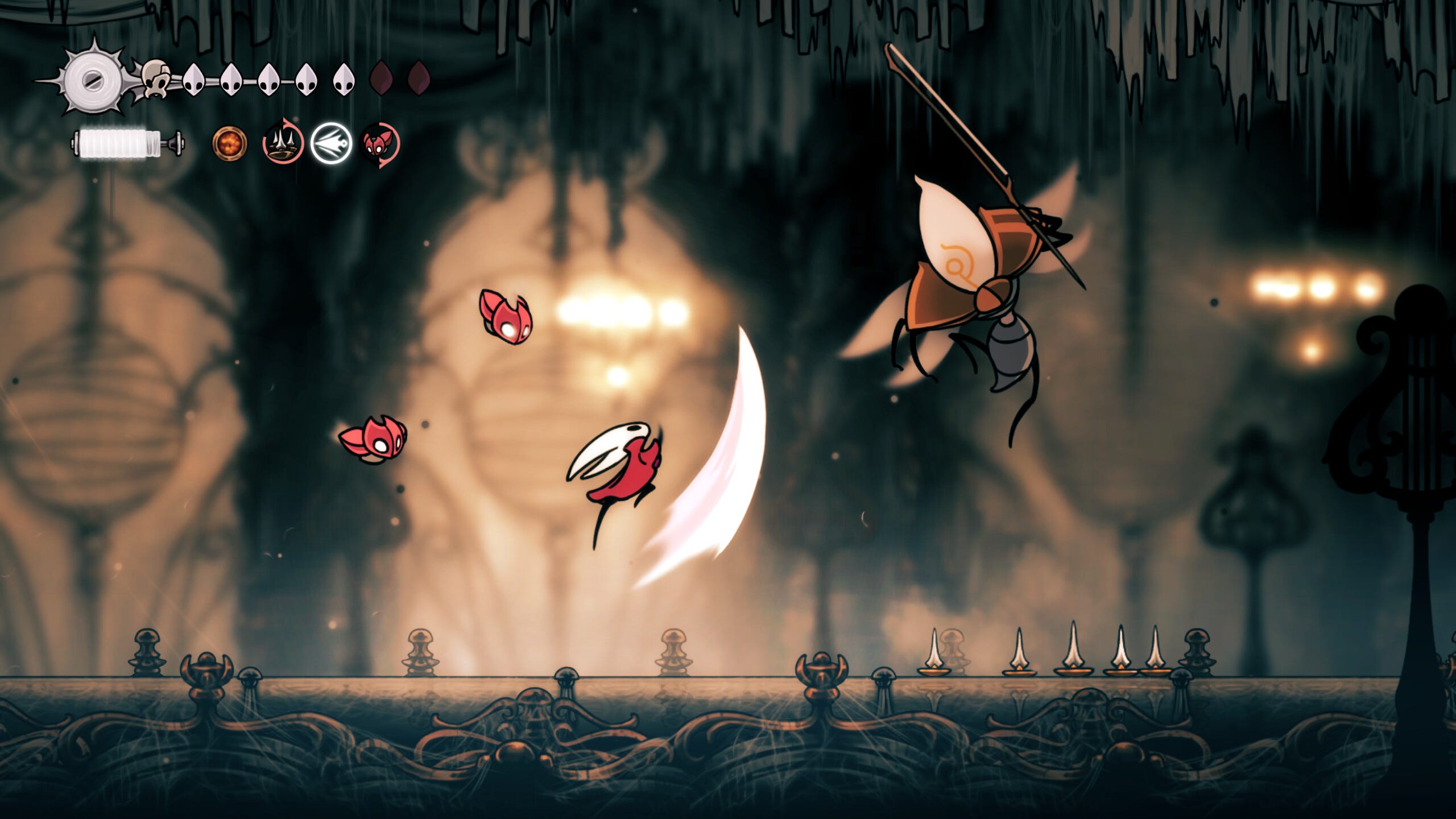
Further frustrating matters are some boss fights where even if you slightly brushing against a boss not counts as the boss hitting you in combat, but also causes you to lose two points of damage. In more generous games, this might be circumvented by having your character simply bounce off, but no. In a fight like the Savage Beastfly, for example, the boss can have his back turned towards you or it could be stunned on the ground and if you so much as barely touch his hitbox, BOOM, you take two hitpoints worth of damage.
Needless to say, while I inevitably got used to this style of combat, I wasn’t a fan of it through and through, especially early on in the game where even the smallest of enemies require multiple hits to kill. The best word to describe the nature of the game’s difficulty: taxing. In the open world, risk and reward often pivot on your ability to be patient and meticulous. However, that all changes during boss fights where survival and victory play solely on quick thinking and split-second decision-making.
Moreover, I hesitate to call most of the early game bosses fair fights if only because, if you have never fought them before, you are expected to adapt to a number of attack patterns you would otherwise be unfamiliar with. What I mean is, it’s good that bosses will make gestures and/or noises proceeding attacks, all of which are intended to have you react and avoid damage. The problem with this design is that, in the early game, you don’t immediately know to associate these gestures and sounds with their related attacks. In much of the early game, I died almost instantly to many bosses simply because my health pool was small and I had no foreknowledge of what fight would look like.
The only other problem with dying to some bosses: the runback. Just like Dark Souls, if you die you are sent all the way back to the last rest point. In Silksong, these rest points are small park benches. There are at least three runback areas in the game that make life excruciatingly painful.
Plot
Silksong sees you taking the role of Hornet, some spider-like creature who had been captured for some reason and was being taken to some far-off land for some reason. Miraculously, her transport cage is destroyed, freeing her as she falls into the depths of Pharloom, a land full of all kinds of insects, spiders, and other crawly creatures. Hornet then decides to find out why she was captured and investigate Pharloom for what secrets the land may hide.
I’ll refrain from spoiling anything for anyone who hasn’t played the game, but know that Silksong graces the player with very short and concise cutscenes. In a world full of mediocre writing and movie-length cutscenes that waste your time, Silksong’s writing is brief and to the point, albeit you are allowed to gratify that lore-hungry part of your autism by reading whatever tablets, slabs, or documents that have been left strewn about the landscape. In my playthrough, I did a bit and discovered that Team Cherry might even have an extended universe knocking around in their noggins.
Art and Themes
Much of the popularity owed to Hollow Knight and Silksong is likely due how similar it is to Tim Burton’s art style which blends Gothic and German expressionist influences with a whimsical, cartoon-like grotesque. Naturally this means all the creatures in Silksong have exaggerated proportions and spindly figures. This is all done to achieve a balance of the macabre and the childlike, creating a darkly playful, surreal aesthetic.
The music (composed again by Christopher Larkin) is also orchestral and melancholic, complimenting the visual aesthetics. You also get flourishes of chamber music such as harps, woodwinds and delicate strings which are woven in with their own dramatic swells or sinister calms.
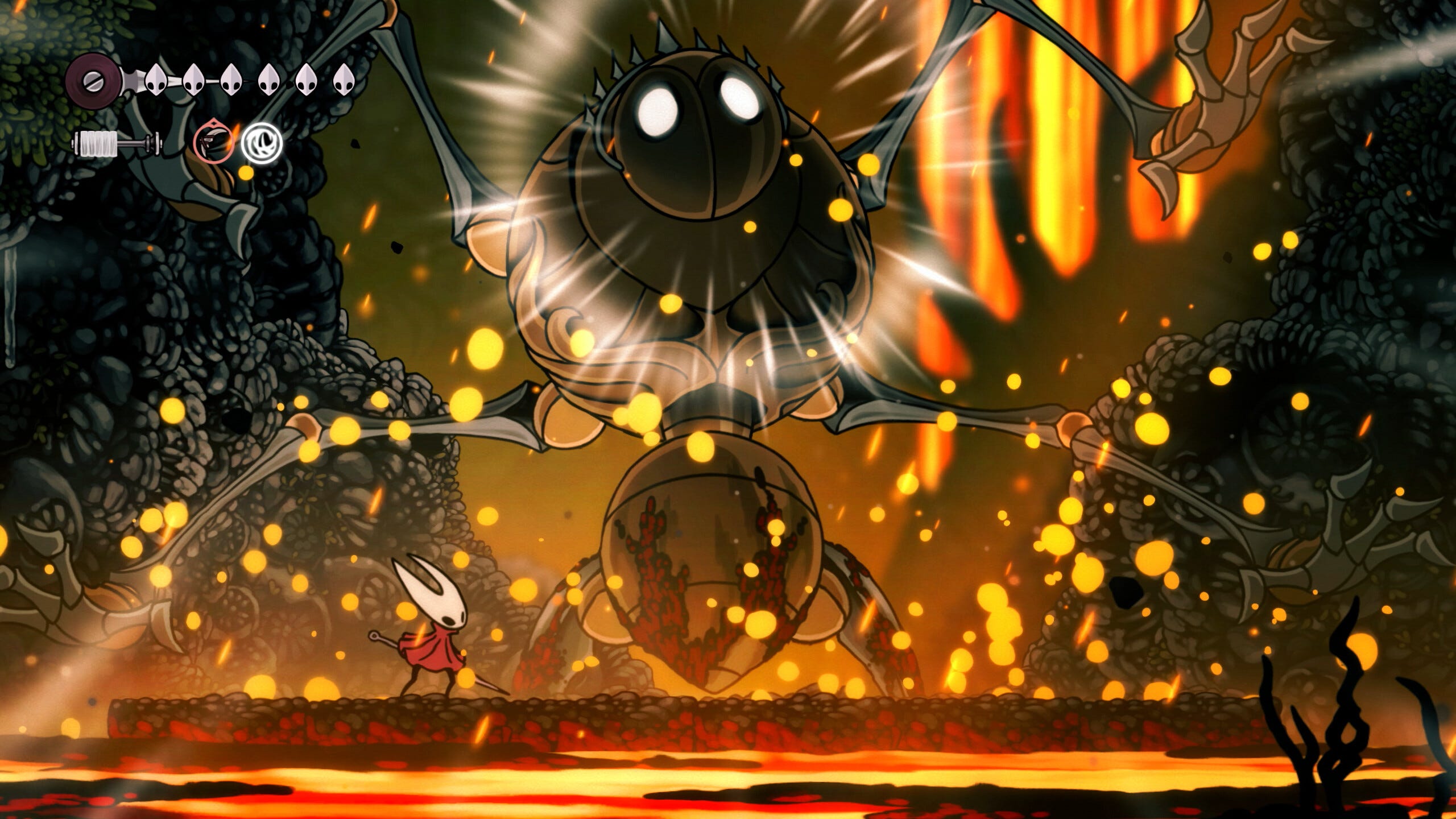
The style thrives on a kind of cultivated pretension by packages childlike imagery inside a Gothic wrapper of sophistication. The appeal lies in the illusion that one is not merely watching or enjoying a cartoon, but partaking in an elevated cartoon: darker, more artsy, and therefore more “adult.” In this way, the style allows audiences to indulge in the comfort of animation and fantasy while flattering themselves that it is something deeper.
I should clarify, that while I might think a lot of this is pretentious, none of this is to say that Silksong is a bad game in any way, shape or form. I enjoyed it and I found the art style quaint. Here, however, I want to offer a coherent explanation as to why many people are seemingly obsessed with its art style and the themes that go along with it. It is an art style compliments a story whose context appears amidst the backdrop of a fallen cities, piles of corpses, gothic arches, and moody chiaroscuro. This all flatters the audience into believing they are experiencing something highbrow.
The comparison to Dark Souls is all but gift-wrapped: an empire-in-ruins motif and a gradual climb toward a tower after ringing a few bells: a visual pilgrimage that is as borrowed as it is recycled
Conclusion
Silksong is well worth picking up, especially for $20. Is it Game of the Year? I don’t know and I don’t care. I enjoyed it and that’s what matters to me and I don’t care what a bunch of suits in an auditorium have to say about it.
While I didn’t enjoy much of the combat for reasons stated, I did enjoy working the kinks out of its complex platforming and pursuing the collect-a-thon parts of it. So, the difficulty curb is present, but I guarantee you’ll come out of it alive if you’re willing to grind at the controller a bit. Ultimately, finishing the game has inspired me to check out Hollow Knight and has left me curious about what other projects Team Cherry has in store.
Although, hopefully we won’t have to wait seven more years for another one.
NEXT: Ubisoft Announces Name For New Subsidiary That Houses Assassin’s Creed, Far Cry, & Rainbow Six

Nice to find another game reviewer on the platform - man the arena with the two fat bell dudes took me so long
Excellent, thorough, and thoughtful review. Thank you for taking the time to write it.