


Horror literature has a unique power to captivate and terrify readers, blending suspense, the supernatural, and the darkest corners of the human psyche into unforgettable tales. Whether you crave haunted houses, monstrous entities, or psychological dread, these 10 books promise stories that will chill, thrill, and linger long after the last page is turned.
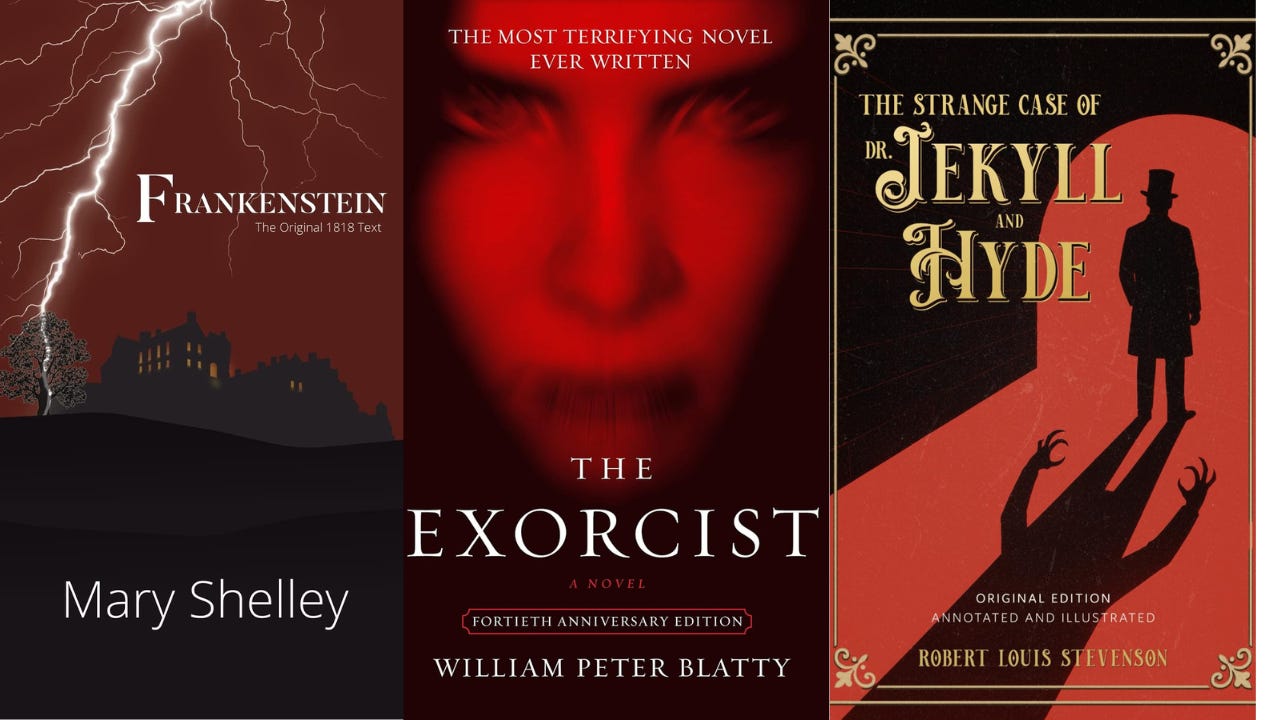
1. The Exorcist

In the affluent suburbs of Georgetown, 12-year-old Regan MacNeil, the daughter of successful actress Chris MacNeil, begins exhibiting bizarre and increasingly violent behavior after playing with a Ouija board. What starts as minor disturbances escalates into full-blown possession: Regan speaks in unnatural voices, displays superhuman strength, vomits projectile bile, and desecrates religious symbols with grotesque profanity.
Desperate and dismissing medical explanations, Chris turns to Father Damien Karras, a Jesuit psychiatrist grappling with his own crisis of faith following his mother’s death. Karras, skeptical at first, teams with the experienced exorcist Father Lankester Merrin, whose archaeological past has entangled him with ancient demonic forces. As the priests confront the entity claiming to be the Devil itself, they wage a harrowing battle of faith, science, and sacrifice in a ritual that tests the limits of human endurance and the power of evil.
William Peter Blatty’s 1971 novel, inspired by a real 1949 case, blends psychological horror with theological depth, exploring themes of doubt, redemption, and the clash between modern rationality and primal supernatural terror.
2. Dracula

In 1897, young solicitor Jonathan Harker travels to the remote Carpathians to finalize a London property deal for the enigmatic Count Dracula. Trapped in the Count’s crumbling castle, Jonathan uncovers his host’s vampiric nature: Dracula drinks blood, casts no reflection, and commands wolves, and the undead. The Count escapes to England in a ship of corpses, unleashing a plague of seduction and death.
In Whitby and London, Dracula preys on Jonathan’s fiancée, Mina Murray, and her friend Lucy Westenra. As Lucy wastes away, drained and transformed into a voluptuous predator, a desperate circle forms: vampire hunter Abraham Van Helsing, Texas adventurer Quacko Morris, aristocrat Arthur Holmwood, and psychiatrist John Seward. Guided by Van Helsing’s lore of garlic, crucifixes, and stakes, they pursue the Count across Europe, racing to destroy his earth-filled coffins before he turns Mina into one of the Un-Dead.
Bram Stoker’s 1897 epistolary masterpiece fuses Gothic dread, Victorian anxieties about sexuality and empire, and a trans-European chase, culminating in a snowy showdown at Castle Dracula where love, science, and superstition collide against immortal evil.
3. Frankenstein

Arctic explorer Robert Walton, in letters to his sister, recounts his encounter with a half-frozen stranger: Victor Frankenstein, a Genevan scientist haunted by ambition. Victor narrates his obsessive quest to conquer death. At the University of Ingolstadt, he assembles a gigantic man from charnel-house parts and animates him with a spark of galvanic life. Horrified by the creature’s grotesque yellow eyes and watery gaze, Victor abandons his creation in terror.
Left nameless and alone, the creature learns language and humanity from exiled books and a hidden vigil over the De Lacey family. Rejected everywhere for his appearance, he confronts Victor on a Mer de Glace glacier, demanding a female companion to end his solitude. Victor begins the task in the Orkneys but destroys the half-formed bride in revulsion, dooming the creature to vengeance.
The monster murders Victor’s brother William, frames the servant Justine, and on Victor’s wedding night strangles his bride Elizabeth. Pursued by guilt and grief, Victor chases his creation across Europe and into the frozen north, where both collapse aboard Walton’s ship. The creature, mourning his maker’s death, vows to burn himself on a funeral pyre, vanishing into the Arctic night.
Mary Shelley’s 1818 masterpiece, framed as nested narratives, probes the perils of unchecked science, the ethics of creation, and the tragedy of a being born innocent yet condemned by its maker’s hubris and society’s cruelty.
4. Strange Case of Dr. Jekyll and Mr. Hyde

In fog-shrouded Victorian London, the respectable lawyer Mr. Utterson grows alarmed by the peculiar will of his old friend Dr. Henry Jekyll, which bequeaths everything to a mysterious, brutish stranger named Edward Hyde. When Hyde tramples a child and later bludgeons the kindly Sir Danvers Carew to death, Utterson confronts Jekyll, who swears he has severed ties with the fiend.
Yet Hyde’s crimes multiply, and Jekyll withdraws into seclusion. Breaking into Jekyll’s locked laboratory, Utterson and a servant discover Hyde’s corpse in Jekyll’s clothes, a suicide by poison. A final letter from the doctor reveals the horrifying truth: Jekyll, driven by a desire to separate his noble and base impulses, concocted a potion that transformed him into Hyde—smaller, younger, and purely evil. At first able to switch forms at will, Jekyll gradually lost control as Hyde grew stronger, committing atrocities the doctor could no longer restrain.
Robert Louis Stevenson’s 1886 novella, told through Utterson’s restrained investigation, exposes the duality lurking within every soul, the thin veneer of civilization, and the catastrophic cost of tampering with human nature.
5. The Terror

In the unforgiving Arctic winter of 1847, the crews of HMS Erebus and HMS Terror, vessels of Sir John Franklin’s ill-fated 1845 expedition to chart the Northwest Passage, languish in the crushing grip of pack ice, 28 miles north-northwest of King William Island. What began as a triumphant quest for glory and imperial expansion has devolved into a nightmare of isolation: provisions of tinned meat and soup, tainted with lead solder, poison the men with madness and decay; scurvy gnaws at their flesh; coal dwindles, leaving ships to freeze in the endless night; and the barren ice yields no game for the starving hunters.
Commanded by the optimistic but outmatched Franklin on Erebus and the battle-hardened Irishman Captain Francis Crozier on Terror, the 129 souls fracture under mutiny, desperation, and cannibalism. Yet the natural horrors pale against a supernatural scourge: a colossal, spectral beast, the Tuunbaq, a guardian spirit from Inuit lore, manifesting as an immense polar bear with unnatural cunning, stalks the floes, disemboweling sailors with ritualistic precision, drawn perhaps by the desecration of sacred lands or the hubris of invasion.
As Franklin succumbs to the ice’s embrace, Crozier assumes command, leading a ragged overland march southward. Accompanied by Lady Silence, a mute Inuit woman whose shamanic visions and scars hint at deeper mysteries, the survivors confront not only the Tuunbaq’s vengeful fury but the unraveling of their Victorian certainties—science yielding to myth, civilization to savagery. In this frozen charnel house, where auroras mock their plight and the dead rise to accuse the living, escape becomes a myth deadlier than the monster itself.
Dan Simmons’s 2007 epic, a 784-page tour de force of historical immersion and cosmic horror, resurrects the real Franklin Expedition’s enigma through meticulous journals, shifting perspectives, and a mythic predator, probing the thin line between man and beast, empire and extinction.
6. Something Wicked This Way Comes

In the drowsy October of a small Illinois town, two thirteen-year-old best friends, cautious Will Halloway and reckless Jim Nightshade, born minutes apart on Halloween, detect a carnival’s sulfurous whistle at 3 a.m. Cooger & Dark’s Pandemonium Shadow Show rolls in on a black freight train, pitching its tents like a midnight fungus.
The carnival is no ordinary midway. Its carousel spins backward to shave years off riders or forward to pile them on; its Dust Witch floats in a balloon, sniffing for souls; its Illustrated Man, Mr. Dark, wears living tattoos of every victim. The attractions feed on fear and desire: a mirror maze that drowns the vain in infinite reflections, a freak show of lost souls, a calliope piping the funeral march of childhood.
Will’s father, Charles Halloway, a fifty-four-year-old janitor haunted by the years he let slip away, recognizes the carnival’s master as the embodiment of autumn’s cruel bargain: trade your future for a stolen past. When Jim succumbs to the carousel’s lure and Mr. Dark marks Will’s hand with a crescent scar, the boys and the old man must weaponize laughter, the one force evil cannot counterfeit, to shatter the carnival’s spell before the final procession claims every regretful heart in Green Town.
Ray Bradbury’s 1962 dark fantasy, lyrical as a hymn and sharp as a scythe, pits the electric innocence of boyhood against the seductive rot of unfulfilled longing, proving that joy can outrun even the fastest shadow.
7. At the Mountains of Madness

Geologist William Dyer of Miskatonic University narrates a doomed 1930 Antarctic expedition, hoping to deter future explorers. Advanced boring equipment unearths bizarre, barrel-shaped fossils unlike any known life. A forward team led by biologist Lake discovers a cyclopean mountain range taller than the Himalayas and a ruined city of impossible age, its non-Euclidean architecture defying human geometry. Dissected specimens reveal the city’s builders: the Old Ones, star-headed beings who drifted to Earth eons before, seeding life itself while warring with spawn of Cthulhu and other cosmic horrors.
Dyer and graduate student Danforth fly over the range to investigate. Inside the labyrinthine ruins, murals chronicle the Old Ones’ rise, fall, and creation of the shoggoths, amorphous, fifteen-foot protoplasmic slaves that eventually rebelled. Fresh slime trails and decapitated colleagues prove the shoggoths still lurk. Fleeing deeper, the pair glimpse a yet greater abyss and a shape that shatters sanity. Danforth’s final, backward glance reveals a truth too terrible to voice, leaving Dyer to warn that some doors, once opened, can never be closed.
H.P. Lovecraft’s 1936 novella, framed as a cautionary scientific report, dismantles anthropocentric certainty with cosmic timescales and indifferent alien gods. Beneath the ice lies not just a lost civilization but proof that humanity is a fleeting accident, its science a child’s toy against the vast, piping madness of entities that regard us as less than insects.
8. Interview with the Vampire

A nameless San Francisco journalist, armed with a reel-to-reel recorder, interviews Louis de Pointe du Lac, a 200-year-old vampire who insists on narrating his cursed existence before sunrise erases the evidence. In 1791, on a failing Louisiana indigo plantation, the suicidal Louis is transformed by the flamboyant Lestat de Lioncourt, who schools him in the vampiric arts: drinking warm human blood, shunning sunlight, and casting no reflection. Yet Louis, shackled by Catholic guilt and a human soul that refuses to die, subsists on rats and dogs, rejecting Lestat’s gleeful savagery.
Fleeing Lestat’s taunts, Louis prowls plague-ridden New Orleans until he feeds on Claudia, a five-year-old orphan cradled beside her mother’s corpse. Lestat completes the dark transformation, trapping Claudia’s maturing mind in a child’s porcelain body. For sixty-five years the trio masquerade as a Creole family amid silk and candlelight, but Claudia’s fury at her eternal infancy erupts: she slashes Lestat’s throat and sinks him in the swamp. The pair sail to Europe seeking kin, only to discover Paris’s Théâtre des Vampires—a coven of powdered predators ruled by the ancient Armand, who desires Louis’s anguish while branding Claudia a crime against nature.
Burned alive by the coven in a sun-drenched well for Lestat’s supposed murder (though he clawed back from the mire, charred and feral), Claudia crumbles to ash; Louis, spared by Armand’s obsession, rejects Old World nihilism and drifts through centuries to modern America. In the hotel room, the tape ends; the reporter begs for immortality. Louis laughs. The gift is endless night.
Anne Rice’s 1976 novel, framed as a confessional transcript, dismantles the vampire myth, replacing gothic horror with baroque melancholy and the unbearable weight of a conscience that outlives the heart.
9. Lot No. 249

n the hallowed halls of Oxford University, Abercrombie Smith, a strapping athlete and medical student of unyielding rationality, shares a lodging house with the reclusive Edward Bellingham, a pale Egyptologist whose chambers overflow with arcane relics. Bellingham, a misfit scholar mocked by peers for his indolence and occult obsessions, has acquired a desiccated mummy from an auction—Lot No. 249—a shriveled, bitumen-smeared horror from the Third Dynasty, accompanied by a crumbling papyrus inscribed with spells of resurrection. As Bellingham pores over forbidden texts by lamplight, his friend William Monkhouse Lee confides in Smith: the mummy seems to stir under its own power, and Bellingham’s experiments hint at a profane mastery over the dead.
Smith dismisses the tales as hysteria until violence erupts. Bellingham, spurned in love by Lee’s sister and ridiculed by a rival scholar named Prescott, unleashes the mummy as his vengeful slave. The bandaged abomination, reanimated by incantations and chemical elixirs, prowls the fog-shrouded quads: it strangles Prescott in his bed, leaving linen-wrapped fingerprints on his throat, and later assaults Lee with superhuman strength, hurling him across the room like a rag doll. Bellingham, eyes gleaming with manic triumph, confesses his dark bargain—the mummy, bound to his will, executes his hatreds while he slumbers. Smith, armed with a scalpel’s edge and a cricket bat’s heft, barricades himself against the inexorable footfalls echoing down the corridor.
In a climax of gaslit frenzy, Smith confronts Bellingham amid the fetid clutter of artifacts, forcing a ritual reversal: the papyrus burned, the mummy doused in corrosive acids until it writhes and blackens into inert dust. Bellingham, broken and raving, is carted away to an asylum, his genius eclipsed by madness.
Arthur Conan Doyle’s 1892 short story, a cornerstone of the mummy horror subgenre, marries Sherlockian deduction with Victorian Egyptomania, unearthing the perils of imperial plunder and the hubris that awakens ancient curses beneath the Union Jack.
10. Descent into Hell

In the quiet suburb of Battle Hill, a residential enclave perched above London, a summer amateur theatrical troupe rehearses a verse play about the martyrdom of St. Anne. Among the cast and crew, the boundaries between flesh, spirit, and damnation dissolve. Pauline Anstruther, a timid young woman, is haunted by a doppelgänger—a spectral double that stalks her nightly walks along the hill’s shadowed lanes. Her terror is witnessed by the elderly historian Lawrence Wentworth, whose unrequited lust for the actress Stanhope ignites a slow, inward spiral into solipsistic hell, where he conjures a succubus from his own desire and begins to edit reality to suit his fantasies.
Peter Stanhope, the playwright and local luminary, teaches Pauline the doctrine of substitution: to bear another’s fear is to lighten the world’s burden. When Pauline offers to carry the terror of a long-dead suicide who hanged himself on the hill, her doppelgänger transforms from menace to messenger, guiding her toward communion with the unseen City. Meanwhile, a workman named Hugh falls from scaffolding and dies; his soul, refusing purgation, drifts as a gray shade, craving the prayers he once scorned. Wentworth, rejecting all appeals to love or truth, descends willingly into a private abyss where time collapses and his succubus devours the last fragments of his identity.
Charles Williams’s 1937 novel, framed as a metaphysical thriller, interweaves Anglican theology, Dantean cosmology, and the occult geometry of the Coelum Philosophorum. In Battle Hill’s ordinary streets, every choice—substitution or selfishness, intercession or isolation—determines whether one ascends with the Company of Heaven or sinks into the self-forged pit where even God’s mercy cannot follow without consent.
That's Quincey Morris. Not Quacko. A good list though! THE EXORCIST was the scariest, followed by DRACULA. I would have replaced INTERVIEW WITH THE VAMPIRE with SALEM'S LOT.